

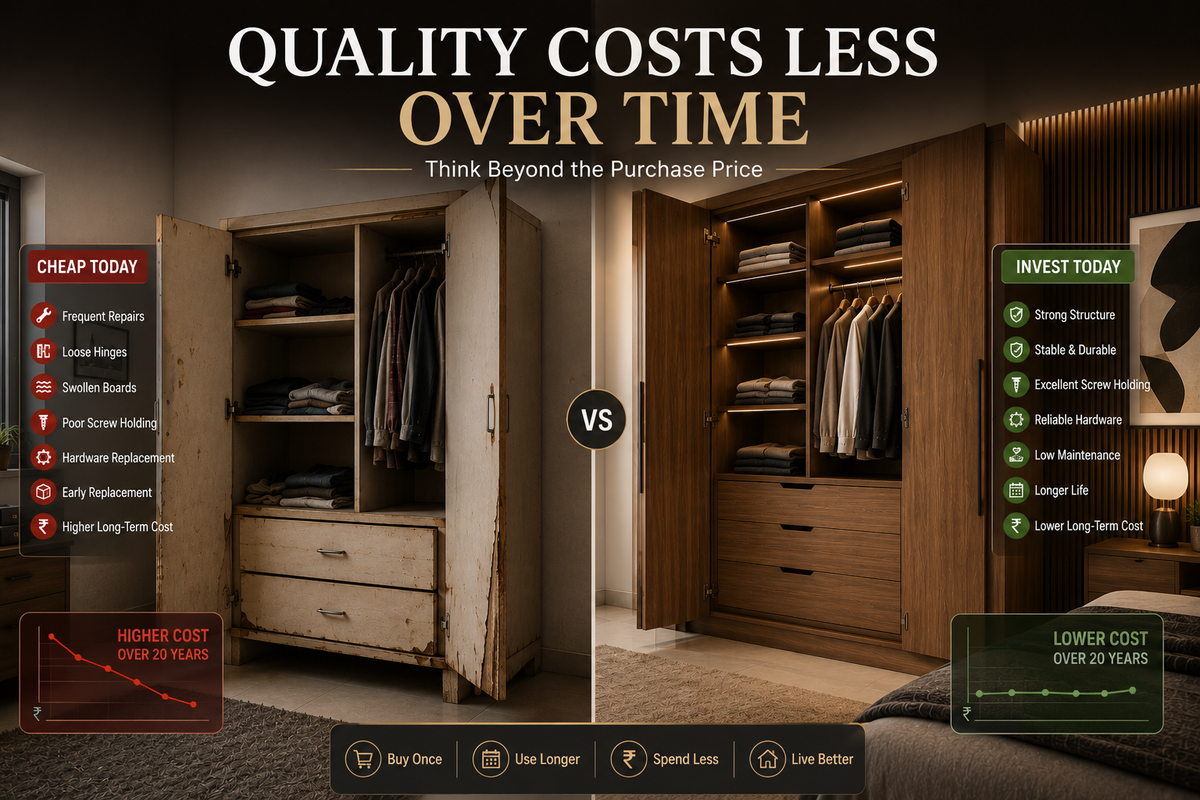
Calculating Furniture Lifecycle Cost: Why Quality Materials Save Money Over Time
When planning home interiors, one number tends to dominate the conversation:
“How much will it cost?”
A modular kitchen costing ₹2 lakh may appear more attractive than one costing ₹3 lakh. A ₹70,000 wardrobe seems like a better deal than a ₹1 lakh alternative.
But the initial quotation doesn't tell you the true cost of furniture.
What happens if the cheaper kitchen needs major repairs after six years? What if wardrobe hinges repeatedly loosen? What if shelves begin sagging? What if water damage forces you to replace the cabinet below your kitchen sink?
To understand whether furniture is genuinely economical, you need to consider its lifecycle cost.
Lifecycle costing shifts the question from
“How much does this furniture cost today?”
to:
“How much will this furniture cost me over 10, 20, or 30 years?”
For homeowners, architects, interior designers, and commercial projects, this can completely change how material choices are evaluated.
What Is Furniture Lifecycle Cost?
Furniture lifecycle cost is the total cost of owning furniture throughout its useful life.
It can include:
- Initial material cost
- Manufacturing and installation
- Maintenance
- Repairs
- Hardware replacement
- Refurbishment
- Replacement
- Removal and disposal
Looking at all these costs gives you a much clearer picture of value than comparing purchase prices alone.
The Simple Furniture Lifecycle Cost Formula
For most homeowners, you don't need a complicated financial model.
A simple formula works well:
Lifecycle Cost = Initial Cost + Maintenance + Repairs + Refurbishment + Replacement Costs
You can then calculate:
Annual Furniture Cost = Total Lifecycle Cost ÷ Years of Useful Life
This makes comparing different furniture options much easier.
Example: Budget vs. Premium Wardrobe
Imagine you're choosing between two wardrobes.
Option A – Budget Wardrobe
Initial cost: ₹70,000
Expected useful life: 8 years
Option B – Premium Wardrobe
Initial cost: ₹100,000
Expected useful life: 20 years
At first glance, Option A saves ₹30,000.
But let's look further.
| Cost Over 20 Years | Budget Wardrobe | Premium Wardrobe |
|---|---|---|
| Initial Cost | ₹70,000 | ₹100,000 |
| Repairs | ₹15,000 | ₹7,000 |
| Hardware/Refurbishment | ₹15,000 | ₹10,000 |
| Replacement | ₹80,000 | ₹0 |
| Illustrative Total | ₹180,000 | ₹117,000 |
In this hypothetical example, the premium wardrobe costs ₹30,000 more initially, yet potentially saves around ₹63,000 over 20 years.
These figures are illustrative; actual lifespan and maintenance depend on materials, design, workmanship, environment, and usage.
The important point is simple:
Purchase price and ownership cost are not the same thing.
Calculate Cost Per Year
Another useful method is calculating the annualized purchase cost.
Suppose:
Furniture A: ₹70,000 lasting 8 years
₹70,000 ÷ 8 = ₹8,750 per year
Furniture B: ₹100,000 lasting 20 years
₹100,000 ÷ 20 = ₹5,000 per year
Despite costing more initially, Furniture B delivers a lower purchase cost per year under these assumptions.
This is why durability can be financially valuable.
Why Plywood Quality Affects Lifecycle Cost
For modular furniture, plywood is often one of the most important structural materials.
You may not see it once laminates or veneers are applied, but it influences how the furniture performs throughout its life.
Quality plywood can contribute to:
- Structural stability
- Better screw holding
- Improved load-bearing performance
- Moisture resistance appropriate to the grade
- Dimensional stability
- Reliable hardware fixing
- Longer furniture life
These characteristics can reduce the likelihood of premature repairs and replacement.
1. Screw Holding and Maintenance Cost
Think about a wardrobe door.
It may be opened thousands of times during its lifetime.
Each movement transfers force through the hinge screws into the plywood.
If the underlying board doesn't hold screws well, problems can develop:
- Hinges loosen
- Doors become misaligned
- Screw holes enlarge
- Hardware requires refitting
- Shutters may eventually need repair
Strong core construction and good screw-holding performance can help reduce these issues.
2. Shelf Sagging and Structural Repairs
Wardrobe shelves, kitchen cabinets, bookshelves, and office storage may remain under continuous load.
Sagging depends on several factors:
Plywood quality + thickness + shelf span + load + support design
Using inadequate material or an unsuitable thickness can eventually require:
- Additional supports
- Shelf replacement
- Cabinet modification
- Complete furniture repair
Designing correctly from the beginning is usually more economical than repairing structural problems later.
3. Moisture Damage Can Be Expensive
Moisture is particularly important in kitchens, bathrooms, and utility spaces.
Imagine saving money by using a material designed for dry interiors beneath the kitchen sink.
A plumbing leak occurs.
The cabinet absorbs moisture, swells, and eventually requires reconstruction.
The original saving can quickly disappear.
For moisture-prone applications, selecting suitable BWP plywood can help improve long-term performance when combined with proper edge protection, plumbing, and installation.
For dry furniture such as bedroom wardrobes and TV units, appropriate MR plywood may be sufficient.
Lifecycle value therefore comes from using the right grade in the right place, not necessarily the most expensive grade everywhere.
4. Hardware Is Part of Lifecycle Cost
Furniture isn't just plywood.
Hinges, drawer channels, handles, sliding mechanisms, and other hardware also influence long-term cost.
Premium plywood combined with poor hardware can still create maintenance problems.
Consider the complete system:
Plywood + Hardware + Design + Installation + Maintenance
All five contribute to furniture lifespan.
5. Installation Quality Matters
Even excellent plywood can perform poorly if the furniture isn't properly constructed.
Problems may arise from:
- Incorrect screw placement
- Poor joinery
- Insufficient shelf support
- Inadequate edge protection
- Improper hardware installation
- Poor alignment
- Incorrect material thickness
Professional fabrication and installation are therefore essential to maximizing the value of premium materials.
Lifecycle Cost of a Modular Kitchen
A modular kitchen is a particularly good example because it experiences:
- Daily use
- Water
- Steam
- Heat
- Heavy storage
- Repeated drawer movement
- Plumbing connections
Suppose one kitchen costs ₹3 lakh and another costs ₹4 lakh.
The cheaper option isn't automatically better value.
Ask:
- What plywood is being used?
- What grade?
- What hardware?
- What countertop?
- How are the edges protected?
- What is being used beneath the sink?
- What warranty is provided?
- What is the expected service life?
A ₹1 lakh saving today becomes irrelevant if major portions of the kitchen need replacement much earlier.
Material Selection by Application
A smart lifecycle-cost strategy allocates materials according to risk.
| Application | Practical Material Strategy |
|---|---|
| Modular Kitchen | Quality BWP plywood |
| Under-Sink Cabinet | BWP + careful edge protection |
| Utility Cabinets | BWP where moisture is expected |
| Bathroom Vanity | Moisture-appropriate material/BWP |
| Bedroom Wardrobe | Quality MR or BWP |
| TV Unit | MR for normal dry interiors |
| Study Table | Quality MR |
| Heavy Bookshelves | Appropriate plywood thickness + support |
| Commercial Furniture | Specification based on usage and load |
This prevents both underspecification and unnecessary overspecification.
A 20-Year View Changes the Buying Decision
Imagine furnishing an entire home.
Your interiors cost ₹10 lakh.
You reduce the material specification and save ₹1 lakh.
That's a 10% initial saving.
But if major furniture requires repairs or replacement significantly earlier, the eventual cost could exceed the original saving.
Now imagine spending slightly more on appropriate structural materials, quality hardware, and installation—and extending the useful life of your interiors.
The financial difference becomes much more meaningful when viewed over decades.
Don't Forget the Cost of Inconvenience
Not every lifecycle cost appears on an invoice.
Imagine dismantling a modular kitchen after your family has moved into the home.
Furniture repair can involve:
- Dust
- Noise
- Carpenter visits
- Moving belongings
- Kitchen downtime
- Repainting
- Electrical work
- Plumbing work
- Disposal of old materials
This disruption has a real value even if it is difficult to calculate precisely.
Long-lasting interiors reduce the frequency of these disruptions.
Lifecycle Cost and Sustainability
Durability also has an environmental dimension.
If furniture needs frequent replacement, every replacement may require:
- More timber and raw materials
- Manufacturing energy
- Packaging
- Transportation
- Installation
- Disposal of old furniture
Extending furniture life can reduce the frequency of this cycle.
That's why one of the simplest sustainability principles is
Build it well. Use it longer. Replace it less often.
Questions to Ask Before Comparing Furniture Quotations
Don't compare two interior quotations only by looking at the final amount.
Ask both vendors:
- Which plywood brand and grade are you using?
- What thickness is being specified?
- What is being used in kitchens and moisture-prone areas?
- Which hardware is included?
- How are plywood edges protected?
- What warranty is provided?
- What maintenance should I expect?
- What is the realistic expected furniture lifespan?
Only after answering these questions are two quotations truly comparable.
A Simple Furniture Lifecycle Calculator
Before making your decision, write down:
Initial Furniture Cost: ₹________
Expected Repairs: ₹________
Expected Maintenance: ₹________
Hardware Replacement: ₹________
Expected Replacement Cost: ₹________
Total Lifecycle Cost
₹________
Then divide by:
Expected Useful Life: ______ years
Estimated Cost Per Year
₹________ per year
Do this for each option.
You may be surprised which quotation actually offers better value.
Conclusion
The cheapest furniture isn't always the most economical furniture.
A smarter buying decision considers how long the furniture will last, how much maintenance it will require, and whether major components will need replacement.
For modular furniture, material quality plays an important role in that calculation.
Choosing appropriate plywood, correct thickness, dependable hardware, and professional installation may increase initial cost, but it can also improve long-term performance and reduce avoidable repair and replacement expenses.
So the next time you're comparing furniture quotations, don't ask only:
“How much does it cost?”
Ask:
“How much will it cost me over the next 20 years?”
That's the number that matters.
Why Choose Plyneer?
At Plyneer Industries Pvt. Ltd., we believe plywood should be evaluated not only by its price per sheet but also by the value it helps deliver throughout the life of the furniture.
From moisture-appropriate plywood for modular kitchens to quality plywood for wardrobes, TV units, office furniture, and commercial interiors, Plyneer helps homeowners, architects, interior designers, carpenters, and furniture manufacturers select materials according to application.
With solutions across plywood, laminates, veneers, MDF, HDHMR, blockboards, and other interior materials, Plyneer helps create interiors designed for long-term performance.
Don't buy only for today. Build for the decades ahead. Choose Plyneer.
🌐 www.plyneer.com
📞 +91 8861717273


