

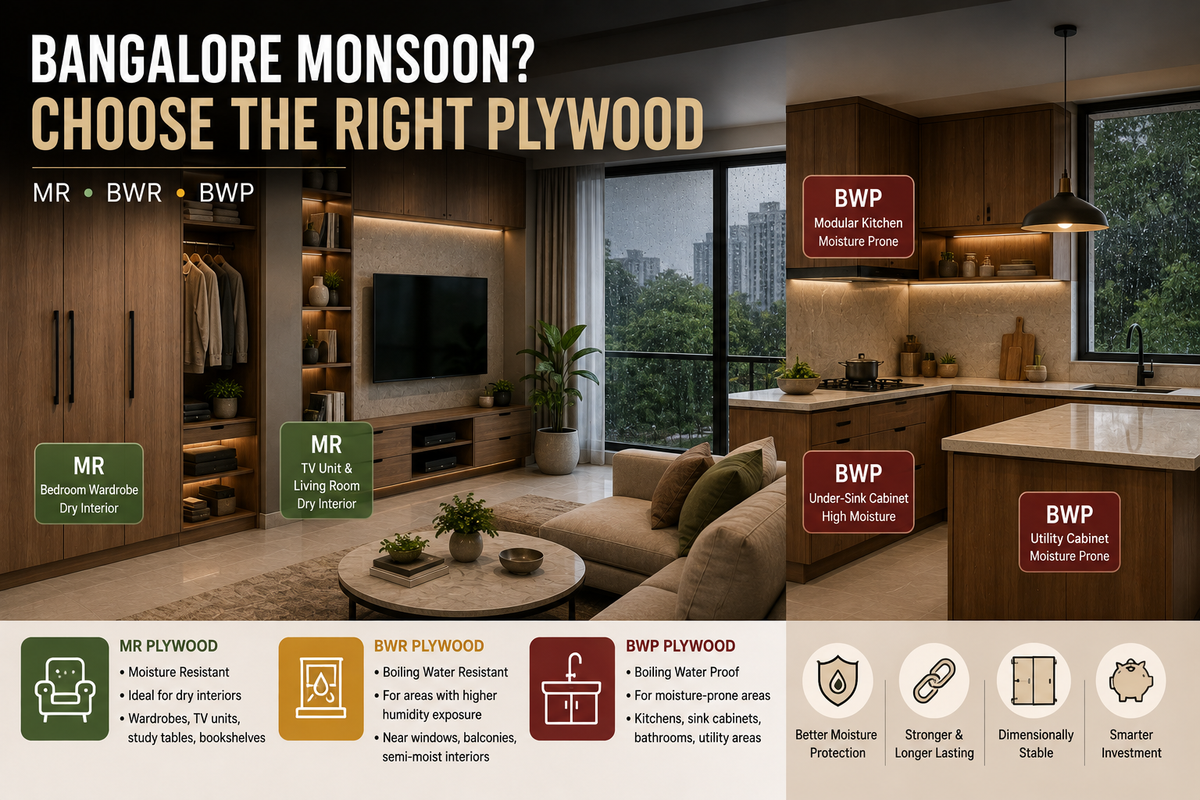
Bangalore’s monsoons bring cooler weather, greener surroundings and much-needed rain. But for homeowners, architects, interior designers and furniture manufacturers, the rainy season also highlights an important issue: moisture management inside the home.
A small plumbing leak, damp external wall, poorly ventilated kitchen or persistent humidity can gradually affect furniture and other wood-based materials.
This is why choosing plywood shouldn't be based only on price, thickness or appearance. You also need to consider where the plywood will be used and how much moisture it is likely to encounter.
The good news is that you don't necessarily need the same plywood everywhere.
Understanding the difference between MR, BWR and BWP plywood can help you build interiors that are better suited to Bangalore's seasonal conditions while keeping your material budget sensible.
Why Bangalore Monsoons Matter for Furniture
Rain doesn't need to fall directly onto your furniture to create problems.
During prolonged wet weather, furniture may encounter moisture through:
- Increased indoor humidity
- Damp exterior walls
- Plumbing leaks
- Water around kitchen sinks
- Wet utility areas
- Poor bathroom ventilation
- Balcony doors and windows
- Water seepage
- Condensation in poorly ventilated spaces
When unsuitable materials are repeatedly exposed to moisture, they may be more vulnerable to swelling, distortion, deterioration of joints or surface-finish problems.
Good material selection helps reduce these risks.
MR vs BWR vs BWP: What's the Difference?
This is one of the most important distinctions to understand before buying plywood.
MR Plywood – For Dry Interiors
MR stands for Moisture Resistant.
Despite the name, MR plywood should not be confused with waterproof plywood. It is primarily intended for interior applications where direct or prolonged water exposure is not expected.
MR plywood can be appropriate for:
- Bedroom wardrobes
- TV units
- Study tables
- Bookshelves
- Dressing units
- Bedside furniture
- Dry office furniture
For normal dry areas of a Bangalore home, good-quality MR plywood can provide a practical balance between performance and cost.
BWR Plywood – For Greater Moisture Exposure
BWR stands for Boiling Water Resistant and is generally selected where greater moisture resistance is required than standard dry-interior applications.
Potential applications include:
- Semi-moist interior areas
- Furniture near windows or balconies
- Selected commercial furniture
- Areas experiencing higher humidity
- Interior applications requiring additional moisture protection
The exact specification should always be matched to the manufacturer's technical data and intended application.
BWP Plywood – For Moisture-Prone Furniture
BWP stands for Boiling Water Proof and is the preferred choice when furniture has a greater likelihood of water or moisture exposure.
Common applications include:
- Modular kitchens
- Sink cabinets
- Utility cabinets
- Bathroom vanities
- Laundry-area furniture
- Other moisture-prone cabinetry
For a Bangalore home, allocating BWP plywood to these high-risk areas can be one of the most effective ways of improving long-term furniture performance.
Which Plywood Should You Use in Each Room?
A smart home doesn't necessarily use the most expensive plywood everywhere.
It uses the right plywood in the right place.
| Area | Practical Plywood Choice |
|---|---|
| Modular Kitchen | BWP |
| Under-Sink Cabinet | BWP |
| Utility Area | BWP |
| Bathroom Vanity | BWP |
| Bedroom Wardrobe | MR / BWR depending on exposure |
| TV Unit | MR |
| Study Table | MR |
| Bookshelf | MR |
| Living Room Storage | MR |
| Furniture Near Damp Walls | BWR/BWP depending on severity |
| Balcony-Adjacent Cabinetry | BWR/BWP depending on exposure |
This application-based approach can deliver better value than specifying one grade throughout the entire house.
The Kitchen Deserves Special Attention
The modular kitchen is probably the most moisture-sensitive major furniture installation in a home.
Even without monsoon weather, kitchens regularly experience:
- Water splashes
- Steam
- Wet utensils
- Sink leakage
- Plumbing connections
- Cleaning water
- Heat and humidity
During the rainy season, ambient humidity can add another challenge.
For this reason, BWP plywood is a strong choice for modular kitchen cabinetry, particularly around the sink and other moisture-sensitive areas.
But remember: water-resistant plywood isn't a substitute for good plumbing.
Leaks should always be repaired quickly.
Be Extra Careful Under the Sink
If there is one cabinet where you shouldn't compromise on moisture planning, it's the kitchen sink cabinet.
A slow plumbing leak can remain unnoticed for weeks.
To improve protection:
- Use appropriate BWP plywood.
- Seal exposed edges carefully.
- Ensure plumbing joints are accessible.
- Don't allow water to remain inside the cabinet.
- Inspect plumbing periodically.
- Provide appropriate ventilation where possible.
Material selection and detailing should work together.
What About Wardrobes During Monsoon?
Most wardrobes don't need BWP plywood simply because it rains outside.
A bedroom is normally a dry interior environment, making quality MR plywood suitable for many wardrobe applications.
However, pay attention to where the wardrobe is positioned.
If it is installed directly against a wall with recurring dampness or seepage, the problem needs to be addressed at the building level.
Don't simply install expensive plywood over a moisture problem and expect it to disappear.
Fix the source of dampness first.
Don't Judge Plywood Only by Weight
A common buying method is to lift two plywood sheets and assume the heavier one must be better.
That's unreliable.
Plywood quality depends on multiple factors, including:
- Core construction
- Veneer quality
- Bonding
- Manufacturing consistency
- Density
- Moisture content
- Screw-holding performance
- Appropriate grade
Weight can provide information, but it shouldn't be the sole quality test.
Core Construction Matters During Humid Conditions
The internal construction of plywood is particularly important for long-term furniture performance.
Look for plywood with:
- Uniform core construction
- Minimal internal gaps
- Consistent thickness
- Reliable bonding
- Good dimensional stability
Quality core construction also supports better machining, stronger joints and improved hardware retention.
This matters regardless of season—but becomes particularly valuable when furniture experiences changing environmental conditions.
Edge Protection Is Critical
Furniture panels are often protected on their broad surfaces by laminates or veneers, but edges can be more vulnerable if they are poorly finished.
Good furniture manufacturing should include appropriate:
- Edge banding
- Sealing
- Lamination
- Joinery
- Finishing
This is especially important around sinks, utility areas and bathroom cabinetry.
Even premium plywood performs best when properly fabricated and installed.
Ventilation Helps Protect Your Interiors
Material selection is only part of monsoon protection.
Good ventilation helps reduce persistent indoor moisture.
During rainy periods:
- Use kitchen exhaust systems.
- Ventilate bathrooms.
- Keep wardrobes reasonably ventilated.
- Avoid storing wet clothes inside closed cabinets.
- Address condensation.
- Repair wall seepage quickly.
Furniture durability is a combination of material + design + installation + environment + maintenance.
Check Your Plywood Before Installation
If plywood has been stored or transported during heavy rain, inspect it before furniture fabrication.
Check for:
- Visible water exposure
- Damaged edges
- Warping
- Surface abnormalities
- Delamination
- Improper storage conditions
Sheets should be stored flat in a protected, dry location rather than directly exposed to rain or standing water.
Your carpenter or interior contractor should inspect material before cutting begins.
Common Monsoon Plywood Mistakes
Avoid these common errors:
Using MR Plywood Under the Kitchen Sink
This is a higher-risk moisture area. Specify BWP plywood instead.
Assuming “Waterproof” Means Furniture Can Stay Wet
No furniture material should be unnecessarily exposed to continuous water.
Ignoring Wall Seepage
Plywood cannot solve a building waterproofing problem.
Buying Only on Price
Saving on the structural material can become expensive if furniture later requires repair or replacement.
Ignoring Edges and Installation
Premium plywood with poor edge treatment and installation can still underperform.
Using the Same Grade Everywhere
A TV unit and an under-sink cabinet face very different conditions. Their material specifications should reflect that.
A Simple Bangalore Monsoon Plywood Strategy
For many homes, the strategy can be surprisingly straightforward:
Dry Areas → Quality MR Plywood
Semi-Moist Areas → Appropriate BWR Plywood
Moisture-Prone Areas → Quality BWP Plywood
Then combine the material with good hardware, correct thickness, proper edge finishing, professional installation and prompt leak maintenance.
This approach provides performance where you need it without unnecessarily increasing the material cost of the entire interior.
Questions to Ask Before Buying Plywood
Before approving your carpenter's or interior designer's plywood selection, ask:
- Which plywood grade are you using?
- Why is this grade suitable for this particular area?
- Is the plywood intended for dry, semi-moist or moisture-prone use?
- What thickness are you specifying?
- How will exposed edges be protected?
- What plywood will be used under the kitchen sink?
- How will furniture near damp walls be handled?
- What warranty and technical specifications are provided?
A good material supplier or contractor should be able to answer these questions clearly.
Conclusion
Bangalore's monsoon doesn't mean every piece of furniture in your house needs waterproof plywood.
It means you need to specify intelligently.
Use good-quality MR plywood for normal dry furniture. Consider BWR where additional moisture resistance is appropriate. Choose BWP plywood for kitchens, utility cabinets, bathroom vanities and other areas with greater risk of moisture exposure.
Most importantly, remember that plywood is only one part of moisture protection. Plumbing, waterproofing, ventilation, edge sealing, furniture design and installation quality all matter.
The goal isn't to buy the most expensive plywood.
It's to put the right plywood in the right place.
Why Choose Plyneer?
At Plyneer Industries Pvt. Ltd., we help homeowners, architects, interior designers, builders, carpenters and furniture manufacturers choose plywood according to the actual demands of each application.
From plywood solutions for dry interiors to BWR and BWP options for applications requiring greater moisture protection, Plyneer provides materials for wardrobes, modular kitchens, TV units, offices, utility spaces and complete residential interiors.
Whether you're renovating during Bangalore's monsoon or planning interiors that need to perform through many monsoons to come, start with the right material specification.
Rain outside. Confidence inside. Choose Plyneer.
🌐 www.plyneer.com
📞 +91 8861717273


