

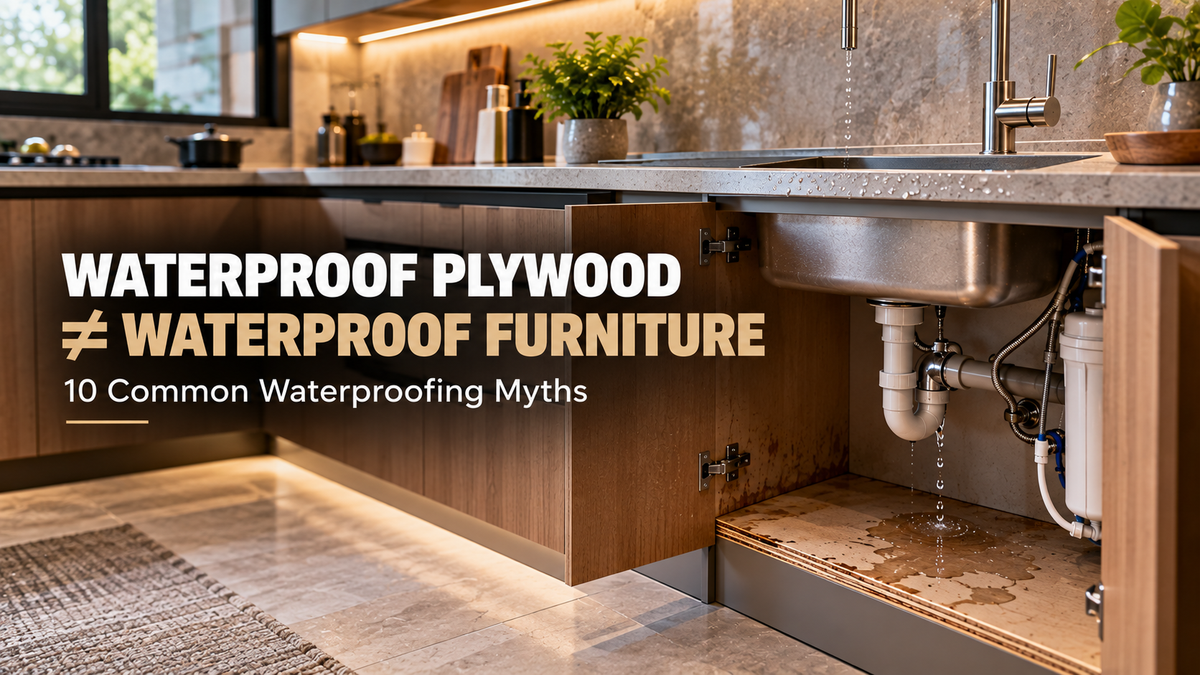
Common Waterproofing Myths in Interiors
Waterproofing is one of the most misunderstood aspects of home interior design.
Many homeowners believe that choosing waterproof plywood is enough to protect their furniture from moisture, leakage and humidity.
However, waterproof plywood and a waterproof interior are not the same thing.
A modular kitchen, bathroom vanity or utility cabinet contains several components, including plywood, laminates, adhesives, hardware, joints and plumbing connections.
Even when the plywood performs well against moisture, other components may still be vulnerable.
Let's explore 10 common waterproofing myths that homeowners and interior designers should understand.
1. Myth: Waterproof Plywood Means Furniture Cannot Be Damaged by Water
Reality: BWP plywood is designed for demanding moisture conditions, but it does not make the entire furniture assembly waterproof.
Water can still affect exposed joints, hardware, surface finishes and poorly protected areas.
Better approach: Combine suitable BWP plywood with proper edge protection, installation and leak prevention.
2. Myth: All Plywood Is Waterproof
Reality: Different plywood grades are intended for different applications.
|
Plywood Grade |
Suitable Application |
|---|---|
|
MR Plywood |
Dry interiors such as wardrobes and TV units |
|
BWR Plywood |
Applications requiring greater moisture resistance than MR |
|
BWP Plywood |
Kitchens and demanding moisture-prone applications |
Choosing the correct grade is more important than simply asking for plywood described as waterproof.
3. Myth: Laminate Makes Plywood Completely Waterproof
Reality: Laminate provides a decorative surface and some protection, but it does not automatically seal every edge, joint or opening.
Water may enter through poorly finished edges, plumbing cut-outs or damaged joints.
Better approach: Ensure appropriate edge finishing and protect vulnerable openings during fabrication.
4. Myth: MR Plywood Is Good Enough for Every Room
Reality: MR plywood is suitable for appropriate dry interior applications.
Using it in locations exposed to significant water increases the risk of moisture-related problems.
For modular kitchens, under-sink cabinets and other demanding wet-area applications, BWP plywood is generally a more suitable choice.
5. Myth: Waterproof Plywood Doesn't Need Edge Protection
Reality: Even moisture-resistant plywood benefits from careful fabrication and finishing.
Cut edges, drilled holes and plumbing openings can expose parts of the furniture assembly to water.
Better approach: Use appropriate sealing and finishing methods, especially around sinks and utility cabinets.
6. Myth: Kitchen Cabinets Fail Only Because of Poor Plywood
Reality: Kitchen cabinet damage can result from several factors:
-
Plumbing leakage
-
Incorrect plywood grade
-
Poor edge finishing
-
Standing water
-
Inadequate ventilation
-
Weak installation
-
Poor-quality hardware
Replacing the plywood without fixing the original moisture problem may lead to repeated damage.
7. Myth: Heavier Plywood Is Always More Waterproof
Reality: Weight alone cannot establish waterproof performance.
A plywood sheet's performance depends on its grade, adhesive bonding, manufacturing quality and compliance with relevant requirements.
A heavier sheet is not automatically better at resisting water.
Better approach: Verify the product grade and relevant technical documentation instead of judging only by weight.
8. Myth: Waterproof Plywood Can Be Used Anywhere Without Maintenance
Reality: BWP plywood is not a substitute for plumbing maintenance or building waterproofing.
Persistent leakage, water accumulation and poor drainage can damage other furniture components and surrounding construction.
Even high-quality materials need appropriate installation and maintenance.
9. Myth: Bathroom Furniture Needs Only Waterproof Plywood
Reality: Bathrooms present multiple moisture risks, including splashes, humidity, condensation and plumbing leakage.
Suitable BWP plywood may be considered for certain vanity applications, but areas experiencing frequent direct water exposure may benefit from alternatives such as WPC or PVC boards.
The best material depends on the exact installation conditions.
10. Myth: Waterproofing Is Only Important During Construction
Reality: Moisture protection should continue throughout the furniture's service life.
Homeowners should periodically inspect plumbing, cabinet interiors, sink connections and damp walls.
Small maintenance issues are easier to address before they cause extensive damage.
Best Materials for Moisture-Prone Interiors
|
Interior Application |
Recommended Material Direction |
|---|---|
|
Bedroom Wardrobe |
Quality MR Plywood |
|
TV Unit |
Quality MR Plywood |
|
Modular Kitchen Cabinets |
BWP Plywood |
|
Under-Sink Cabinet |
BWP / suitable wet-area material |
|
Bathroom Vanity |
BWP or suitable WPC/PVC |
|
Utility Storage |
BWP where water exposure is expected |
|
Frequently Wet Areas |
Suitable WPC/PVC or other wet-area systems |
These are general material-selection guidelines. Actual suitability depends on exposure, construction and installation.
How to Protect Your Furniture From Water Damage
A dependable moisture-protection strategy involves more than choosing the right plywood.
1. Select the correct plywood grade. Match MR, BWR or BWP to the application.
2. Protect exposed edges. Pay attention to cut-outs, joints and plumbing openings.
3. Inspect plumbing regularly. Repair small leaks before they become major problems.
4. Improve ventilation. Reduce persistent moisture in enclosed spaces.
5. Use appropriate hardware. Select fittings suited to the environment.
6. Fix damp walls first. Never conceal an existing seepage problem behind furniture.
The most effective approach is:
Correct Plywood + Edge Protection + Waterproofing + Plumbing + Ventilation + Maintenance
Why Choose Plyneer for Moisture-Prone Interiors?
At Plyneer Industries, we understand that different furniture applications require different material specifications.
Our plywood range includes solutions for dry interiors, moisture-prone furniture and demanding applications.
For premium projects, Plyneer Club combines waterproof performance, fire-retardant properties, premium hardwood core construction and a Lifetime Warranty, subject to applicable warranty terms.
The correct product should always be selected according to the environment and intended application.
Conclusion
Waterproofing is not a feature that can be achieved by choosing one material alone.
It requires the right combination of plywood, installation, edge finishing, plumbing protection and regular maintenance.
Understanding these myths helps homeowners avoid expensive mistakes and make better material decisions.
Waterproof Plywood Is Important. A Complete Moisture-Protection System Is Essential.
For premium plywood and interior material solutions, explore Plyneer Industries.
Website: https://www.plyneer.com
Contact: +91 8861717273


