

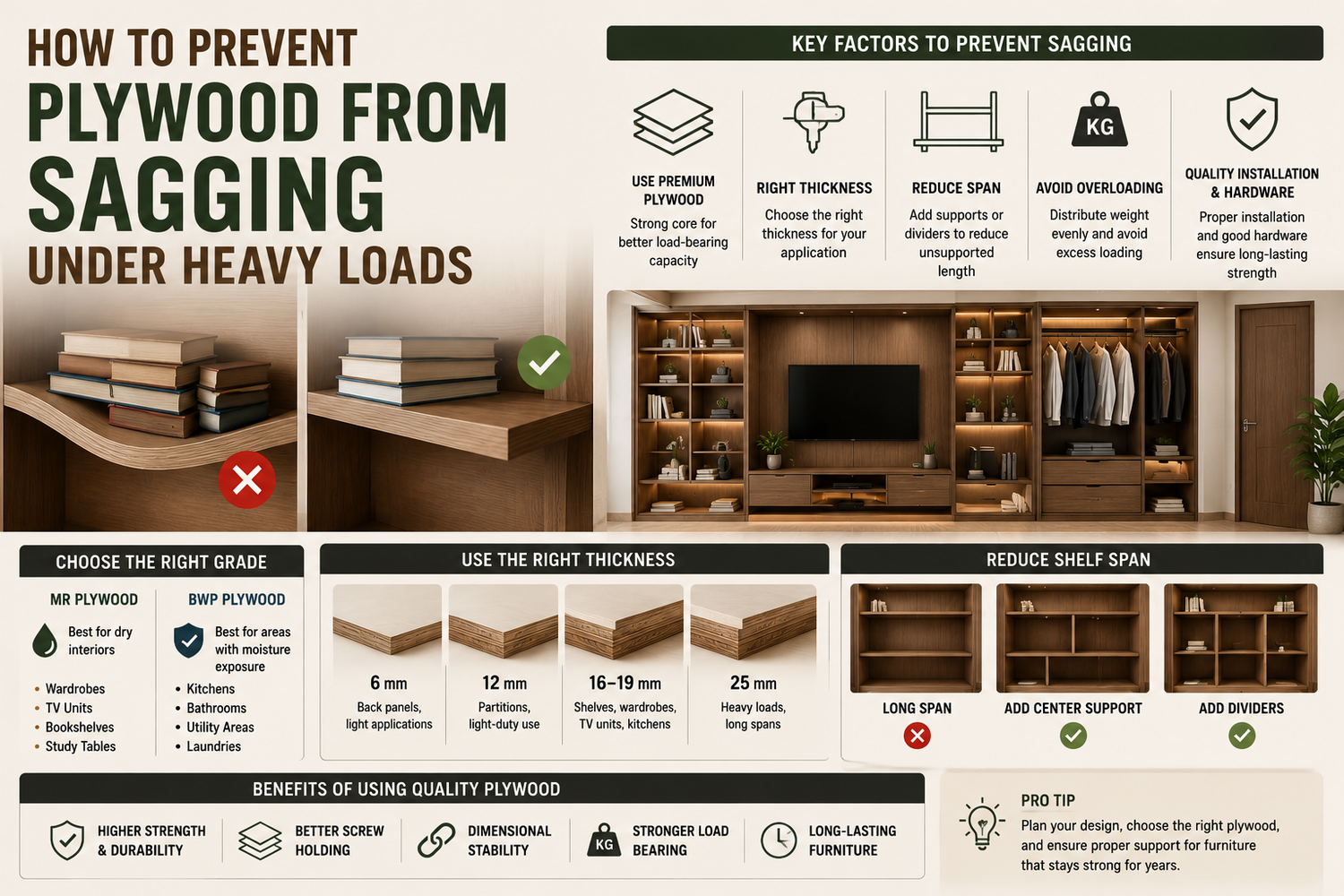
How to Prevent Plywood from Sagging Under Heavy Loads
A beautifully designed wardrobe or bookshelf can quickly lose its appeal when shelves begin to bend under the weight of clothes, books, or kitchen utensils. Sagging plywood is one of the most common furniture problems, yet it's also one of the easiest to prevent with the right planning and material selection.
Many people assume sagging occurs because the plywood is old. In reality, it usually starts much earlier—when the wrong plywood grade, inadequate thickness, poor support, or low-quality construction is used.
Whether you're building a modular kitchen, wardrobe, TV unit, office workstation, or commercial storage system, understanding how to prevent plywood from sagging will help you create stronger, longer-lasting furniture.
Why Does Plywood Sag?
Plywood naturally bends when subjected to excessive weight over long periods. However, premium plywood is engineered to resist this deflection far better than low-quality alternatives.
Common causes of sagging include:
- Using plywood that is too thin
- Long unsupported shelf spans
- Poor-quality core construction
- Excessive loading
- Low-density or weak plywood
- Internal voids within the plywood
- Improper installation
Fortunately, most of these issues can be avoided during the design stage.
Choose High-Quality Plywood
The first step in preventing sagging is selecting premium plywood with a strong and uniform core.
Quality plywood provides:
- Better load-bearing capacity
- Superior structural strength
- Higher density and consistency
- Fewer internal voids
- Better dimensional stability
Premium plywood distributes weight more evenly across the panel, reducing long-term bending.
Select the Correct Plywood Grade
Different furniture applications require different plywood grades.
MR Plywood
Ideal for:
- Wardrobes
- TV units
- Study tables
- Bookshelves in dry interiors
- Bedroom furniture
BWP Plywood
Recommended for:
- Modular kitchens
- Bathroom cabinets
- Utility furniture
- Laundry areas
- Moisture-prone environments
Using the appropriate plywood grade ensures the furniture maintains its strength throughout its lifespan.
Use the Right Thickness
Thickness plays a significant role in preventing sagging.
For most residential furniture:
- 6 mm plywood is suitable for lightweight panels and backboards.
- 12 mm plywood works for partitions and light-duty applications.
- 16 mm to 19 mm plywood is commonly preferred for shelves, wardrobes, TV units, and kitchen cabinets because it offers a good balance of strength and practicality.
- 25 mm plywood may be used where exceptionally high loads or long spans are expected.
The required thickness depends on the shelf span, support spacing, and expected load. A thicker panel generally resists bending better than a thinner one when all other factors are equal.
Reduce Shelf Span
One of the simplest ways to prevent sagging is to shorten the unsupported distance between supports.
For long shelves:
- Add vertical dividers
- Install center supports
- Break wide cabinets into smaller sections
- Use intermediate brackets where appropriate
Shorter spans greatly improve rigidity and reduce long-term deflection.
Avoid Overloading Shelves
Every shelf has a practical load limit.
Examples of heavy loads include:
- Large books
- Crockery
- Kitchen appliances
- Power tools
- Files and office records
- Decorative stone pieces
Distribute heavy objects evenly rather than concentrating weight in the center of the shelf.
Choose Premium Core Construction
The internal core is the structural backbone of plywood.
Premium core construction provides:
- Uniform veneer layers
- Balanced cross-lamination
- Strong adhesive bonding
- Minimal internal gaps
- Better stress distribution
These features help the plywood maintain its shape even under continuous loading.
Ensure Proper Installation
Even high-quality plywood can sag if it is installed incorrectly.
Best installation practices include:
- Level cabinet installation
- Strong wall anchoring
- Proper screw spacing
- Quality brackets and supports
- Accurate alignment
Professional installation allows the plywood to perform as intended.
Don't Compromise on Hardware
Shelf supports and cabinet hardware also influence performance.
Invest in:
- Heavy-duty shelf pins
- Quality brackets
- Premium hinges
- Strong drawer channels
- Reliable fasteners
Good hardware works together with quality plywood to provide maximum stability.
Maintain Stable Indoor Conditions
Although plywood is engineered for dimensional stability, prolonged exposure to moisture can affect any wood-based product.
To maximise furniture life:
- Repair plumbing leaks quickly
- Ensure adequate room ventilation
- Avoid prolonged water exposure
- Keep furniture away from persistent dampness
- Clean spills promptly
For kitchens, bathrooms, and utility spaces, choosing BWP plywood provides additional protection against moisture.
Best Applications for High-Strength Plywood
Premium plywood helps prevent sagging in:
- Modular kitchens
- Wardrobes
- Bookshelves
- TV units
- Office furniture
- Display cabinets
- Library shelving
- Retail fixtures
- Hotel furniture
- Educational institutions
These applications benefit from improved load-bearing capacity and long-term stability.
Common Mistakes That Cause Sagging
Avoid these common errors:
- Using plywood based only on price
- Choosing insufficient thickness
- Ignoring shelf span
- Overloading shelves
- Using poor-quality hardware
- Purchasing plywood with weak core construction
- Skipping proper support during installation
Avoiding these mistakes can significantly extend the life of your furniture.
Quick Checklist Before Buying Plywood
Before you purchase plywood, ask yourself:
✔ Is the plywood suitable for the intended application?
✔ Does it have a strong, uniform core?
✔ Is the thickness appropriate for the shelf span and load?
✔ Is the plywood manufactured to relevant quality standards?
✔ Is the hardware capable of supporting the expected weight?
✔ Am I buying from a trusted manufacturer?
Making informed choices at this stage can prevent expensive repairs later.
Conclusion
Sagging shelves are not an inevitable part of furniture—they are usually the result of poor planning, unsuitable materials, or inadequate support. By choosing premium plywood, selecting the correct thickness, reducing unsupported spans, and using quality hardware, you can build furniture that remains straight, stable, and reliable for many years.
Whether you're designing a modular kitchen, wardrobe, bookshelf, or office storage system, investing in quality materials from the start ensures stronger furniture, lower maintenance, and greater peace of mind.
Why Choose Plyneer?
At Plyneer Industries Pvt. Ltd., we manufacture premium plywood engineered for superior structural strength, excellent screw-holding capacity, and long-term durability. Our carefully selected hardwood veneers, advanced manufacturing processes, and strict quality control help create plywood that performs reliably in homes, offices, and commercial interiors.
Whether you're building bookshelves, wardrobes, modular kitchens, or custom furniture, Plyneer provides dependable plywood solutions trusted by homeowners, architects, interior designers, builders, and furniture manufacturers.
Build furniture that stays strong for years. Build with Plyneer.
📞 +91 8861717273


