

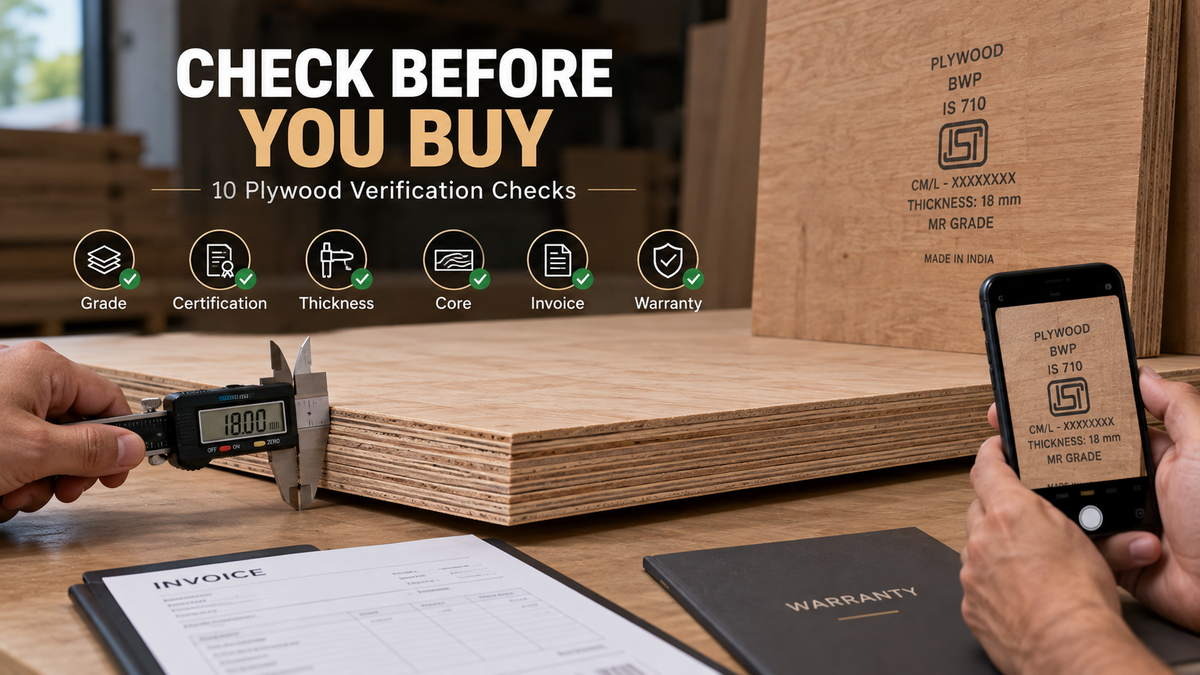
When buying plywood, homeowners often depend on what the dealer, carpenter or interior contractor recommends.
But once plywood is converted into furniture and covered with laminate or veneer, identifying what was actually used becomes much harder.
That's why verification should happen before fabrication begins.
Here are 10 practical checks you can make before purchasing plywood.
1. Check the Brand and Manufacturer
Start with the basics.
Look for clear identification of the:
- Brand name
- Product name
- Manufacturer
- Plywood grade
- Thickness
- Relevant product markings
Be cautious when a sheet has unclear branding or when the seller cannot provide basic product information.
2. Understand the Plywood Grade
Don't simply ask for “waterproof plywood” or “good plywood.”
Ask for the exact grade being supplied.
For example:
MR plywood – suitable for many dry interior applications.
BWR plywood – designed for greater moisture resistance than standard MR grades.
BWP plywood – intended for demanding applications where higher water resistance is required.
The correct plywood depends on where you're going to use it.
3. Check the Applicable IS Standard
Where ISI/BIS certification is claimed, check which Indian Standard applies to the product.
Different plywood categories are covered by different standards.
Don't treat the ISI mark as a decorative logo.
Ask: “Which IS standard is this plywood certified to?”
The standard should correspond to the product being purchased.
4. Verify the BIS Licence
Where a plywood product carries BIS certification, don't rely only on the printed mark.
Check the manufacturer's licence details through official BIS verification resources where applicable.
This can help confirm whether the certification information corresponds to the manufacturer and product category claimed.
Verify the certification—not just the sticker.
5. Check the Thickness
If you're purchasing 18 mm plywood, confirm what is actually being supplied.
Thickness consistency can be important for:
- Modular furniture
- CNC machining
- Edge banding
- Hardware installation
- Cabinet alignment
A simple thickness check using appropriate measuring equipment can reveal inconsistencies before fabrication begins.
6. Inspect the Core and Edges
Look at the plywood edge.
A well-constructed plywood core should generally appear consistent and properly bonded.
Watch for obvious issues such as:
- Large visible core gaps
- Irregular layers
- Open edges
- Delamination
- Significant construction inconsistencies
Remember, the face veneer can look beautiful while the real structural story is inside.
Don't judge plywood only by its surface.
7. Don't Use Weight as Your Only Quality Test
A common assumption is:
“Heavier plywood must be better.”
Not necessarily.
Weight can be influenced by timber species, density, moisture and construction.
Plywood quality should be evaluated using multiple factors, including:
Core construction + Bonding + Grade + Thickness + Application + Manufacturing consistency
Weight alone cannot establish whether plywood is genuine or suitable.
8. Ask for a Proper Invoice
A genuine purchase should be documented.
Your invoice should clearly identify the material being purchased as far as practical, including the correct product/brand, quantity and specification.
Keep the invoice safely.
It may be important if you later need:
- Warranty support
- Product verification
- Replacement consideration
- Purchase records
Don't spend lakhs on interiors without documenting the materials inside them.
9. Understand the Warranty
A “25-year warranty” or “lifetime warranty” sounds impressive—but understand exactly what it means.
Check:
✓ What is covered?
✓ What isn't covered?
✓ Is registration required?
✓ Is the original invoice required?
✓ Does the warranty cover termite/borer damage?
✓ What conditions or exclusions apply?
A genuine warranty should have understandable terms rather than being only a headline.
10. Photograph the Plywood Before Fabrication
This is one of the easiest steps—and one homeowners often forget.
Before your carpenter starts cutting the sheets, photograph:
- Brand markings
- Product name
- Grade
- Thickness information
- Certification/licence markings where applicable
- Batch or identification information where provided
Keep these photographs together with the invoice and warranty documents.
Once laminate covers the plywood, this information may no longer be visible.
Quick Genuine Plywood Checklist
Before approving your plywood order, check:
✓ Brand and manufacturer
✓ Exact product name
✓ MR/BWR/BWP grade
✓ Applicable IS standard where claimed
✓ BIS licence details where applicable
✓ Actual thickness
✓ Core and edge construction
✓ Surface condition
✓ Proper invoice
✓ Warranty terms
✓ Product photographs before cutting
Don't Confuse “Genuine” With “Suitable”
A plywood sheet can be an authentic product and still be the wrong material for your application.
For example, genuine MR plywood shouldn't automatically be selected for a moisture-prone kitchen simply because it comes from a recognised manufacturer.
Likewise, buying a higher specification isn't always necessary for every dry-area wardrobe.
The goal is:
Genuine Product + Correct Grade + Correct Application + Good Workmanship
All four matter.
Conclusion
Verifying plywood doesn't require you to become a plywood engineer.
You simply need to ask better questions.
Don't buy only on the basis of:
Price. Weight. Colour. Sticker. Carpenter recommendation.
Instead, verify the manufacturer, product, grade, certification where claimed, thickness, core construction, invoice and warranty.
And do it before the first sheet is cut.
Because once your plywood disappears behind a beautiful laminate, verification becomes much more difficult.
Check Before You Cut. Verify Before You Build.
At Plyneer Industries, we believe homeowners, architects, interior designers and furniture manufacturers should know exactly what material is going into their interiors.
🌐 www.plyneer.com
📞 +91 8861717273


