

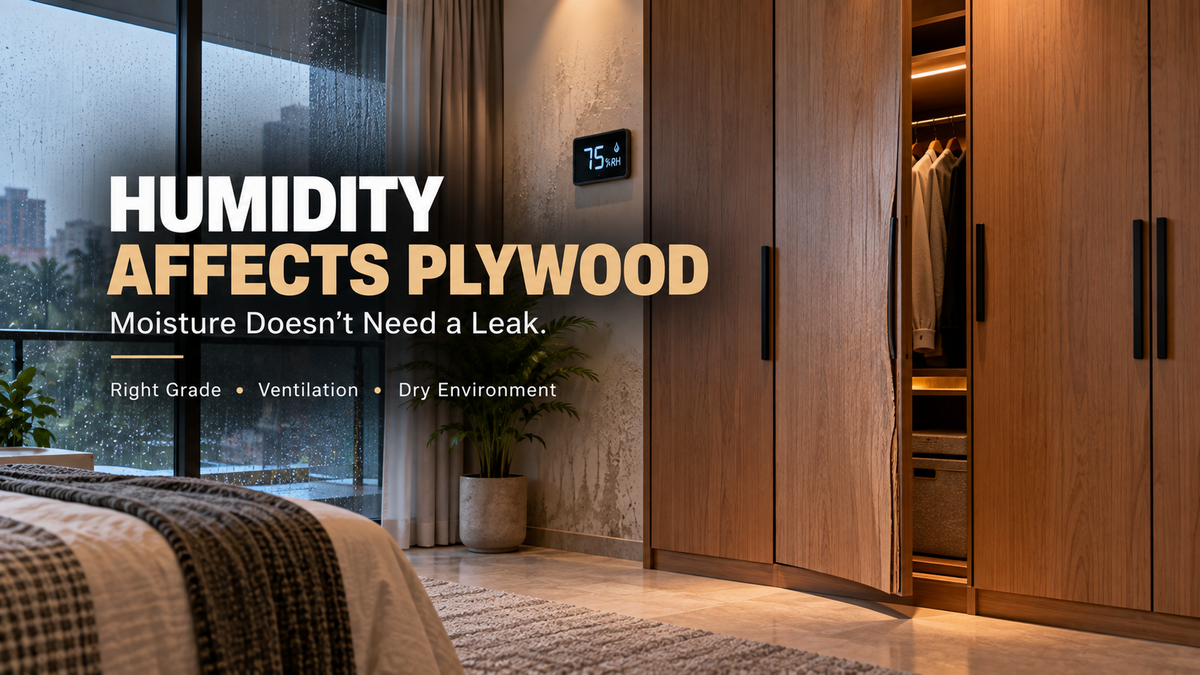
Humidity Impact on Plywood: What Homeowners Should Know
Plywood furniture does not need to come into direct contact with water to be affected by moisture.
Humidity in the surrounding air matters too.
This is especially important in cities such as Bengaluru, where seasonal weather changes, monsoons, closed rooms, damp walls and poor ventilation can create changing indoor humidity conditions.
Because plywood is a wood-based material, it naturally interacts with moisture in its environment.
Understanding this behaviour can help homeowners, architects and interior designers make better material decisions.
1. Plywood Responds to Changes in Humidity
Wood-based materials can absorb or release moisture depending on surrounding conditions.
When humidity increases, the moisture content of the material can increase. When conditions become drier, moisture can be released.
Well-manufactured plywood is engineered for dimensional stability, but it is not completely unaffected by environmental conditions.
2. Repeated Moisture Cycles Matter
A single humid day is usually not the main concern.
The bigger issue can be repeated cycles:
Humidity Rises → Material Absorbs Moisture → Environment Dries → Material Releases Moisture → Cycle Repeats
Over time, repeated exposure combined with poor material selection or installation can contribute to dimensional movement and furniture problems.
3. Humidity Can Contribute to Warping
Plywood construction helps improve dimensional stability compared with solid wood, but warping can still occur.
Risk may increase with:
- Uneven moisture exposure
- Poor-quality core construction
- Incorrect storage
- Damp walls
- Inadequate support
- Improper installation
- Unprotected edges
If one side experiences significantly different conditions from the other, dimensional imbalance may develop.
4. Furniture Edges Need Attention
Cut edges are important areas in plywood furniture.
During fabrication, plywood is cut for shelves, hardware, plumbing and furniture dimensions. These areas require appropriate finishing and workmanship.
This is particularly important in kitchens and utility areas where humidity may be accompanied by actual water exposure.
5. Humidity Can Affect Hardware Performance
Sometimes what appears to be a hardware problem begins with the substrate.
Dimensional changes or deterioration around fixing points can contribute to:
Loose Hinges → Shutter Misalignment → Repeated Adjustment → Maintenance
Good plywood, dependable hardware and proper installation should therefore be considered together.
6. Damp Walls Can Damage Wardrobes
A common mistake is installing a wardrobe directly against a wall with an existing moisture problem.
Even quality plywood cannot solve building seepage.
Before furniture installation, inspect walls for:
- Damp patches
- Plumbing leakage
- Exterior seepage
- Bathroom leakage
- Condensation
- Poor ventilation
Fix the source of moisture before covering it with furniture.
7. Choose the Plywood Grade According to Exposure
Not every room needs the same plywood.
| Application | Material Direction |
|---|---|
| Bedroom Wardrobe | Quality MR Plywood |
| TV Unit | Quality MR Plywood |
| Study Furniture | Quality MR Plywood |
| Modular Kitchen | BWP Plywood |
| Under-Sink Cabinet | BWP / suitable wet-area material |
| Utility Storage | BWP where moisture exposure is expected |
| Bathroom Vanity | Suitable wet-area material |
For normal dry interiors, quality MR plywood can be appropriate.
Where greater moisture or water exposure is expected, BWP plywood is generally a more suitable direction.
8. Ventilation Helps Control Indoor Moisture
Material selection is only part of the solution.
Good ventilation can help manage indoor humidity and reduce persistent dampness.
Pay particular attention to wardrobes against external walls, kitchens, utility areas and rooms that remain closed for extended periods.
9. Storage Before Installation Matters
Plywood can be affected before the carpenter even starts fabrication.
Sheets should generally be stored:
✓ Flat
✓ Dry
✓ Properly supported
✓ Protected from rain
✓ Away from direct floor moisture
✓ In suitable site conditions
Leaning sheets against walls for long periods or storing them in damp construction areas can contribute to distortion.
10. Moisture Resistance Is a Complete System
Even BWP plywood should not be expected to compensate for persistent leaks or poor construction.
Long-lasting furniture depends on:
Correct Plywood + Proper Storage + Good Installation + Edge Protection + Plumbing + Waterproofing + Ventilation
Treating moisture management as a complete system is more effective than relying on a single product.
Signs Humidity May Be Affecting Furniture
Watch for unusual:
- Shutter misalignment
- Edge swelling
- Surface distortion
- Persistent musty smell
- Dampness behind wardrobes
- Loose hardware
- Laminate or veneer problems
- Mould around surrounding walls or surfaces
These symptoms do not automatically mean the plywood is defective. The underlying source of moisture should first be investigated.
How to Protect Plywood Furniture
Before installation, choose the correct plywood grade for the application and ensure the site is sufficiently dry.
During fabrication, use appropriate thickness, support, edge finishing and installation practices.
After installation, repair plumbing leaks quickly, maintain ventilation and investigate damp walls rather than allowing furniture to conceal the problem.
Control the Environment, Not Just the Material.
Conclusion
Humidity is an important but often overlooked factor in furniture performance.
Plywood is designed to provide better dimensional stability than many forms of natural solid wood, but it remains a wood-based material and can respond to changing moisture conditions.
For dry furniture such as wardrobes, TV units and study tables, quality MR plywood may be appropriate. For kitchens and other moisture-prone applications, BWP plywood provides a more suitable material direction.
The goal isn't simply to buy “waterproof plywood.”
It is to create a complete moisture-management system around the furniture.
Right Grade. Dry Environment. Better Installation. Longer-Lasting Furniture.
At Plyneer Industries, we offer plywood solutions for different interior environments, from MR plywood for dry-area furniture to premium BWP plywood for demanding moisture-prone applications.
🌐 www.plyneer.com
📞 +91 8861717273


