

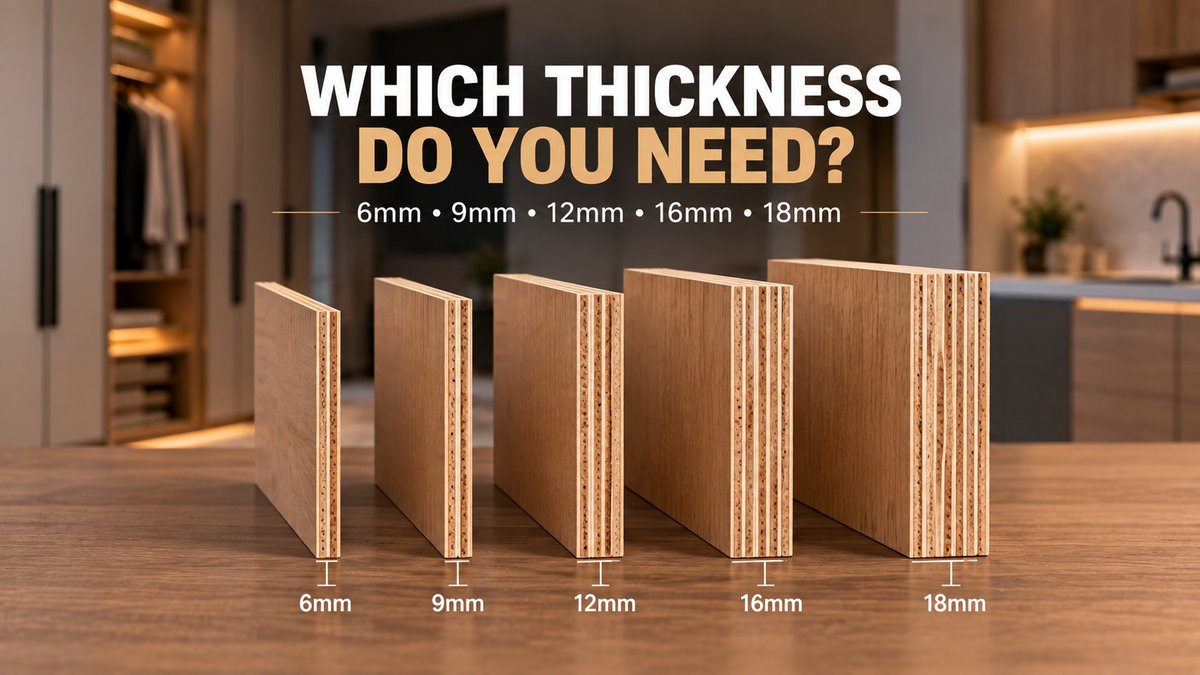
Plywood Thickness Guide: 6mm, 9mm, 12mm, 16mm & 18mm
Choosing plywood isn't only about deciding between MR, BWR or BWP. Thickness also plays an important role in furniture strength, weight, appearance and cost.
Using plywood that is too thin may lead to excessive flexing or sagging. Using unnecessarily thick plywood can increase weight and cost without providing meaningful benefits.
The correct thickness depends on:
Application + Load + Span + Support + Furniture Design
Here's a practical guide to common plywood thicknesses.
1. 6mm Plywood – Lightweight Applications
6mm plywood is relatively thin and is generally better suited to applications where it is supported rather than expected to carry significant structural loads.
Common applications include:
Furniture back panels
Decorative panelling
Drawer bottoms with suitable support
Lightweight partitions
Interior cladding
Certain curved or design applications
It generally shouldn't be treated as the primary structural material for heavy shelves or large unsupported furniture components.
2. 9mm Plywood – Light-Duty Interior Work
9mm provides greater rigidity than 6mm while remaining relatively lightweight.
It may be used for:
Cabinet back panels
Drawer components
Decorative furniture elements
Wall panelling
Light-duty partitions
Furniture components with adequate framing
Whether 9mm is suitable depends heavily on the size of the component and the support behind it.
3. 12mm Plywood – Medium-Duty Applications
12mm plywood offers a useful middle ground between lightweight panels and thicker furniture boards.
Typical applications can include:
Drawer components
Smaller shelves with adequate support
Cabinet components
Partition work
Storage components
Certain furniture shutters or panels depending on design
For shelving, span and expected load should always be considered before deciding on thickness.
4. 16mm Plywood – Furniture Construction
16mm plywood is widely useful for furniture applications where greater rigidity and fastening capacity are required.
It can be considered for:
Wardrobes
Cabinets
Modular furniture
TV units
Study tables
Storage units
Kitchen cabinetry
For Plyneer furniture applications, 16mm is an important working thickness, particularly where calibrated plywood and precision furniture construction are required.
However, thickness alone doesn't determine performance. Core construction, plywood grade and furniture engineering remain equally important.
5. 18mm Plywood – Heavy-Duty Furniture
18mm plywood is commonly selected for robust furniture construction.
Typical applications include:
Modular kitchens
Wardrobe carcasses
Heavy storage
Shelves
Worktops with appropriate support
Beds and structural furniture components
Office furniture
It provides greater rigidity than thinner panels, making it useful where the design requires additional structural strength.
But even 18mm plywood can sag when used across a long unsupported span carrying excessive weight.
Thicker doesn't eliminate the need for good furniture design.
Quick Plywood Thickness Chart
Thickness
Common Application
6mm
Back panels, decorative panels, lightweight applications
9mm
Cabinet backs, panelling, light-duty components
12mm
Drawers, partitions, smaller supported shelves
16mm
Wardrobes, cabinets, modular furniture, kitchens
18mm
Kitchens, wardrobes, shelves, heavy-duty furniture
These are general guidelines rather than universal structural specifications. Final thickness should be selected according to the furniture design and expected load.
Thickness Isn't the Only Decision
Two 18mm plywood sheets aren't necessarily equal.
When selecting plywood, also consider:
✓ Plywood grade
✓ Core construction
✓ Bonding quality
✓ Screw holding
✓ Thickness consistency
✓ Moisture exposure
✓ Furniture design
✓ Expected lifespan
For example, using 18mm MR plywood in a moisture-prone application doesn't automatically make it equivalent to appropriately specified BWP plywood.
Thickness determines dimensions. Grade determines suitability for the environment.
Both matter.
What Thickness Is Best for Wardrobes?
For the main wardrobe structure, 16mm or 18mm plywood may commonly be considered depending on the furniture design.
Back panels can often use thinner material because they are supported by the carcass.
Shelf thickness should depend on shelf width, load and intermediate support.
For a normal dry bedroom, quality MR plywood can be appropriate.
What Thickness Is Best for Modular Kitchens?
16mm or 18mm plywood is commonly considered for kitchen cabinetry depending on the design and hardware system.
Because kitchens experience greater moisture exposure than normal bedroom furniture, plywood grade becomes particularly important.
For moisture-prone kitchen applications, BWP plywood is generally a more suitable direction than MR plywood.
What Thickness Is Best for Shelves?
There isn't one universal answer.
A shelf's performance depends on:
Thickness + Width + Span + Load + Support
A short 16mm shelf with adequate support may perform differently from a long 18mm shelf carrying heavy books without intermediate support.
For heavy storage, reduce unsupported spans and provide appropriate structural support.
Don't Select Plywood Only by Thickness
A quotation saying “18mm plywood” doesn't tell you enough.
Ask:
Which brand?
Which grade?
Which product?
What core construction?
What application is it intended for?
An interior quotation should ideally specify something like:
18mm BWP Plywood – Kitchen Carcass
rather than simply:
18mm Plywood
That small difference creates much greater transparency.
Conclusion
Choosing the right plywood thickness is about balancing strength, weight, application and cost.
As a general guide:
6mm → Lightweight and backing applications
9mm → Light-duty components
12mm → Medium-duty supported components
16mm → Main furniture construction
18mm → Robust and heavy-duty furniture
But remember:
The right thickness cannot compensate for the wrong plywood grade or poor furniture design.
Select thickness according to the load and structure, and select plywood grade according to the environment.
Right Grade. Right Thickness. Right Application. Better Furniture.
At Plyneer Industries, we offer plywood solutions across multiple thicknesses and grades for wardrobes, kitchens, modular furniture and interior projects.
🌐 www.plyneer.com�
📞 +91 8861717273


