

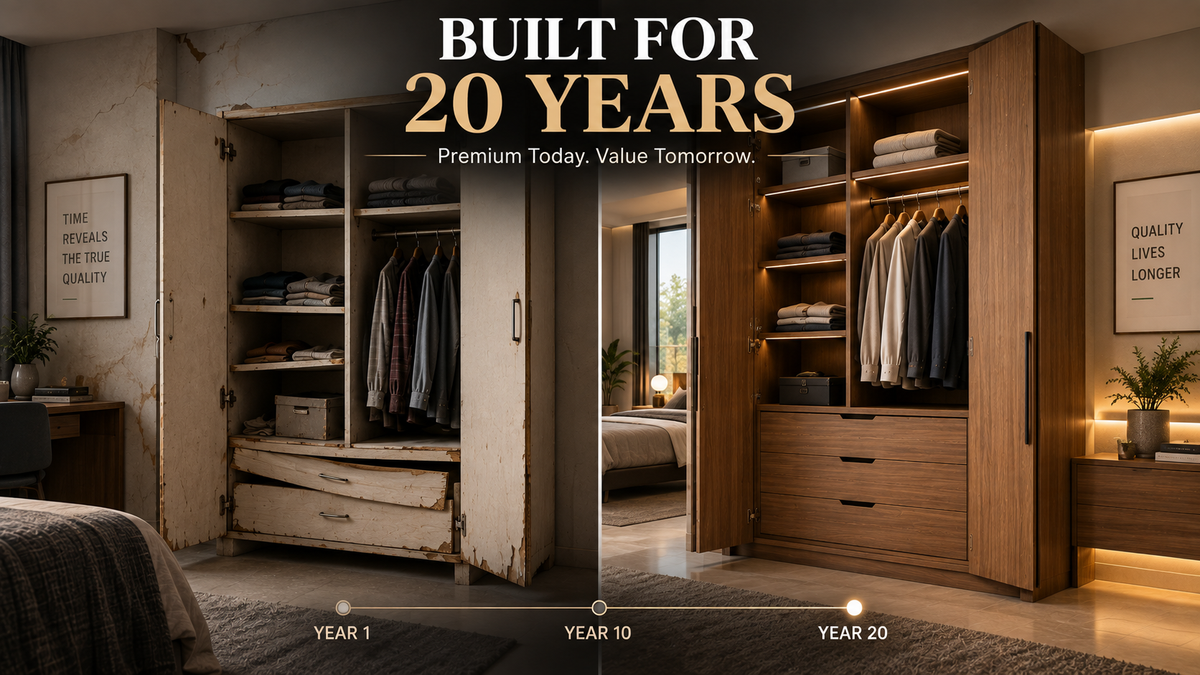
When building a new home, homeowners often compare plywood by price per square foot.
If one plywood costs ₹10 or ₹20 less per sq. ft., choosing it can appear to be an easy way to reduce the interior budget.
But furniture isn't purchased for one year.
A modular kitchen, wardrobe, TV unit or built-in storage system may be expected to remain in your home for 15–20 years or longer.
That changes the calculation.
Instead of asking:
“Which plywood is cheaper today?”
Ask:
“What will my furniture cost me over the next 20 years?”
Premium plywood can cost more initially, but if appropriate material selection and better construction help reduce repairs, hardware problems and premature replacement, the long-term value can be significantly different.
Here are 10 reasons premium plywood can make financial sense over the life of your interiors.
1. Longer Furniture Life
The biggest potential saving is also the simplest:
You don't want to build the same furniture twice.
A wardrobe isn't just plywood.
Its total cost includes:
- Plywood
- Laminates or veneers
- Hardware
- Edge banding
- Labour
- CNC work
- Transport
- Installation
If the underlying structure needs premature replacement, much of that investment may have to be repeated.
This is why plywood should be evaluated as the foundation of the furniture, not simply another item on the carpenter's material list.
For a broader comparison of materials for different areas of the home, read our Complete Home Interior Material Buying Guide.
2. Fewer Repairs Over the Years
Furniture experiences continuous use.
Wardrobe shutters open and close.
Kitchen drawers operate every day.
Shelves carry weight.
Furniture is cleaned, moved and occasionally exposed to moisture.
Over many years, small weaknesses can become expensive problems.
Depending on the cause, repairs may involve:
- Carpenter visits
- Hinge repositioning
- Panel replacement
- Shelf replacement
- Shutter adjustment
- Re-lamination
- Hardware refitting
A ₹2,000 repair may not seem significant.
But repeated repairs across a complete home over many years can add up.
Good furniture should require maintenance—not constant correction.
3. Better Screw Holding Protects Your Furniture
Screw holding is one of the most important characteristics of furniture-grade plywood.
Think about a wardrobe hinge.
Every time you open the shutter, forces are transferred through the hinge screws into the plywood.
Over thousands of cycles, the substrate matters.
Poor screw holding can contribute to:
Loose Hinge → Misaligned Shutter → Repeated Tightening → Damaged Screw Hole → Repair
The same applies to:
- Drawer channels
- Cabinet hinges
- Wardrobe hardware
- Connectors
- Shelving systems
Premium hardware also deserves a dependable substrate.
You can understand this in greater detail in our Guide to the Science Behind Screw Holding Strength in Plywood.
4. Better Moisture Protection Can Prevent Expensive Damage
Moisture is one of the biggest risks to home furniture.
This is particularly important in:
- Modular kitchens
- Under-sink cabinets
- Utility rooms
- Bathroom vanities
- Other moisture-prone areas
A small plumbing leak can remain unnoticed for days.
If inappropriate material has been used, the resulting damage can cost considerably more than the amount originally saved.
This is why the right plywood grade matters.
Dry Interior Areas
Quality MR plywood can be suitable for wardrobes, TV units, study tables and other dry furniture.
Moisture-Prone Areas
Appropriate BWP plywood should be considered for kitchens, under-sink cabinetry, utilities and other applications with greater moisture exposure.
The goal isn't to buy the most expensive plywood everywhere.
The goal is to spend correctly where performance matters.
5. Reduced Risk of Sagging
Long shelves can gradually bend under load.
This is common in:
- Bookshelves
- Wardrobes
- Kitchen cabinets
- Shoe racks
- Storage units
- Office furniture
Sagging isn't determined by plywood quality alone.
It also depends on:
Thickness + Span + Load + Support + Furniture Design
But starting with suitable material and designing the furniture correctly can reduce avoidable problems.
A sagging shelf isn't always solved by simply pushing it back into position. In some cases, the component must be replaced or redesigned.
Read our detailed Guide to Preventing Plywood from Sagging Under Heavy Loads.
6. Premium Plywood Helps Protect Expensive Hardware
Modern modular furniture can contain surprisingly expensive hardware.
A premium kitchen or wardrobe may include:
- Soft-close hinges
- Tandem drawers
- Telescopic channels
- Sliding mechanisms
- Lift-up systems
- Pull-out accessories
- Wardrobe fittings
Homeowners may spend heavily on these visible and moving components.
But every hinge and channel eventually connects to the furniture substrate.
Premium hardware + unsuitable substrate = weak system.
Good furniture should be designed as one complete system:
Plywood + Hardware + Design + Workmanship
Saving a relatively small amount on the structural material while spending heavily on hardware can be a false economy.
7. Premium Plywood Protects Premium Finishes
Imagine selecting a beautiful natural veneer.
Or an expensive designer laminate.
Or a luxury acrylic finish.
These finishes may completely transform the appearance of your home.
But beneath that premium surface is the substrate.
If the underlying furniture structure develops problems, the expensive finish cannot compensate for it.
Replacing the panel may also mean replacing:
- Laminate
- Veneer
- Edge finish
- Hardware
- Labour
That's why premium interiors should be designed:
From the inside out.
The visible finish creates luxury.
The material underneath helps support its longevity.
For premium projects, see our Guide to Designing Long-Lasting Luxury Interiors with Premium Plywood.
8. Avoiding One Replacement Can Change the Entire Calculation
Consider a simple hypothetical example.
These figures are purely illustrative:
| 20-Year Cost | Lower-Cost Furniture | Premium Furniture |
|---|---|---|
| Initial Cost | ₹1,50,000 | ₹1,90,000 |
| Repairs | ₹20,000 | ₹7,000 |
| Major Repair | ₹40,000 | ₹10,000 |
| Replacement | ₹1,80,000 | — |
| Illustrative Total | ₹3,90,000 | ₹2,07,000 |
This does not mean premium furniture is guaranteed to last 20 years or that cheaper furniture will necessarily require replacement.
Actual furniture life depends on material specification, design, workmanship, usage, moisture exposure, hardware and maintenance.
The example demonstrates something more important:
Initial price and lifetime cost are not the same thing.
Avoiding even one premature replacement can dramatically alter the financial calculation.
Learn more about this approach in our Furniture Lifecycle Cost Guide.
9. Less Repair Means Less Disruption
There is another cost that rarely appears on an interior quotation.
Your time.
Imagine replacing a built-in wardrobe.
First, everything needs to be removed.
Then the furniture is dismantled.
Old material needs disposal.
New material must arrive.
Carpenters return.
Cutting and installation begin.
There may be:
- Dust
- Noise
- Labour
- Furniture movement
- Repainting
- Cleaning
- Several days of inconvenience
The same is even more disruptive with a modular kitchen.
Long-lasting furniture therefore doesn't only potentially save money.
It can save inconvenience.
10. Lower Cost Per Year
One of the easiest ways to understand long-term value is to calculate the approximate cost per year of use.
Consider another hypothetical example.
Furniture Option A
Initial cost: ₹1,50,000
Useful life in the example: 8 years
Approximate cost per year:
₹18,750
Now consider:
Furniture Option B
Initial cost: ₹2,00,000
Useful life in the example: 20 years
Approximate cost per year:
₹10,000
Again, these aren't lifespan promises.
They simply demonstrate the principle.
A product that costs more initially can become less expensive when its cost is spread across a longer useful life.
That's why homeowners should evaluate lifecycle value, not just today's quotation.
Premium Doesn't Mean Using the Most Expensive Plywood Everywhere
This is extremely important.
Buying premium plywood intelligently doesn't mean specifying the highest-priced plywood for every piece of furniture.
A better approach is application-based material selection.
| Home Application | Practical Material Direction |
|---|---|
| Modular Kitchen | BWP Plywood |
| Under-Sink Cabinet | BWP / appropriate wet-area material |
| Utility Cabinet | BWP where moisture exposure is expected |
| Bathroom Vanity | BWP / suitable wet-area solution |
| Bedroom Wardrobe | Quality MR Plywood |
| TV Unit | Quality MR Plywood |
| Study Table | Quality MR Plywood |
| Bookshelf | MR + appropriate thickness/support |
| Premium Veneered Furniture | Premium plywood substrate |
| Curved Furniture | Flexible plywood |
This approach allows homeowners to invest where performance matters and optimise where conditions are less demanding.
What Actually Makes Plywood “Premium”?
Don't assume expensive automatically means premium.
Look beyond the price.
Consider:
✓ Appropriate plywood grade
✓ Consistent thickness
✓ Core construction
✓ Bonding quality
✓ Surface quality
✓ Screw-holding performance
✓ Dimensional consistency
✓ Applicable IS/BIS specification
✓ Warranty terms
✓ Manufacturer credibility
The internal construction deserves particular attention because once furniture is laminated, you may never see the plywood core again.
Read our Guide to Premium Core Construction to understand why the inside of plywood matters.
Don't Judge Plywood Only by Weight
Another common misconception is:
“Heavier plywood must be better plywood.”
Not necessarily.
Density can influence certain performance characteristics, but plywood quality cannot be determined from weight alone.
You should also consider:
- Timber species
- Core quality
- Veneer construction
- Bonding
- Grade
- Manufacturing consistency
- Intended application
Our Complete Guide to Plywood Density and Why It Matters explains this relationship in detail.
Premium Plywood Can Also Support More Sustainable Interiors
Furniture that remains useful for longer can also reduce unnecessary material consumption.
Every replacement can require additional:
- Plywood
- Laminates
- Adhesives
- Hardware
- Packaging
- Transportation
- Labour
- Energy
So sustainability isn't only about choosing a material with an environmental claim.
Durability itself can be part of sustainable design.
Building furniture for longer service can help reduce repeated material consumption and waste.
Explore this idea further in The Future of Sustainable Plywood Manufacturing.
The 20-Year Question
When comparing two plywood quotations, don't immediately choose the lower number.
Ask:
How long am I expecting this furniture to perform?
If you're building temporary furniture, the lowest initial price may be important.
But if you're building:
- Your own home
- A premium apartment
- A villa
- A modular kitchen
- Large built-in wardrobes
- Permanent storage
- Luxury veneered furniture
then long-term performance deserves greater weight in the decision.
The plywood may eventually disappear beneath beautiful laminates and veneers.
But the performance of the furniture will continue depending on what's underneath.
Conclusion
Premium plywood doesn't save money because it is cheaper.
It can save money because you may have to repair and replace less over the life of your furniture.
Think beyond the initial quotation.
Think about:
1. Longer furniture life
2. Fewer repairs
3. Better screw holding
4. Appropriate moisture protection
5. Reduced sagging risk with correct design
6. Protection for expensive hardware
7. Protection for premium finishes
8. Lower risk of premature replacement
9. Less renovation disruption
10. Better cost per year
The smartest interior investment isn't necessarily the material with the lowest price today.
It's the material that delivers the right performance for the years ahead.
Why Choose Plyneer?
At Plyneer Industries Pvt. Ltd., we believe homeowners should select plywood according to application, expected performance and long-term value.
From MR plywood for dry interior furniture to BWP and premium plywood solutions for demanding applications, Plyneer offers materials for homeowners, architects, interior designers, carpenters and furniture manufacturers.
Explore our plywood range or start with our Complete Home Interior Material Buying Guide.
Pay More Once. Repair Less. Replace Less. Build for Longer.
🌐 www.plyneer.com
📞 +91 8861717273


