

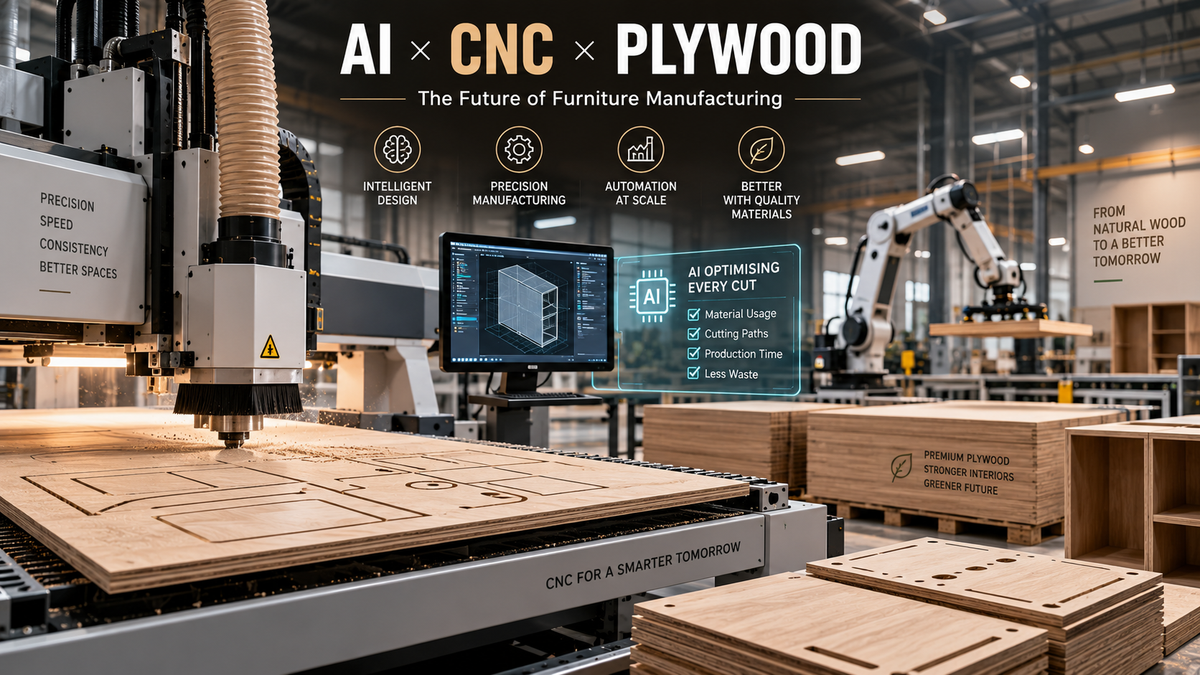
AI in Furniture Manufacturing: How Artificial Intelligence Is Transforming the Industry
Introduction
Furniture manufacturing has always depended on three fundamentals: good design, skilled craftsmanship and quality materials.
Now, a fourth element is becoming increasingly important—data and artificial intelligence.
AI is beginning to influence almost every stage of furniture production, from generating initial design concepts and estimating material requirements to optimising CNC cutting, identifying defects and planning factory production.
For modular furniture manufacturers, interior companies and large furniture factories, the opportunity is significant.
The objective isn't simply to replace people with machines. It is to use technology to help designers, carpenters, CNC operators and production managers make faster and more accurate decisions.
So, what could AI actually change inside a furniture factory?
1. AI-Assisted Furniture Design
Traditionally, developing furniture involves several stages:
Concept → Drawing → 3D Design → Material Selection → Prototype → Production
AI-assisted design tools can speed up the early stages of this process.
A designer could provide requirements such as room dimensions, storage requirements, preferred style and budget. Software can then help generate different layouts or concepts for consideration.
For example, instead of manually developing multiple wardrobe configurations, a designer could rapidly explore variations in:
- Internal storage
- Drawer placement
- Hanging areas
- Shutter styles
- Shelving
- Materials
- Colours
The designer still makes the final decisions.
AI simply allows more ideas to be evaluated in less time.
This is particularly useful as customers increasingly expect personalised furniture rather than standardised designs.
2. Turning Measurements Into Manufacturing Data
One of the biggest opportunities lies between design and production.
Imagine measuring an apartment and converting that information through a connected workflow:
Site Measurement → 3D Design → Bill of Materials → Cutting List → CNC Program → Production
Today, many companies still transfer information manually between several systems.
Every manual transfer creates another opportunity for error.
AI and connected manufacturing software can help reduce repetitive work and make the transition from design to production more efficient.
For modular furniture businesses handling hundreds of cabinets, kitchens and wardrobes, even small improvements can become significant at scale.
3. AI Can Help Select the Right Interior Material
Furniture doesn't require the same material everywhere.
A bedroom wardrobe and an under-sink kitchen cabinet operate in completely different environments.
An intelligent material-selection system could consider:
- Moisture exposure
- Expected load
- Furniture dimensions
- Hardware
- Finish
- Budget
- Expected lifespan
It could then recommend suitable material categories.
For example:
| Application | Material Direction |
|---|---|
| Bedroom Wardrobe | Quality MR Plywood |
| TV Unit | MR Plywood |
| Modular Kitchen | BWP Plywood |
| Under-Sink Cabinet | BWP / appropriate wet-area material |
| Decorative CNC Panel | MDF / HDHMR |
| Curved Furniture | Flexible Plywood |
| Premium Veneered Furniture | Premium Plywood + Veneer |
Homeowners who want to understand these choices in greater detail can also read our Complete Home Interior Material Buying Guide.
AI can support the decision—but understanding the application remains essential.
4. AI and CNC: A Powerful Manufacturing Combination
CNC technology has already changed modern furniture production.
Machines can cut, drill and route panels with high repeatability.
AI and optimisation software can make the process even smarter.
Suppose a factory has orders for:
- 30 wardrobes
- 20 modular kitchens
- 15 TV units
- 25 study tables
That could require hundreds or thousands of individual plywood components.
The challenge isn't simply cutting them.
The challenge is arranging all those pieces across standard plywood sheets while generating the least possible waste.
Advanced nesting and optimisation systems can evaluate different layouts before cutting begins.
The result can be better material utilisation and more efficient production.
5. Reducing Plywood Wastage With Smarter Nesting
Material utilisation has a direct impact on furniture manufacturing costs.
An 8 × 4 plywood sheet provides a fixed area.
Poor cutting layouts can create large offcuts that cannot easily be reused.
Now imagine a manufacturer processing thousands of sheets.
Even a modest improvement in sheet utilisation could affect:
- Material purchasing
- Production cost
- Waste generation
- Storage requirements
- Profitability
- Sustainability
This connects directly with the broader movement toward sustainable plywood manufacturing.
The future of sustainable furniture isn't only about what materials manufacturers buy.
It's also about how intelligently those materials are used.
6. AI-Powered Quality Inspection
Quality inspection traditionally relies heavily on experienced workers.
They may check furniture components for:
- Surface defects
- Edge damage
- Incorrect drilling
- Dimensional variation
- Finish inconsistencies
- Lamination defects
Computer vision can support this process.
Cameras installed at different points on a production line can capture images of components. AI models can then analyse those images and flag potential abnormalities for further inspection.
Instead of replacing the quality-control team, the system can help them focus attention on components most likely to have a problem.
The ideal combination becomes:
Machine Consistency + Human Experience
7. Predictive Maintenance for Furniture Machinery
Unexpected machine downtime can be expensive.
If a CNC router suddenly stops operating, it can affect:
Cutting → Drilling → Edge Banding → Assembly → Dispatch
Modern manufacturing equipment can generate operational information such as:
- Runtime
- Motor load
- Temperature
- Vibration
- Tool usage
- Error patterns
Predictive-maintenance systems can analyse this data and identify abnormal behaviour.
Instead of:
Machine Failure → Production Stops → Repair
manufacturers can increasingly move toward:
Warning Signal → Planned Maintenance → Reduced Downtime
For high-volume furniture factories, this can improve both productivity and delivery reliability.
8. Smarter Inventory Management
A furniture factory may need to manage hundreds or thousands of material SKUs:
- Plywood
- MDF
- HDHMR
- Laminates
- Veneers
- Edge bands
- Hinges
- Channels
- Handles
- Adhesives
- Screws
Too little stock can stop production.
Too much stock blocks working capital and warehouse space.
AI-assisted forecasting can analyse historical consumption, confirmed orders, lead times, production schedules and seasonal patterns to support purchasing decisions.
Instead of asking:
“How much plywood did we consume last month?”
manufacturers can increasingly ask:
“How much plywood are we likely to require next month?”
That shift from reporting the past to predicting future requirements can make inventory management much more effective.
9. Faster Furniture Cost Estimation
Preparing quotations can take significant time, particularly for customised interiors.
The cost of a wardrobe, for example, may depend on:
- Plywood quantity
- Plywood grade
- Thickness
- Laminate
- Hardware
- Edge band
- Machining
- Labour
- Installation
- Wastage
AI-connected estimating systems can potentially analyse a design and create a preliminary bill of materials.
The workflow could become:
Design → Component List → Sheet Requirement → Hardware → Labour → Estimated Cost
Sales teams could generate structured quotations faster while production teams receive more consistent information.
But the lowest initial quotation isn't necessarily the best value.
Our guide to calculating furniture lifecycle cost explains why material durability, repairs and replacement should also be considered when evaluating furniture costs.
10. AI Can Improve Production Scheduling
A furniture factory may have dozens of projects moving through production simultaneously.
One kitchen needs cutting.
Another wardrobe needs edge banding.
A third project is waiting for hardware.
Another must be dispatched tomorrow.
AI-supported scheduling systems can evaluate:
- Delivery deadlines
- Machine availability
- Labour availability
- Material availability
- Job priority
- Production capacity
- Setup times
The goal is to identify the most efficient production sequence.
This can help factories reduce idle time and potentially increase output without immediately purchasing additional machinery.
11. Mass Customisation Could Become Much Easier
Customers increasingly want customised furniture.
One customer wants three drawers.
Another wants six.
One wardrobe requires sliding shutters.
Another requires hinged shutters.
Every kitchen has different dimensions.
Traditionally, increasing customisation also increases manufacturing complexity.
AI, parametric design and automated manufacturing can help companies manage these variations more efficiently.
This creates the possibility of mass customisation:
Furniture personalised for individual customers but produced using efficient industrial manufacturing processes.
This could become particularly important for India's growing modular furniture and interior industry.
12. AI Can Connect Online Sales Directly to the Factory
The next major shift could happen between e-commerce and manufacturing.
Imagine configuring a wardrobe online.
You select:
Dimensions → Internal Layout → Plywood → Finish → Hardware
The system calculates a price.
Once the order is confirmed, software could potentially generate:
Production Drawing → Bill of Materials → Cutting List → Material Requirement → Production Order
Instead of the website being separate from manufacturing, the two become connected.
This could significantly shorten the journey from customer requirement to finished furniture.
13. Digital Twins Could Create Smarter Factories
A digital twin is a digital representation of a physical machine, process or production environment.
Manufacturers can use digital models to understand how changes might affect production before making expensive physical modifications.
For example:
What happens if production demand increases by 20%?
Does the factory need another CNC machine?
Or is the real bottleneck edge banding?
Could changing the production sequence increase output?
Data-driven simulation can help manufacturers make more informed investment decisions.
14. AI Can Make Furniture Manufacturing More Sustainable
Sustainable manufacturing isn't only about selecting environmentally responsible materials.
Efficiency matters too.
AI and automation can potentially help reduce:
- Plywood wastage
- Unusable offcuts
- Rework
- Defective components
- Excess inventory
- Unnecessary machine downtime
- Overproduction
- Energy waste
Producing more usable furniture from the same quantity of material can improve both environmental and commercial performance.
For a deeper look at this shift, read The Future of Sustainable Plywood Manufacturing.
15. Better Data Can Improve Plywood Purchasing
Furniture manufacturers frequently rely on experienced purchasing teams.
That experience remains extremely valuable.
Data can make it even stronger.
Imagine continuously analysing:
Plywood consumption by thickness
Sheet wastage by project
Rejection percentage
Material availability
Supplier lead time
Production schedule
Purchase price
Manufacturers can begin answering more valuable questions.
Which thickness generates the most wastage?
Which projects consume more BWP plywood than estimated?
Which materials frequently delay production?
Which panel sizes could improve utilisation?
This turns purchasing from a reactive activity into a more strategic function.
16. Material Consistency Becomes More Important With Automation
This is one of the most important connections between AI and plywood.
Precision machines benefit from consistent materials.
Automated furniture manufacturing depends on predictable:
- Thickness
- Flatness
- Surface quality
- Core construction
- Density
- Machining behaviour
Variation in the raw material can affect CNC cutting, drilling, edge finishing and assembly.
That is why manufacturers should understand plywood density and why it matters.
But density isn't the only consideration.
The internal construction of plywood also influences performance. Our guide to premium plywood core construction explains why the quality inside the sheet can matter as much as the visible surface.
17. Screw Holding Still Matters in a High-Tech Factory
A CNC machine may drill the hole perfectly.
But the screw still needs to hold.
Furniture hardware—including hinges, channels and connectors—depends heavily on the substrate supporting the fastener.
Poor screw holding can contribute to:
- Loose hinges
- Misaligned shutters
- Weak joints
- Hardware failure
- Repeated repairs
This is why screw holding strength in plywood remains important even in highly automated furniture manufacturing.
Technology improves precision.
It cannot compensate for unsuitable raw materials.
18. Will AI Replace Carpenters and Furniture Designers?
Not entirely.
Furniture exists in the physical world.
Someone still needs to understand:
- Materials
- Joinery
- Site conditions
- Installation
- Hardware
- Finishing
- Customer requirements
- Practical construction
AI may calculate an efficient cutting layout.
But an experienced furniture professional understands whether that design will actually work inside a real home.
The future is therefore more likely to be:
Craftsmanship + CNC + Software + AI
The professionals who understand both traditional furniture construction and modern technology may become increasingly valuable.
19. What Will the Furniture Factory of the Future Look Like?
Imagine a factory where:
Customer orders arrive digitally.
AI assists with design.
Software calculates material requirements.
Nesting systems optimise plywood sheets.
CNC machines cut and drill components.
Automated systems inspect finished panels.
Predictive software monitors machinery.
Inventory systems forecast upcoming requirements.
Production software schedules every job.
And skilled professionals supervise the entire process.
This isn't necessarily a factory without people.
It's a factory where people spend less time handling repetitive calculations and more time making decisions that require experience, creativity and judgement.
20. How Furniture Manufacturers Can Start Using AI Today
Manufacturers don't need to transform their entire factory overnight.
Start with areas where technology can solve measurable problems.
1. Digitise Designs
Build structured CAD/CAM workflows.
2. Track Material Consumption
Compare estimated plywood requirements against actual usage.
3. Measure Wastage
Record offcuts and unusable material.
4. Improve CNC Nesting
Optimise sheet layouts before cutting.
5. Digitise Inventory
Connect material consumption with purchasing.
6. Track Machine Performance
Collect useful operating and maintenance data.
7. Improve Quality Data
Record why components are rejected or reworked.
8. Introduce AI Gradually
Start with real operational problems rather than implementing AI simply because it is fashionable.
Conclusion: AI Will Make Manufacturing Smarter, but Materials Still Matter
Artificial intelligence has enormous potential in furniture manufacturing.
It can help companies:
Design faster.
Quote faster.
Reduce plywood waste.
Improve production planning.
Detect defects.
Predict maintenance.
Manage inventory.
Customise furniture at scale.
But there is one fundamental principle technology cannot change:
Furniture is still only as good as the materials and workmanship behind it.
An AI-optimised cutting plan cannot turn poor-quality plywood into premium furniture.
A CNC machine can make a precise cut—but it still needs a consistent sheet.
Automated drilling can position every hole accurately—but hardware still depends on good screw holding.
The future of furniture manufacturing isn't AI alone.
It's:
Intelligent Design + Precision Manufacturing + Quality Materials + Skilled People
And that combination has the potential to transform how furniture is made.
Why Choose Plyneer?
As furniture manufacturing becomes more automated, precision-driven and data-led, material consistency becomes increasingly important.
At Plyneer Industries Pvt. Ltd., we work with homeowners, carpenters, furniture manufacturers, modular furniture companies, architects, interior designers and contractors across a wide range of interior applications.
Explore our range of plywood and interior materials for modern furniture and interior manufacturing.
Our portfolio includes plywood, calibrated plywood, fire-retardant plywood, blockboards, MDF, HDHMR, pre-laminated boards, WPC/PVC, flexible plywood, veneers, laminates and other interior solutions.
Because whether furniture is manufactured by a skilled carpenter or an advanced CNC production line:
Precision Manufacturing Deserves Dependable Materials.
🌐 www.plyneer.com
📞 +91 8861717273


