

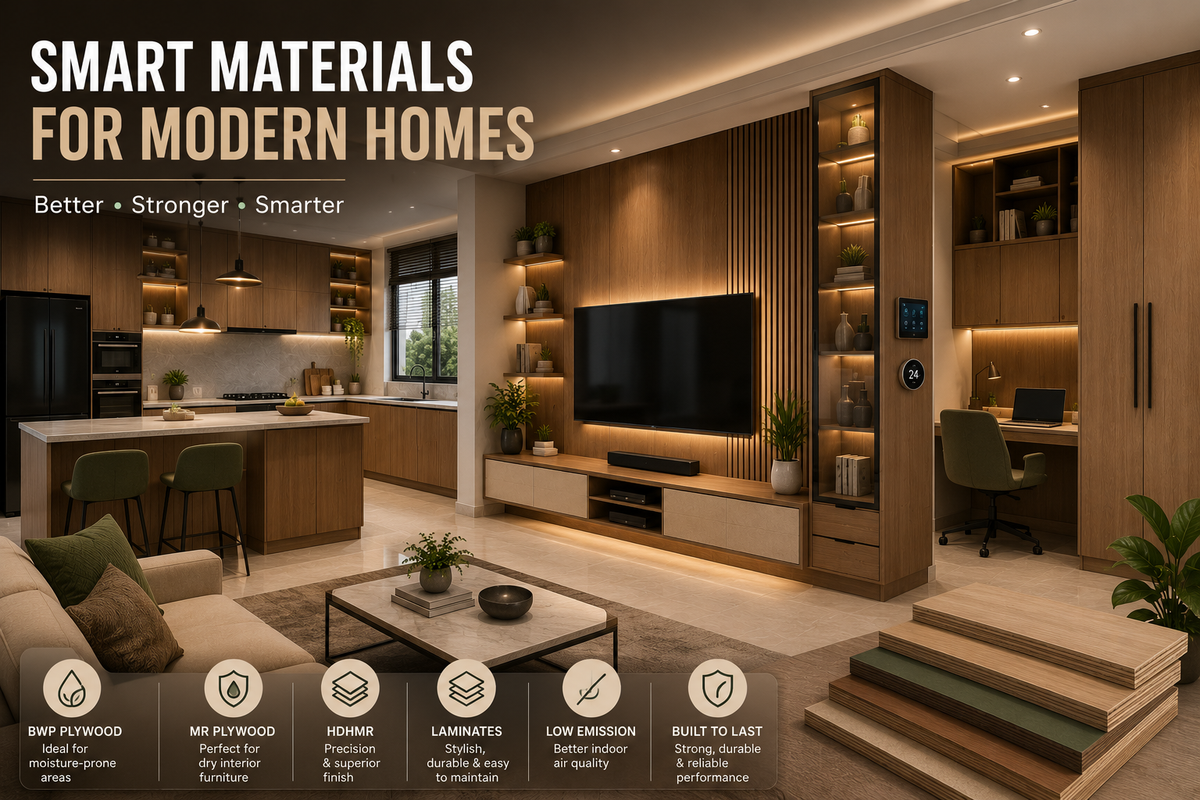
A truly smart home isn't defined only by voice-controlled lighting, automated curtains, connected appliances, or intelligent security systems.
It also depends on something far less visible: the materials from which the home is built.
Today's homeowners expect interiors to look beautiful while surviving moisture, heavy storage, everyday wear, changing lifestyles, and years of repeated use. That means material selection has become just as important as design.
For kitchens, wardrobes, TV units, bathrooms, home offices, and modular furniture, choosing the right engineered material for the right application can dramatically improve long-term performance.
So, what exactly makes a material "smart"?
In modern interiors, a smart material is one selected according to where it will be used, what conditions it will face, how it will perform, and how long it is expected to last.
1. Premium Plywood: The Foundation of Modern Furniture
Plywood remains one of the most versatile materials for contemporary interiors.
But all plywood isn't the same.
Quality plywood combines cross-laminated veneer construction with reliable bonding and consistent manufacturing to provide the structural performance required for modern furniture.
Depending on the grade and application, plywood can be used for:
-
Modular kitchens
-
Wardrobes
-
TV units
-
Beds
-
Study tables
-
Office furniture
-
Storage cabinets
-
Commercial interiors
The smart approach is not simply choosing "plywood." It is selecting the correct plywood grade for each application.
2. BWP Plywood for Moisture-Prone Areas
A kitchen cabinet and a bedroom wardrobe don't face the same environment, so they shouldn't automatically use the same material specification.
Areas exposed to higher moisture require greater protection.
BWP plywood is particularly suitable for applications such as
-
Modular kitchens
-
Sink cabinets
-
Utility storage
-
Bathroom vanities
-
Other moisture-prone furniture
For Indian buyers, checking the applicable BIS specification is also important. BIS's current plywood compendium covers IS 303:2024 for general-purpose plywood and IS 710:2024 for marine plywood, with requirements covering construction and performance characteristics.
Using the appropriate grade where moisture exposure It's far smarter to use the appropriate grade where moisture exposure is expected than to repair swollen or delaminated furniture later.
3. MR Plywood for Dry Interior Furniture
Not every piece of furniture needs the highest level of water resistance.
For normal dry interiors, high-quality MR plywood can provide an effective balance between performance and budget.
It is commonly suitable for:
-
Bedroom wardrobes
-
TV units
-
Study tables
-
Bookshelves
-
Dressing units
-
Living-room storage
-
Office furniture
This is where intelligent material specification can also control project costs: invest more where the environment demands it rather than overspecifying every piece of furniture.
4. HDHMR for Demanding Interior Applications
High-Density High Moisture Resistance (HDHMR) boards have become another useful engineered material for modern furniture manufacturing.
Their dense, uniform structure can make them suitable for applications requiring precise machining and detailed surface work, depending on the product specification and installation environment.
They are often considered for applications such as
-
CNC-routed shutters
-
Decorative furniture
-
Cabinet shutters
-
Wall features
-
Precision-cut interior components
The key is to select HDHMR because its properties suit the design—not simply because the material is fashionable.
5. Laminates: More Than Decoration
Laminates are often considered purely decorative, but in practical interiors they perform another important job: protecting the surface underneath.
A quality laminate can provide a durable, easy-to-maintain furniture surface while allowing enormous design flexibility.
Modern options include:
-
Woodgrain finishes
-
Fabric textures
-
Marble-inspired designs
-
Matte surfaces
-
High-gloss finishes
-
Solid colors
-
Textured finishes
This approach makes it possible to change the character of an interior without changing the structural material underneath.
6. Smarter Materials Consider Indoor Air Quality
Modern material selection increasingly includes factors that aren't immediately visible.
One is emissions.
The BIS 2024 specifications for plywood include formaldehyde-related requirements, reflecting the importance of considering emissions alongside conventional performance characteristics.
For homeowners, architects, and interior designers, this means material evaluation can go beyond color, price, and water resistance to include the broader indoor environment.
When comparing products, ask manufacturers or suppliers about relevant certifications and emission classifications rather than relying on vague claims such as "eco-friendly" or "non-toxic."
7. CNC-Compatible Materials Enable Better Design
Technology is also changing what we expect from interior materials.
CNC machines can be used to produce furniture parts, grooves, decorative patterns, and custom panels with a high degree of accuracy. But precision machinery works best when the material itself is uniform.
Quality engineered panels can support: Accurate cutting 2.4 Repeatable dimensions Detailed routing: more clean assembly Module production: production of custom furniture As manufacturing processes get smarter, the need for material consistency will become more critical.
8. A smart home requires smart storage. Modular layouts and space-saving furniture are now a part of modern Indian homes as urban living spaces become smaller. Latest 2026 design coverage also points out modular layouts and multi-functional furniture as key trends for modern Indian homes.
That means furniture materials must support increasingly demanding designs such as
-
Floor-to-ceiling wardrobes
-
Floating TV units
-
Concealed storage
-
Under-bed drawers
-
Integrated workstations
-
Tall kitchen units
-
Multifunctional furniture
These designs place significant demands on core strength, screw holding, hardware fixing, and dimensional stability.
9. Durability Is One of the Smartest Features
A material doesn't have to contain electronics to be intelligent.
Sometimes the smartest material is simply the one that doesn't need replacing prematurely.
Consider two cabinets. One uses inexpensive material and requires major repairs or replacement after several years. The other is properly specified with durable components and has a much longer reliable life.
The second cabinet potentially saves:
-
Raw materials
-
Labor
-
Transportation
-
Repair costs
-
Replacement costs
-
Construction waste
That's why durability should be considered part of sustainable material selection—not separate from it.
10. Match the Material to the Application
The smartest interior isn't necessarily the one using the most expensive materials everywhere.
It is the one using the right material in the right place.
Interior Application: Practical Material Approach Modular Kitchen: BWP plywood + durable laminate Sink Cabinet: BWP plywood + careful edge protection Bathroom Vanity Moisture-Appropriate Material: BWP plywood Bedroom Wardrobe Quality MR or BWP plywood TV Unit MR plywood for normal dry interiors Study Unit MR plywood CNC Decorative Shutters Suitable HDHMR/engineered board based on design, premium decorative furniture plywood + laminate or veneer Utility Storage BWP plywood where moisture exposure is expected
Final specifications should always consider span, loading, moisture exposure, hardware, installation conditions, and the manufacturer's technical data.
The Future of Interior Materials
The next generation of homes will increasingly combine smart technology with smart material specification.
We can expect greater attention to material efficiency, manufacturing consistency, lower emissions, digital fabrication, multifunctional furniture, and products designed for longer service lives.
But the basic principle will remain simple:
Technology can make a home smarter. Quality materials make that home last.
Conclusion
Modern homeowners have more material choices than ever before. The challenge isn't finding more options—it's understanding which option belongs where.
A smart material strategy considers moisture exposure, structural requirements, screw holding, surface finish, maintenance, indoor environment, and expected lifespan before looking at aesthetics alone.
If water exposure is a concern, use BWP plywood. Good MR plywood for dry furniture applications. Use engineered boards (e.g., HDHMR) if their special properties suit the design. Use suitable laminates and finishes to protect surfaces. Most importantly, choose materials for performance and not only for price.
Because the smartest home isn't simply connected.
It's built intelligently from the inside out.
Why Choose Plyneer?
At Plyneer Industries Pvt. Ltd., we help homeowners, architects, interior designers, carpenters, builders, and furniture manufacturers select materials according to the needs of each application.
From premium plywood and blockboards to MDF, HDHMR, laminates, veneers, WPC and other interior solutions, Plyneer brings multiple material categories together to help professionals create durable and modern interiors.
Whether you're designing a modular kitchen, wardrobe, TV unit, home office, or an entire residence, the goal should be simple: use the right material in the right place.
Smarter materials. Stronger interiors. Better homes. Choose Plyneer.
🌐 www.plyneer.com
📞 +91 8861717273


