

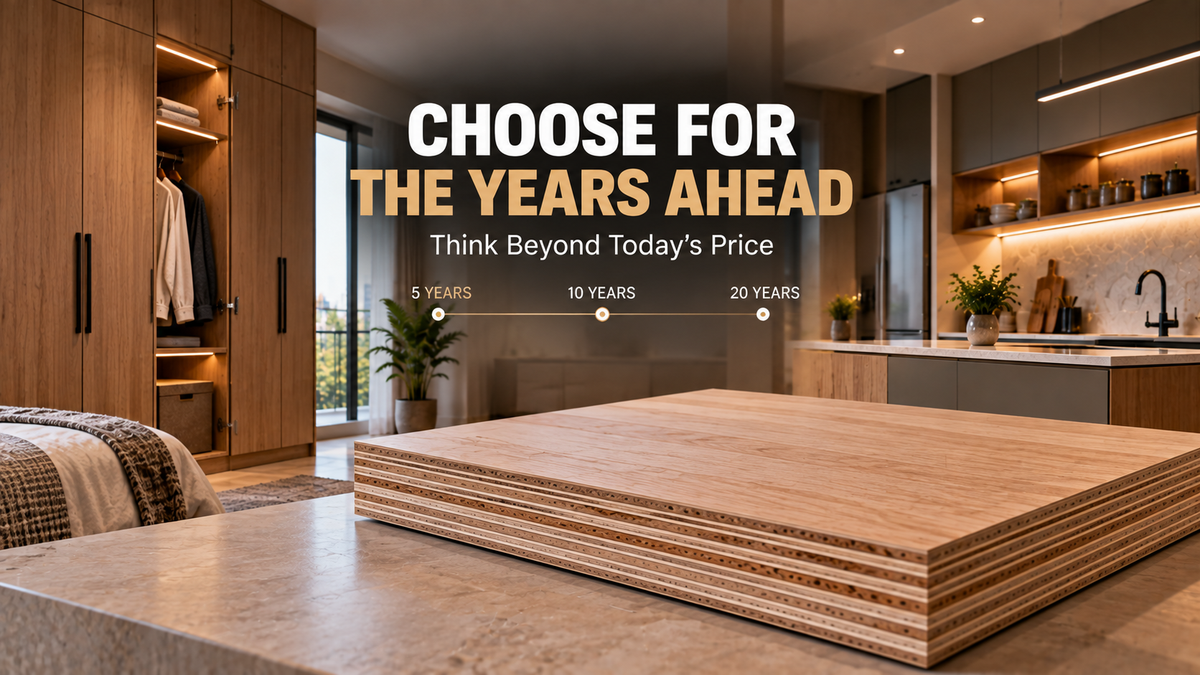
Choosing Plywood Based on Furniture Lifespan
When planning furniture, most people ask:
“Which plywood is cheapest?”
or
“Which plywood is best?”
A better question is:
“How long do I expect this furniture to remain in my home?”
A temporary storage cabinet has very different requirements from a modular kitchen or built-in wardrobe expected to remain for many years.
There is no plywood grade that automatically guarantees a particular lifespan. Furniture life depends on material quality, application, moisture exposure, design, hardware, workmanship and maintenance.
Here are 10 factors that can help you choose more intelligently.
1. Decide the Expected Furniture Lifespan
Start by considering whether the furniture is:
- Short-term or temporary
- Medium-term
- Long-term built-in furniture
The longer you expect to retain the furniture, the more important the underlying material becomes.
Replacing a movable table is relatively simple. Replacing a complete modular kitchen is not.
2. Consider How Often It Will Be Used
Frequency of use matters.
Kitchen shutters, wardrobe doors and drawers may be opened thousands of times over their service life.
For frequently used furniture, consider:
Core Quality + Screw Holding + Hardware + Thickness + Workmanship
A premium finish alone doesn't create durable furniture.
3. Match Plywood Grade to the Environment
One of the most important decisions is selecting the correct grade.
| Application | Material Direction |
|---|---|
| Bedroom Wardrobe | Quality MR Plywood |
| TV Unit | Quality MR Plywood |
| Study Table | Quality MR Plywood |
| Bookshelf | MR + appropriate thickness/support |
| Modular Kitchen | BWP Plywood |
| Under-Sink Cabinet | BWP / suitable wet-area material |
| Utility Storage | BWP where moisture exposure is expected |
| Bathroom Vanity | Suitable wet-area material |
MR plywood is suitable for appropriate dry interiors, while BWP plywood is a better direction where significant moisture or water exposure is expected.
4. Think About Future Moisture, Not Just Today's Conditions
Your kitchen may have no leakage today.
But what happens over the next 10 or 15 years?
Plumbing joints can develop leaks. Sinks can overflow. Utility areas experience wet cleaning. Humidity changes throughout the year.
For furniture intended to remain for a long time, consider its potential lifetime exposure to moisture.
5. Inspect the Core, Not Just the Face
The decorative surface disappears beneath laminate or veneer.
The plywood core remains responsible for supporting the furniture.
Look for:
✓ Consistent construction
✓ Proper bonding
✓ Minimal visible core gaps
✓ Uniform thickness
✓ Good surface quality
A beautiful laminate cannot correct an unsuitable foundation.
6. Consider Screw-Holding Requirements
Hinges, drawer channels and other fittings transfer repeated forces into the plywood.
Poor fastening performance can lead to:
Loose Hinges → Misaligned Shutters → Repeated Repairs → Damaged Fixing Points
This is especially important for kitchens, wardrobes and frequently operated furniture.
7. Select Thickness According to Design
Don't assume thicker always means better.
Thickness should be determined by:
Load + Span + Support + Application
For example, a long bookshelf carrying heavy books may require greater thickness or intermediate support than a small cabinet shelf.
Good furniture engineering matters as much as good plywood.
8. Protect Your Premium Finishes
Natural veneer, premium laminates, acrylic surfaces and expensive hardware can represent a substantial portion of furniture cost.
Putting expensive finishes over unsuitable plywood can create a false economy.
Think of furniture as a system:
Plywood → Hardware → Finish → Installation
The performance of each layer affects the others.
9. Consider Replacement Cost and Disruption
The real cost of furniture replacement isn't only the new plywood.
Replacing built-in furniture can involve:
- Dismantling
- Carpenter labour
- New plywood
- Laminates or veneers
- Hardware
- Electrical modifications
- Plumbing work
- Painting
- Cleaning
- Time and inconvenience
This is why material selection becomes increasingly important for permanent furniture.
10. Think in Cost Per Year
Suppose Furniture A costs ₹1.5 lakh and provides 8 years of useful service.
₹1,50,000 ÷ 8 = ₹18,750 per year
Furniture B costs ₹2 lakh and hypothetically provides 20 years of useful service.
₹2,00,000 ÷ 20 = ₹10,000 per year
This is only an illustration—not a plywood lifespan guarantee—but it demonstrates why purchase price and lifecycle value are different.
A higher initial investment can sometimes make financial sense when it reduces repair or replacement requirements.
A Simple Furniture Lifespan Framework
Before selecting plywood, ask:
1. Where will the furniture be installed?
2. How frequently will it be used?
3. Will it face moisture or water?
4. How much weight will it carry?
5. How long do I expect to retain it?
6. How difficult will replacement be?
7. What hardware will be installed?
8. What finish will cover the plywood?
These questions provide far more useful information than simply asking for the “best plywood.”
Conclusion
The right plywood isn't necessarily the most expensive option.
It is the material that correctly matches the application, environment, structural requirement and expected furniture lifespan.
For dry bedroom furniture, quality MR plywood may be perfectly appropriate. For kitchens and water-exposed applications, BWP plywood is generally a more suitable direction.
And for furniture intended to remain for many years, pay particular attention to core construction, screw holding, thickness, hardware and workmanship.
Don't Choose Plywood Only for Today's Budget. Choose It for the Years You Expect the Furniture to Perform.
At Plyneer Industries, we offer plywood solutions for different furniture applications—from dry-area wardrobes and living-room furniture to premium BWP plywood for demanding moisture-prone interiors.
🌐 www.plyneer.com
📞 +91 8861717273


