

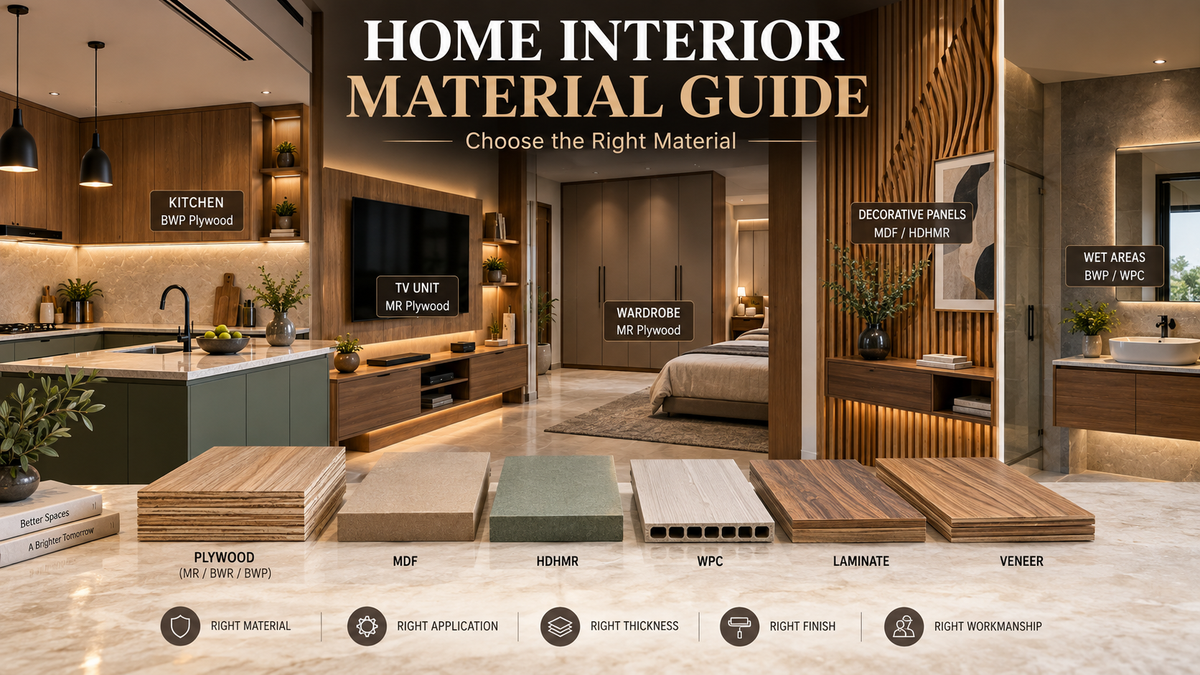
Complete Home Interior Material Buying Guide
Planning a new home interior can involve hundreds of decisions.
You choose the kitchen layout, wardrobes, TV unit, beds, bathroom vanities, study areas, colours, finishes, handles and lighting.
Then your carpenter or interior designer starts discussing materials:
MR. BWR. BWP. MDF. HDHMR. WPC. Blockboard. Veneer. Laminate.
Suddenly, something that looked simple becomes technical.
The biggest mistake is trying to identify one material that is "best" for the entire house.
There isn't one.
A kitchen sink cabinet faces completely different conditions from a bedroom wardrobe. A decorative wall panel has different requirements from a heavily loaded bookshelf.
The smarter approach is:
Right Material + Right Application + Right Thickness + Right Finish + Right Workmanship.
This guide will help you understand the major interior materials and make more informed buying decisions.
1. Start With the Application, Not the Brand
Before comparing brands or prices, identify where the material will actually be used.
Ask four questions:
Will it face water or moisture?
Will it carry significant weight?
Will screws and hardware be repeatedly used?
Is it structural or primarily decorative?
These questions immediately narrow down your options.
For example, a kitchen cabinet needs greater moisture protection than a bedroom TV unit.
Material selection should follow the application—not the other way around.
2. Plywood: The Workhorse of Home Furniture
Plywood is manufactured by bonding multiple wood veneers together, generally with adjacent layers arranged so their grain directions alternate.
This cross-layered construction helps make plywood highly useful for furniture and interior applications.
Quality plywood can offer:
- Good structural strength
- Strong screw holding
- Dimensional stability
- Good load-bearing capability
- Furniture fabrication flexibility
- Compatibility with laminates and veneers
But all plywood isn't the same.
The grade matters enormously.
3. MR Plywood: For Dry Interior Furniture
MR stands for Moisture Resistant.
The important word is resistant—not waterproof.
MR plywood is a practical choice for normal dry interiors such as:
- Bedroom wardrobes
- TV units
- Study tables
- Bookshelves
- Bedside tables
- Dressing units
- Office furniture
- Living-room storage
For these applications, using BWP everywhere may unnecessarily increase your budget.
Don't Use MR As Your Default for:
- Under-sink cabinets
- Regularly wet utility areas
- Moisture-prone bathroom furniture
- Other areas where significant water exposure is expected
Buying principle: Use MR intelligently in dry areas.
4. BWR Plywood: The Middle Ground
BWR stands for Boiling Water Resistant.
It offers a higher level of moisture resistance than plywood intended primarily for dry interiors.
Depending on the product specification and exposure, BWR can be considered for semi-moist applications where additional moisture resistance is desirable.
It can provide a useful middle position between general dry-interior plywood and BWP specifications.
Always confirm the exact product grade and technical specification rather than relying only on the letters printed on a sheet.
5. BWP Plywood: Prioritise It in Moisture-Prone Areas
BWP stands for Boiling Water Proof.
For home interiors, this is an important category for cabinetry that may experience greater moisture exposure.
Common applications include:
- Modular kitchens
- Under-sink cabinets
- Utility cabinets
- Bathroom vanities
- Laundry-area storage
- Other moisture-prone cabinetry
If you're trying to optimise your interior budget, this is one of the areas where spending more on the correct specification can make sense.
A leaking sink can cause far more expensive problems than the original difference in plywood price.
6. What About Fire-Retardant Plywood?
Fire safety is receiving greater attention in premium residential and commercial interiors.
Fire-retardant plywood is designed to meet specified fire-performance requirements.
In India, IS 5509 is associated with fire-retardant plywood.
Depending on project requirements, fire-retardant plywood may be considered for selected:
- Premium residential interiors
- Commercial interiors
- Offices
- Hospitality spaces
- Other projects with defined fire-performance requirements
An important distinction:
Fire-retardant does not mean fireproof.
It should form one part of a broader fire-safety strategy involving electrical safety, alarms, extinguishers, escape planning and appropriate building design.
7. MDF: Excellent When Used for the Right Purpose
MDF—Medium Density Fibreboard—is an engineered wood panel with a smooth, uniform surface.
Its consistency makes it particularly useful for:
- Decorative panels
- CNC-routed designs
- Wall panelling
- Painted furniture components
- Decorative shutters
- Selected dry-area furniture applications
MDF can provide an excellent finish because the surface is highly uniform.
But it shouldn't automatically replace plywood in every structural application.
Think of MDF as a different material with different strengths—not simply "cheap plywood."
8. HDHMR: A Denser Engineered Board Option
HDHMR stands for High Density High Moisture Resistance board.
It is commonly selected where designers want a dense, uniform engineered panel with better moisture resistance than conventional MDF.
Applications can include:
- Furniture shutters
- CNC designs
- Wall panels
- Cabinet components
- Decorative furniture
- Selected moisture-sensitive interior applications
HDHMR's smooth, consistent structure makes it particularly attractive for precision machining and decorative designs.
However, always evaluate the manufacturer's technical specification and suitability for the exact application.
9. WPC/PVC Boards: Useful for Wet-Area Applications
WPC and PVC-based boards are popular for applications where resistance to water is particularly important.
Potential uses include:
- Bathroom cabinetry
- Utility areas
- Sink-area applications
- Selected wet-zone furniture
- Other moisture-intensive locations
They shouldn't automatically replace plywood throughout the home.
Their mechanical characteristics, fastening behaviour, fabrication requirements and appearance differ from wood-based panels.
Again, the application should determine the material.
10. Blockboard: Useful for Long Furniture Components
Blockboard has a different internal construction from conventional plywood.
Its core typically consists of wooden strips positioned between veneer layers.
Blockboard can be useful for:
- Long shelves
- Doors
- Tables
- Partitions
- Selected wardrobe components
- Long furniture panels
Depending on the product and application, its construction can make it attractive where long dimensions and appropriate stiffness are desirable.
Check the grade, core quality and application before purchasing.
11. Flexible Plywood: When Your Design Has Curves
Modern interiors increasingly include:
- Curved reception counters
- Rounded furniture
- Arched wall features
- Curved partitions
- Cylindrical elements
- Sculptural cabinetry
Conventional plywood isn't designed to bend freely into tight curves.
That's where flexible plywood becomes useful.
It allows designers and carpenters to create curved forms that would otherwise require more complicated fabrication.
Flexible plywood is therefore less about replacing regular plywood and more about enabling a particular design language.
12. Laminates: The Everyday Surface Finish
Once you've selected the structural material, you need to choose what goes over it.
Laminates are among the most practical furniture finishes because they are available in enormous varieties of:
- Colours
- Woodgrains
- Stones
- Textures
- Matte finishes
- High-gloss finishes
- Fabric-inspired surfaces
They're commonly used on:
- Wardrobes
- Kitchens
- TV units
- Study tables
- Office furniture
- Storage cabinets
Don't select laminate only from a tiny sample.
Whenever possible, view a larger sample because woodgrains and patterns can look very different across a full shutter.
13. Natural Veneer: For Premium and Luxury Interiors
Natural veneer provides the appearance and character of real wood.
Because it is derived from natural timber, grain and colour variation are part of its appeal.
Veneer works beautifully for:
- Premium wardrobes
- Luxury TV units
- Wall panelling
- Executive offices
- Bars
- Libraries
- Headboards
- Bespoke furniture
A high-quality veneer over a suitable plywood substrate can create furniture that feels warm, sophisticated and distinctive.
But remember:
Premium veneer deserves a premium foundation.
Using an expensive surface over poor core material is a false economy.
14. Pre-Laminated Boards: Speed and Consistency
Pre-laminated MDF and HDHMR arrive with decorative surfaces already applied.
They can be useful when projects need:
- Faster fabrication
- Consistent factory finish
- Reduced finishing work
- Standardised cabinetry
- Efficient modular production
For suitable applications, they can reduce the number of fabrication stages required at site.
15. Don't Forget the Hardware
A ₹5 lakh wardrobe can still feel cheap if the hardware performs poorly.
Pay attention to:
- Hinges
- Drawer channels
- Sliding systems
- Handles
- Lift-up mechanisms
- Wardrobe accessories
- Shelf supports
- Fasteners
Hardware and substrate must also work together.
A premium hinge needs a material capable of holding its fasteners reliably.
Good furniture is a system—not a collection of expensive individual components.
16. Choosing the Correct Thickness
One of the most overlooked buying decisions is plywood thickness.
There is no single thickness suitable for every component.
As a broad furniture-planning reference:
| Thickness | Typical Direction |
|---|---|
| 6 mm | Back panels, lightweight applications |
| 8–12 mm | Selected partitions, panels and light applications |
| 16 mm | Common furniture construction |
| 18–19 mm | Heavy-duty furniture, shutters, shelves depending on design |
| 25 mm | Selected heavy-load or longer-span applications |
These are general guidelines—not structural engineering rules.
Actual thickness should depend on:
- Span
- Load
- Support
- Furniture design
- Material properties
- Hardware
- Application
A long bookshelf may require additional support even when thick plywood is used.
17. Core Quality Matters More Than Most Buyers Realise
When buying plywood, people naturally look at the face.
But furniture performance depends heavily on what is inside.
Look for:
- Uniform core construction
- Minimal gaps
- Consistent thickness
- Reliable bonding
- Good surface quality
- Appropriate density
- Good screw holding
Poor core construction can contribute to problems with hardware, machining and long-term furniture performance.
Once laminates are applied, you may never see that core again.
Check it before fabrication.
18. Understand ISI/BIS Certification
Don't buy plywood simply because you see an ISI-looking mark.
Understand what is behind it.
Depending on the product, you may encounter standards including:
IS 303 – plywood for general purposes
IS 710 – marine plywood
IS 5509 – fire-retardant plywood
Where BIS certification applies, check relevant markings and licence information.
For larger purchases, verification can provide additional confidence that the certification information corresponds with the manufacturer and product being offered.
Don't just look for the sticker. Understand the specification.
19. Room-by-Room Material Buying Guide
Here's a practical starting point for a typical home:
| Area | Recommended Material Direction |
|---|---|
| Modular Kitchen | BWP plywood |
| Under-Sink Cabinet | BWP plywood / suitable wet-area solution |
| Bedroom Wardrobe | Quality MR plywood |
| TV Unit | MR plywood |
| Study Table | MR plywood |
| Bookshelf | MR plywood + correct thickness/support |
| Bathroom Vanity | BWP or appropriate wet-area material |
| Utility Cabinet | BWP where moisture is expected |
| Decorative CNC Panel | MDF / HDHMR |
| Curved Furniture | Flexible plywood |
| Luxury Veneered Furniture | Premium plywood + natural veneer |
| Wet-Area Cabinetry | WPC/PVC or suitable moisture-resistant material |
| Long Furniture Components | Appropriate plywood/blockboard depending on design |
This table isn't a substitute for project-specific design, but it gives homeowners a much stronger starting point.
20. Where Should You Spend More?
If your interior budget is limited, don't distribute it equally.
Prioritise areas where failure would be expensive.
Spend More On:
Kitchen carcasses
Because moisture, hardware and daily usage are high.
Under-sink cabinets
Because leakage risk is greater.
Heavy wardrobes
Because hardware and long-term structural performance matter.
Large shelves
Because sagging becomes expensive to correct.
Premium furniture receiving veneer
Because replacing the underlying structure later can destroy an expensive finish.
Frequently used hardware
Because these components operate thousands of times.
This is smarter than buying the most expensive material for every decorative panel.
21. Where Can You Optimise the Budget?
Not every component needs premium BWP plywood.
For example, appropriate MR plywood can be practical for many dry-area:
- TV units
- Bedroom furniture
- Study tables
- Bookshelves
- Storage units
Likewise, MDF can be excellent for selected decorative elements where its smoothness and CNC capability provide an advantage.
Budget optimisation should mean intelligent specification—not simply buying cheaper material.
22. Calculate Lifecycle Cost, Not Just Purchase Price
Suppose one furniture material saves ₹20,000 during construction.
That sounds attractive.
But if the resulting furniture needs repeated repairs or premature replacement, the saving can disappear.
A better comparison considers:
Purchase + Installation + Maintenance + Repairs + Replacement
This is the lifecycle cost.
For major fixed furniture expected to remain in your home for many years, durability can provide significant long-term value.
23. Common Material-Buying Mistakes
Choosing Everything Based on Price
The cheapest sheet may not provide the lowest long-term cost.
Using BWP Everywhere
Often unnecessary and can increase the project budget without meaningful benefit in dry areas.
Using MR in Wet Areas
Saving money in a moisture-prone cabinet can create avoidable risk.
Spending More on Finish Than Structure
A ₹5,000 premium veneer cannot fix poor plywood underneath.
Ignoring Thickness
Correct material at the wrong thickness can still result in poor furniture design.
Assuming Heavier Always Means Better
Weight alone doesn't determine plywood quality.
Ignoring Hardware
Furniture is only as functional as its joints and moving components.
Ignoring Installation
Excellent materials can still perform poorly when incorrectly fabricated.
24. What to Check When Plywood Arrives at Site
Before your carpenter starts cutting, inspect the material.
Check:
✓ Brand and product name
✓ Grade
✓ Thickness
✓ Applicable certification/standard information
✓ Quantity
✓ Visible damage
✓ Sheet flatness
✓ Edge/core appearance
✓ Storage conditions
Take photographs of the sheets and markings.
Once furniture fabrication begins and laminates are applied, verification becomes much harder.
25. The Ultimate Interior Material Buying Checklist
Before finalising your interiors, make sure you can answer:
STRUCTURE
✓ Which plywood/board is being used?
✓ What grade is it?
✓ What thickness is specified?
✓ Is it suitable for the application?
MOISTURE
✓ Which material is used in the kitchen?
✓ What is used under the sink?
✓ What is used in bathrooms and utilities?
FINISH
✓ Laminate, veneer or paint?
✓ Is the substrate appropriate for that finish?
HARDWARE
✓ Which hinges and channels?
✓ Is the underlying material appropriate for fastening?
QUALITY
✓ What is the core construction like?
✓ Are thickness and surfaces consistent?
DOCUMENTATION
✓ What standard/certification applies?
✓ What warranty is provided?
✓ Are invoices and product details being retained?
INSTALLATION
✓ Are edges properly finished?
✓ Are long shelves adequately supported?
✓ Are wet areas detailed correctly?
If you know these answers, you're already making a far more informed interior purchase.
Conclusion: There Is No Single “Best Material”
The best material depends on where and how it will be used.
A successful home interior may combine:
BWP plywood in the kitchen.
MR plywood in wardrobes and TV units.
HDHMR or MDF for selected decorative applications.
WPC in appropriate wet areas.
Flexible plywood for curves.
Natural veneer for luxury furniture.
Laminates for practical everyday surfaces.
The goal isn't to choose the most expensive material.
It's to build a material system in which every component performs the job it was selected to do.
Because great interiors aren't created by one premium finish.
They're built layer by layer—from the inside out.
Why Choose Plyneer?
At Plyneer Industries Pvt. Ltd., we help homeowners, architects, interior designers, contractors, carpenters and furniture manufacturers choose materials according to the actual requirements of their projects.
Our interior material portfolio includes:
- Plywood
- Fire-retardant plywood
- Blockboards
- MDF
- HDHMR
- Pre-laminated boards
- WPC/PVC boards
- Flexible plywood
- Natural veneers
- Laminates
- Adhesives and other interior solutions
Whether you're building a modular kitchen, luxury wardrobe, TV unit, office, villa or complete home interior, start with one principle:
Don't just choose a material. Choose the right material for the job.
🌐 www.plyneer.com
📞 +91 8861717273


