

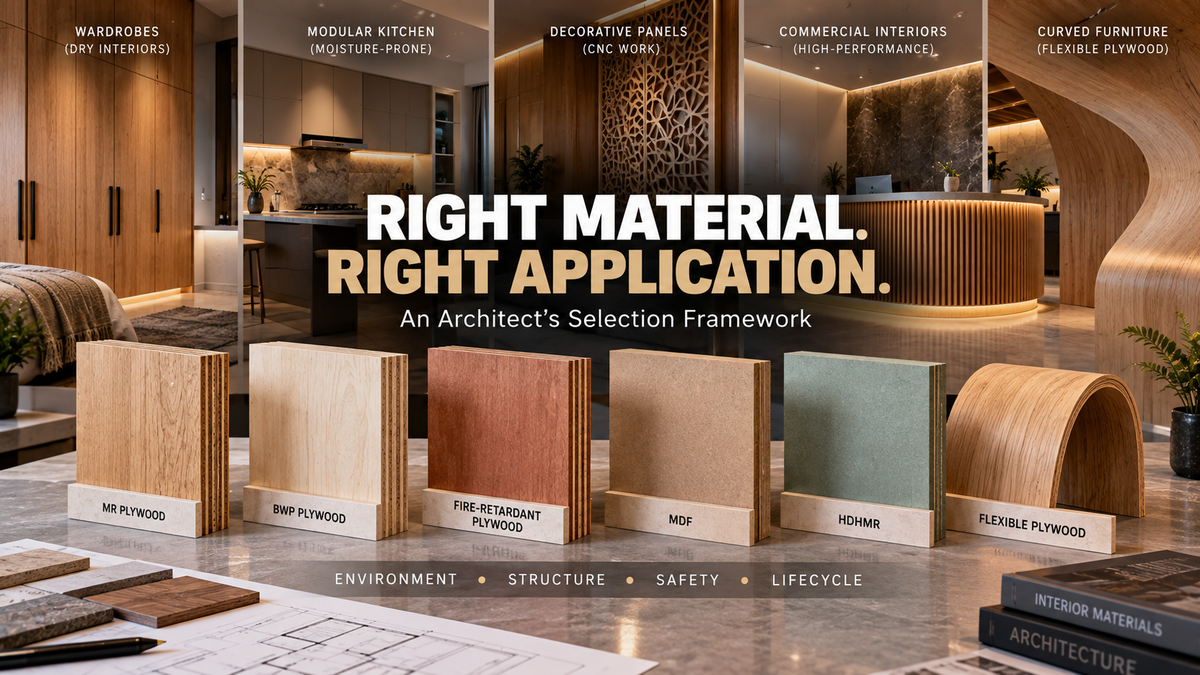
Material Selection Framework for Architects
Architecture is not only about how a space looks on handover day.
It is also about how that space performs five, ten or fifteen years later.
Behind every laminate, veneer and beautifully detailed cabinet is a substrate that influences stability, hardware performance, maintenance and durability.
Instead of asking, “Which is the best material?”, architects can use a more useful question:
“Which material is right for this specific application?”
Here is a practical 10-point material selection framework.
1. Define the Application First
Start with exactly where the material will be used.
A bedroom wardrobe, modular kitchen, bathroom vanity, reception counter and decorative wall panel have completely different performance requirements.
Create specifications application-by-application rather than using one material throughout the project.
2. Classify Moisture Exposure
Determine whether the application is:
Dry → Occasionally Humid → Moisture-Prone → Water-Exposed
For example:
| Application | Material Direction |
|---|---|
| Bedroom Wardrobe | MR Plywood |
| TV / Study Unit | MR Plywood |
| Modular Kitchen | BWP Plywood |
| Under-Sink Cabinet | BWP / suitable wet-area material |
| Utility Cabinet | BWP where moisture exposure is expected |
| Decorative CNC Work | MDF / HDHMR depending application |
| Curved Furniture | Flexible Plywood |
| High Water-Exposure Areas | WPC/PVC where appropriate |
This prevents both under-specification and unnecessary over-specification.
3. Determine Structural Requirements
Before deciding thickness, understand what the component must support.
Consider:
- Load
- Span
- Support
- Thickness
- Fixing method
- Frequency of use
A decorative wall panel and a long bookshelf carrying heavy books should not have the same structural specification.
Material + Thickness + Span + Support = Furniture Performance
4. Evaluate the Plywood Core
The plywood face may look perfect, but much of its long-term performance depends on what is inside.
Architects should evaluate:
✓ Core consistency
✓ Visible gaps
✓ Bonding quality
✓ Thickness consistency
✓ Surface flatness
✓ Overall construction quality
Once laminate or veneer is applied, these characteristics become difficult to inspect.
5. Consider Hardware Performance
Modern furniture increasingly uses sophisticated hardware—soft-close hinges, drawer channels, sliding systems, lift-up mechanisms and wardrobe accessories.
These components repeatedly transfer loads into the substrate.
The specification should therefore consider:
Plywood + Screw Holding + Hardware + Installation
Premium hardware deserves an appropriate substrate underneath it.
6. Select the Right Thickness
Thicker plywood is not automatically better.
For example, common interior applications may use different thicknesses:
6mm – backing and lightweight applications
9mm – light-duty panels and components
12mm – medium-duty supported components
16mm – furniture and cabinetry
18mm – robust furniture and demanding applications
These are general directions, not universal structural rules. Final thickness should depend on furniture engineering.
7. Evaluate Safety and Standards
For projects with specific performance requirements, architects should verify applicable product standards and documentation.
Depending on the product and application, this may include specifications such as:
IS 303 – general-purpose plywood categories
IS 710 – marine plywood
IS 5509 – fire-retardant plywood
For projects requiring enhanced fire performance, correctly specified fire-retardant plywood can form one part of the overall fire-safety strategy.
Fire-retardant does not mean fireproof.
8. Match the Substrate to the Finish
Material selection should ideally follow this sequence:
Application → Environment → Substrate → Performance → Finish
Not:
Finish → Everything Else
Premium veneer, laminate or acrylic placed over an unsuitable substrate can become an expensive mistake.
The hidden material should be specified with the same care as the visible finish.
9. Consider Maintenance and Replacement
Ask what happens if the furniture fails after five years.
Can it be repaired easily?
Or will replacement require dismantling cabinets, removing countertops, disturbing plumbing, replacing hardware and refinishing surrounding areas?
For permanent built-in furniture, replacement can be far more expensive than the original difference between two material specifications.
This is where lifecycle thinking becomes important.
10. Evaluate Lifecycle Value, Not Only ₹/Sq. Ft.
Material comparison should not stop at purchase price.
A better framework is:
Initial Cost + Maintenance + Repairs + Replacement + Disruption
The lowest-priced material may not always produce the lowest lifetime cost.
At the same time, specifying the most expensive plywood everywhere isn't necessarily intelligent either.
The goal is appropriate specification—not maximum specification.
A Simple Architect's Selection Matrix
Before approving a material, evaluate it against these questions:
Application — Where will it be used?
Environment — Dry, humid or water-exposed?
Load — What must it support?
Thickness — What does the design require?
Core — Is construction consistent?
Hardware — What fixing loads are expected?
Finish — Laminate, veneer, paint or another surface?
Safety — Are specific fire/performance requirements applicable?
Manufacturing — Will CNC or precision machining be involved?
Maintenance — How easily can it be repaired?
Lifespan — How long is the installation expected to remain?
Lifecycle Cost — What happens beyond the initial quotation?
Avoid the “One Plywood Everywhere” Approach
One of the simplest ways to improve project specifications is to stop treating plywood as a single material.
A bedroom wardrobe may need a dependable MR plywood.
A modular kitchen may justify BWP plywood.
A project with specific fire-performance requirements may require appropriately certified fire-retardant plywood.
A curved reception counter may need flexible plywood.
A decorative CNC element may be better suited to MDF or HDHMR depending on the environment and design.
Different applications deserve different materials.
That approach can improve performance while also controlling project cost.
Conclusion
Great architecture combines design intent with material intelligence.
Instead of choosing interior materials primarily by appearance, brand or price, architects can evaluate:
Application + Environment + Structure + Safety + Manufacturing + Maintenance + Lifecycle Value
The result is a more defensible specification—one designed not just for project completion, but for long-term performance.
Specify for the Application. Design for the Lifecycle.
At Plyneer Industries, we work with architects, interior designers, contractors and furniture manufacturers across plywood and interior material requirements, including MR, BWP and fire-retardant plywood, MDF, HDHMR, blockboards, WPC, laminates and veneers.
🌐 www.plyneer.com
📞 +91 8861717273


