

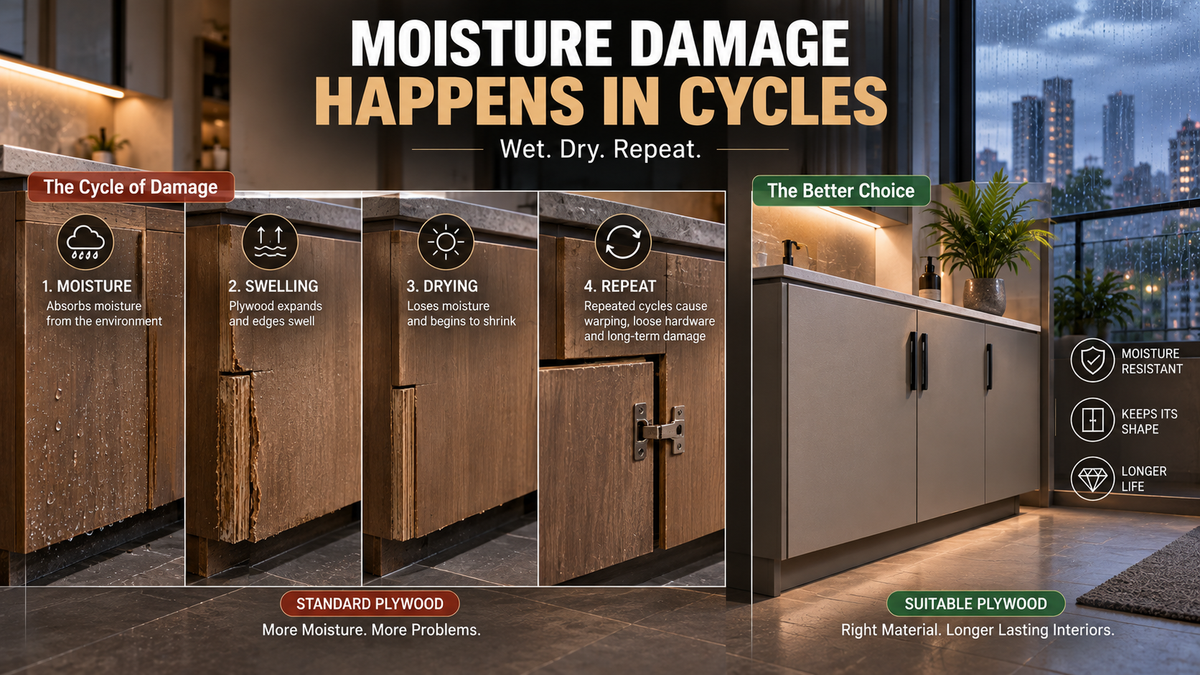
Furniture is often damaged by moisture gradually rather than suddenly.
A kitchen cabinet may become humid during the monsoon and dry again later. A bathroom vanity may experience repeated steam and drying. A wardrobe against a damp wall may absorb moisture during wet weather and lose some of it when conditions become dry.
This repeated process is called a moisture cycle.
Because plywood and other wood-based materials respond to environmental moisture, repeated wetting and drying can affect furniture over time.
Here are the key things homeowners should understand.
1. Wood-Based Materials Respond to Moisture
Wood naturally interacts with moisture in the surrounding environment.
As conditions become more humid, wood can absorb moisture. As conditions become drier, it can release moisture.
Well-manufactured plywood is engineered for greater dimensional stability than ordinary solid timber, but it is still a wood-based material.
Repeated moisture changes can therefore place stress on furniture components.
2. Repeated Expansion and Contraction Can Affect Furniture
Think of the cycle as:
Moisture ↑ → Material Responds → Environment Dries → Material Responds Again
When this happens repeatedly, small dimensional changes can affect the furniture system.
Over time, depending on exposure and construction, this may contribute to:
- Panel movement
- Joint stress
- Edge deterioration
- Shutter alignment issues
- Surface irregularities
The severity depends on the material, exposure, furniture design and workmanship.
3. Edges Are Particularly Important
Cut edges, drilled holes and plumbing cut-outs deserve special attention because they may be more exposed than finished surfaces.
This is particularly relevant around:
Kitchen sinks, bathroom vanities, utility cabinets and plumbing openings.
Good fabrication should include appropriate edge finishing and protection.
4. Hardware Can Also Be Affected
Moisture-related movement isn't only about the plywood sheet.
Furniture operates as a complete system.
If panels repeatedly move, hardware alignment can also be affected.
You may eventually notice:
- Loose hinges
- Misaligned shutters
- Drawers requiring adjustment
- Gaps changing around furniture
Good material selection, secure fastening and quality installation all matter.
5. Kitchens Face Frequent Moisture Cycles
Kitchens are one of the most demanding areas.
Cooking produces heat and vapour. Sinks create splash risk. Plumbing connections can leak, and cabinets may then dry again.
For this reason, BWP plywood is generally more appropriate for kitchens and other areas where greater moisture exposure is expected.
Using the correct plywood grade from the beginning can help reduce avoidable problems.
6. Bathrooms and Utility Areas Need Extra Attention
Bathroom vanities and utility cabinets can experience humidity, splashes and frequent wet cleaning.
Material selection should reflect the actual exposure.
Depending on the application, BWP plywood or another suitable wet-area material may be appropriate.
Remember:
Water-resistant performance doesn't mean furniture should remain continuously wet.
Plumbing, drainage and ventilation remain equally important.
7. Damp Walls Can Damage Wardrobes
Bedroom wardrobes are normally dry-area furniture, where quality MR plywood can be suitable.
But problems can arise when a wardrobe is installed directly against a wall experiencing seepage or persistent dampness.
Instead of simply upgrading the plywood, first identify and repair the source of moisture.
Don't hide a damp wall behind expensive furniture.
8. Poor Ventilation Can Make the Problem Worse
Not every moisture problem comes from a leak.
Closed kitchens, bathrooms, utility spaces and wardrobes can retain humidity when ventilation is poor.
Appropriate airflow and exhaust systems help moisture escape instead of remaining trapped around furniture.
This is especially important during humid and monsoon conditions.
9. Moisture Can Affect Decorative Finishes Too
The substrate isn't the only concern.
Depending on the materials and exposure, prolonged moisture problems may also affect:
- Laminates
- Veneers
- Edge bands
- Adhesives
- Paint finishes
- Hardware
This is why premium finishes should always be supported by the right substrate and proper installation.
10. Moisture Protection Requires More Than Waterproof Plywood
One of the biggest mistakes is assuming a single product solves every moisture problem.
Even high-quality BWP plywood cannot compensate for a continuously leaking pipe or unresolved wall seepage.
A better approach combines:
Correct Material + Waterproofing + Plumbing + Ventilation + Edge Protection + Good Installation
Every layer plays a role.
How to Protect Furniture from Moisture Cycles
Use this simple checklist:
✓ Use MR plywood for appropriate dry interiors
✓ Use BWP plywood in moisture-prone applications
✓ Repair wall seepage before installing furniture
✓ Protect exposed and cut edges appropriately
✓ Check plumbing connections regularly
✓ Provide ventilation in kitchens and bathrooms
✓ Don't allow standing water around cabinets
✓ Keep furniture away from persistently damp surfaces
✓ Use suitable hardware and proper installation
✓ Investigate moisture problems early
Conclusion
Furniture doesn't need to experience a major leak to be affected by moisture.
Repeated cycles of humidity, moisture absorption and drying can gradually influence wood-based furniture, finishes, joints and hardware.
The solution isn't simply buying the most expensive plywood.
It's choosing the right material for the right environment and combining it with good waterproofing, plumbing, ventilation and workmanship.
For dry interiors, quality MR plywood can be appropriate. For kitchens and other moisture-prone applications, BWP plywood offers a more suitable material direction.
Control the Moisture. Choose the Right Material. Protect Your Furniture for Longer.
At Plyneer Industries, we offer plywood and interior material solutions designed for different applications across modern homes.
🌐 www.plyneer.com
📞 +91 8861717273


