

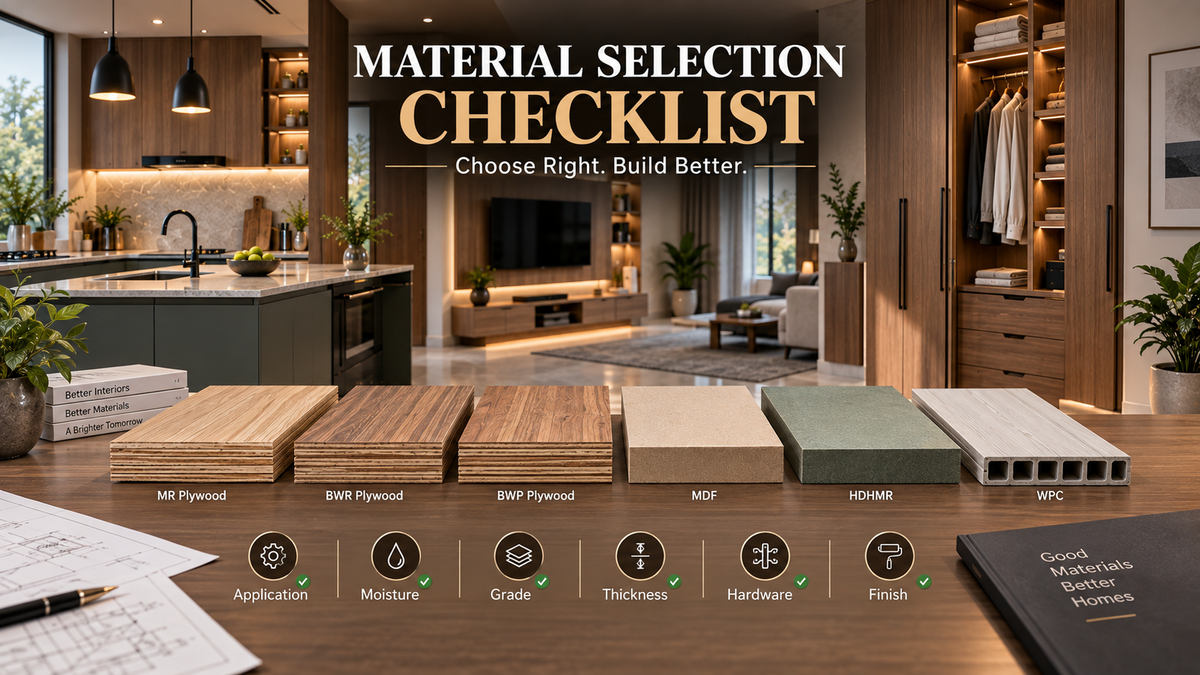
Interior Material Selection Checklist: A Smart Guide Before Starting Your Interiors
When planning home interiors, homeowners often spend more time selecting colours, laminates and finishes than choosing the material underneath them.
But the internal material is what supports your kitchen, wardrobes, TV units and storage for years.
Before approving your interior quotation, use this checklist to make smarter material decisions.
1. Identify the Application First
Never choose one material for the entire home simply because it is convenient.
Start by asking:
Where will this material be used?
A bedroom wardrobe and an under-sink kitchen cabinet experience completely different conditions.
A practical starting point is:
| Application | Material Direction |
|---|---|
| Bedroom Wardrobe | MR Plywood |
| TV Unit | MR Plywood |
| Study Table | MR Plywood |
| Modular Kitchen | BWP Plywood |
| Under-Sink Cabinet | BWP / suitable wet-area material |
| Utility Cabinet | BWP where moisture exposure is expected |
| Bathroom Vanity | BWP / suitable wet-area material |
| Decorative CNC Panels | MDF / HDHMR depending application |
| Wet-Area Furniture | WPC/PVC where appropriate |
| Curved Furniture | Flexible Plywood |
The objective is simple: match the material to the application.
2. Check Moisture Exposure
Ask whether the furniture will be exposed to:
- Humidity
- Damp walls
- Plumbing
- Water splashes
- Sink areas
- Frequent wet cleaning
For normal dry interiors, quality MR plywood can be suitable.
For kitchens and other moisture-prone applications, BWP plywood should be considered.
Don't pay for a higher specification where it isn't necessary—but don't save money in areas where moisture exposure is predictable.
3. Check the Plywood Grade
Don't simply ask:
“Is this good plywood?”
Ask:
“Which grade is being supplied?”
MR, BWR and BWP plywood have different intended performance levels.
Where fire performance is specifically required, appropriately certified fire-retardant plywood may also form part of the material specification.
4. Look Beyond the Surface
Two plywood sheets may look similar from the outside but differ significantly internally.
Consider:
✓ Core construction
✓ Core gaps and uniformity
✓ Bonding
✓ Surface quality
✓ Thickness consistency
✓ Manufacturing quality
Once laminate is applied, the plywood disappears—but its performance continues to matter.
5. Consider Screw-Holding Performance
Wardrobe hinges, kitchen shutters, drawer channels and accessories all depend on screws holding securely in the substrate.
This becomes particularly important for furniture that is opened and closed thousands of times.
Good screw holding can help reduce loose hinges and repeated hardware repairs over the life of the furniture.
6. Select the Correct Thickness
Don't automatically use the same thickness everywhere.
Thickness should depend on:
Load + Span + Application + Support + Furniture Design
A long bookshelf carrying heavy books has different structural requirements from a decorative panel.
Your architect, interior designer or furniture manufacturer should specify thickness according to the actual application.
7. Choose MDF and HDHMR Carefully
Plywood isn't necessarily the best material for every component.
MDF can provide a smooth, consistent surface for decorative applications, CNC work and certain furniture components.
HDHMR offers higher density and improved moisture resistance compared with conventional MDF and can be useful for suitable furniture applications.
Material selection should depend on performance requirements rather than simply choosing whichever board costs less.
8. Select Finishes After Selecting the Substrate
Laminate, veneer, acrylic and paint create the visible appearance.
But first decide what's underneath.
A premium veneer applied over an unsuitable substrate doesn't automatically create premium furniture.
Think:
Structure → Performance → Finish
rather than:
Finish → Everything Else
9. Don't Ignore Hardware
Your interior material checklist should also include:
- Hinges
- Drawer channels
- Sliding systems
- Handles
- Connectors
- Kitchen accessories
Premium hardware performs best when properly installed into a suitable substrate.
Plywood, hardware, furniture design and workmanship should be considered as one complete system.
10. Check Certification and Documentation
Where an applicable Indian Standard or certification has been specified, don't look only for a logo or sticker.
Check the relevant product information and retain:
✓ Invoice
✓ Product name
✓ Grade
✓ Thickness
✓ Manufacturer details
✓ Applicable certification information
✓ Warranty details
Documentation can be extremely useful if questions arise after installation.
Interior Material Checklist Before You Buy
Before approving your final material order, ask:
✓ Where will the material be used?
✓ Is the area dry or moisture-prone?
✓ Is MR, BWR or BWP appropriate?
✓ Is enhanced fire performance required?
✓ What thickness does the application need?
✓ How much weight will the furniture carry?
✓ Is the core construction consistent?
✓ Will it hold hardware securely?
✓ Is MDF, HDHMR or WPC better for this component?
✓ Which laminate or veneer will be applied?
✓ What certification/specification applies?
✓ What warranty is offered?
✓ Have product details been mentioned in the quotation?
✓ Have invoices and documentation been retained?
Conclusion
There is no single “best interior material” for every part of a home.
The best choice is the material that matches the application, moisture exposure, structural requirement, finish and expected service life.
Spend more where performance matters. Optimise where conditions are less demanding. Most importantly, decide what goes inside the furniture before choosing what goes outside it.
Choose by Application. Build for Performance. Design for the Long Term.
At Plyneer Industries, we offer plywood, MDF, HDHMR, WPC, blockboards, laminates, veneers and other interior materials for homeowners, architects, interior designers and furniture manufacturers.
🌐 www.plyneer.com
📞 +91 8861717273


