

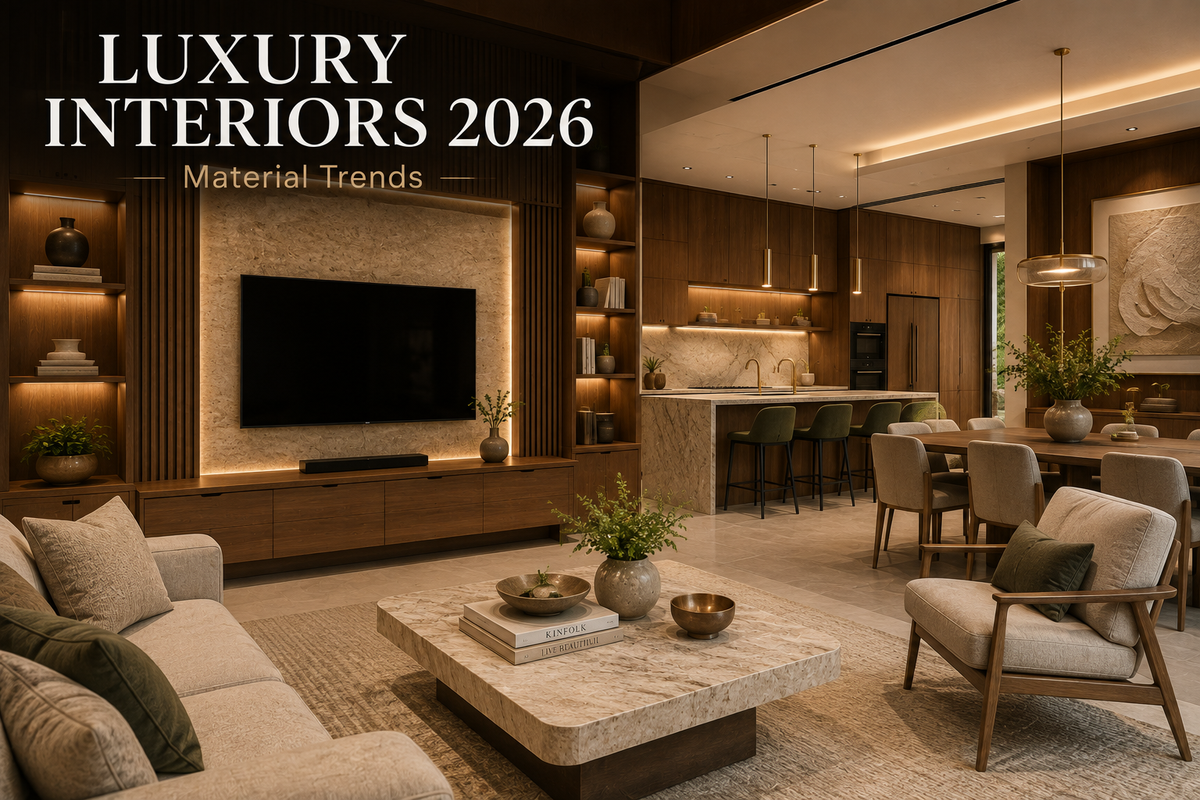
Luxury Interior Material Trends for 2026: What Defines a Truly Premium Home
Luxury interiors are changing.
For years, a "luxury home" often meant glossy surfaces, dramatic marble, oversized chandeliers, metallic accents, and highly decorative furniture. In 2026, the definition is becoming considerably more sophisticated.
Current Indian design coverage points toward warm minimalism, natural materials, tactile surfaces, sustainability, craftsmanship, and quieter expressions of luxury. Rather than filling a home with expensive-looking finishes, designers are concentrating on material authenticity and how beautifully those materials age.
The result is a new kind of luxury:
Less show. Better materials. Better detailing. Longer life.
For architects, interior designers, furniture manufacturers, and homeowners planning premium interiors, here are the material trends shaping luxury homes in 2026.
1. Natural Wood Tones Are Taking Center Stage
One of the strongest shifts in luxury interiors is the return of visible wood.
Walnut, oak, teak-inspired tones, smoked woods, and warm natural grains are replacing some of the cold grey and ultra-gloss finishes that dominated previous years.
Natural timber and wood textures add warmth and visual depth while working beautifully with stone, linen, metal, and neutral palettes. Current Indian 2026 design forecasts consistently identify timber and other natural materials as central to premium interiors.
Expect wood looks across:
- Wardrobes
- TV units
- Wall panelling
- Kitchens
- Home offices
- Bar units
- Bedroom furniture
- Bespoke cabinetry
For furniture construction, premium plywood combined with natural veneer or quality woodgrain laminates allows designers to achieve this aesthetic while maintaining structural performance.
2. Natural Veneers Are Becoming a Luxury Statement
When every surface is perfectly uniform, interiors can sometimes feel manufactured.
Natural veneer introduces something different: individual character.
No two pieces of natural wood veneer are exactly identical. Grain variations and subtle tonal differences give furniture visual richness.
In 2026 luxury interiors, veneer works particularly well for:
- Full-height wardrobes
- Entertainment walls
- Home offices
- Headboards
- Luxury kitchens
- Bars
- Libraries
- Bespoke furniture
Instead of using elaborate decoration, designers can allow the material itself to become the feature.
3. Quiet Luxury Is Replacing Loud Luxury
One of the defining ideas of 2026 is quiet luxury.
Rather than announcing expense through excessive ornamentation, quiet-luxury interiors communicate quality through material, proportion, detailing, craftsmanship, and restraint. Contemporary Indian interpretations use materials such as travertine, oak, linen, lime plaster, and brushed brass within tightly controlled palettes.
Imagine:
Smoked wood + travertine + linen + warm lighting + brushed brass.
There may be very little decoration, yet the room feels unmistakably premium.
This places greater importance on material quality because there are fewer decorative elements available to hide imperfections.
4. Stone Is Moving Beyond Flooring and Countertops
Marble remains important in luxury interiors, but stone is being used more creatively.
Natural stone, travertine, limestone, quartz, engineered stone, and stone-inspired surfaces are appearing on:
- TV walls
- Bar counters
- Side tables
- Kitchen islands
- Vanity units
- Feature walls
- Furniture accents
Current 2026 design coverage points to stone and stoneware as important ways of adding tactile richness and luxury to interiors.
One particularly elegant approach is combining stone with wood.
The contrast between a cool stone surface and warm timber creates a sophisticated material palette without requiring excessive decoration.
5. Texture Is Becoming More Important Than Shine
Luxury is becoming increasingly tactile.
Instead of asking only, "What colour is it?", designers are thinking:
"How does this surface feel?"
Expect more:
- Fluted panels
- Ribbed cabinetry
- Fabric-inspired laminates
- Brushed surfaces
- Natural wood grains
- Matte finishes
- Textured plaster
- Stone textures
Fluted and ribbed panels remain especially visible in premium Indian projects, although careful detailing is important to keep them timeless rather than overused.
A sophisticated luxury interior may use a very restrained colour palette while creating visual interest entirely through different textures.
6. Premium Plywood Is Becoming Part of the Luxury Conversation
One of the most important luxury materials is also one of the least visible.
The structural board beneath the finish.
A wardrobe may have a beautiful natural veneer outside, but if the plywood beneath it has poor core construction or inadequate screw holding, the furniture may not perform like a premium product.
Luxury furniture demands:
- Strong core construction
- Excellent screw holding
- Dimensional stability
- Appropriate moisture resistance
- Consistent thickness
- Precision machining
- Reliable bonding
This is particularly important for large shutters, floating TV units, long shelves, premium kitchens, and bespoke furniture.
In other words:
Luxury shouldn't stop at the surface.
7. Brushed Metals Are Replacing Excessive Shine
Metallic detailing remains important, but the finish is becoming more refined.
Instead of highly reflective chrome everywhere, designers are using accents such as:
- Brushed brass
- Champagne gold
- Antique brass
- Bronze
- Matte black
- Brushed stainless steel
These work beautifully for handles, profiles, lighting, shelving details, partitions, and furniture accents. Contemporary material guides similarly point toward brushed and softer metallic finishes as a way to introduce understated luxury.
The key word is accent.
Metal should complement the material palette rather than dominate it.
8. Sustainable Materials Are Becoming Premium Materials
Sustainability and luxury are increasingly converging.
2026 Indian interior forecasts highlight responsibly sourced wood, bamboo, reclaimed timber, recycled materials, low-VOC finishes, and other environmentally conscious choices.
But sustainability should also be considered through longevity.
Furniture that performs for decades can reduce the frequency of:
- Replacement
- Manufacturing
- Transportation
- Installation
- Material disposal
For premium interiors, durability itself should therefore be part of the sustainability strategy.
9. Biophilic Materials Are Moving Indoors
Biophilic design isn't simply about putting plants in every corner.
It is about establishing a stronger connection with nature through materials, daylight, ventilation, views, textures, and greenery.
Natural wood, stone, cane, linen, clay, and organic textures are all becoming part of this language. Current 2026 coverage shows biophilic design evolving into a broader sensory connection with natural environments, while living walls are also appearing as a luxury feature in urban homes.
This trend works particularly well with Bangalore's preference for homes connected to balconies, gardens, natural light, and greenery.
10. Curves Are Influencing Material Selection
Curves are no longer limited to sofas and coffee tables.
In 2026, curved forms are moving into architectural and furniture detailing, including rounded shelving, curved islands, softer wall transitions, and sculptural cabinetry. Current Indian trend forecasts specifically highlight architectural curves using materials such as microcement, lime plaster, and engineered stone.
For furniture manufacturers, this creates growing interest in materials capable of supporting curved applications and precision fabrication.
Flexible plywood and appropriately engineered substrates can help create:
- Curved counters
- Rounded furniture
- Arched panels
- Curved partitions
- Sculptural cabinetry
This allows furniture to become part of the architecture rather than simply being placed inside it.
11. Material Layering Is Creating Richer Interiors
One of the most sophisticated 2026 approaches is material layering.
Instead of making an entire room from one finish, designers are combining complementary materials.
For example:
Natural veneer + stone + brushed brass + linen
or
Warm laminate + fluted panel + matte metal + textured fabric
The objective isn't to use more materials.
It's to use fewer materials more intelligently.
This creates visual depth while keeping the overall interior calm.
12. Indian Craftsmanship Is Returning to Luxury Homes
Premium Indian interiors are becoming more personal and less dependent on copying international hotel aesthetics.
Handcrafted furniture, regional textiles, cane, carved timber, handloom fabrics, artisanal metalwork, and locally sourced stone can introduce cultural character into otherwise contemporary homes. Current luxury design guidance increasingly emphasizes Indian materials and craftsmanship as valuable sources of authentic premium design.
The result can be a home that feels globally sophisticated without losing its Indian identity.
The 2026 Luxury Material Palette
| Interior Element | Trending Material Direction |
|---|---|
| Wardrobes | Premium plywood + natural veneer / textured laminate |
| Modular Kitchen | BWP plywood + matte or natural finish |
| TV Wall | Wood + stone + fluted detailing |
| Luxury Furniture | Premium plywood + veneer |
| Feature Walls | Stone, veneer, fluted panels, textured finishes |
| Bathroom Vanity | Moisture-appropriate substrate + stone |
| Curved Furniture | Flexible plywood / suitable engineered substrate |
| Hardware | Brushed brass, bronze, champagne & matte finishes |
| Soft Furnishing | Linen, natural fabrics & textured textiles |
| Decorative Elements | Stone, timber, cane & handcrafted materials |
What Is Going Out of Style?
Luxury interiors are gradually moving away from:
- Excessive high-gloss surfaces
- Too much gold
- Completely grey interiors
- Identical laminate throughout the home
- Overdecorated feature walls
- Furniture designed only for appearance
- Copy-paste "hotel luxury"
- Excessive artificial-looking finishes
In their place, 2026 interiors favour warmth, authenticity, texture, craftsmanship, restraint, and individuality.
How to Make a Home Look Luxurious Without Overdesigning It
The secret is not adding more.
Start with a restrained palette—perhaps three or four major materials—and repeat them thoughtfully throughout the home.
For example:
Warm walnut + travertine + ivory fabric + brushed brass
could influence the TV wall, dining area, wardrobes, bedroom furniture, and kitchen details.
Repeating materials creates visual continuity and makes the entire home feel intentionally designed.
Don't Forget What's Underneath
When planning a luxury home, it's easy to spend heavily on what is visible.
₹3 lakh stone.
Premium veneer.
Designer lighting.
Imported hardware.
Custom furniture.
But those materials ultimately depend on the structure supporting them.
A premium finish applied over unsuitable plywood doesn't create premium furniture.
That's why architects and homeowners should evaluate:
- Plywood grade
- Core construction
- Screw-holding performance
- Thickness
- Moisture exposure
- Shelf spans
- Hardware
- Installation quality
The hidden material should be specified as carefully as the visible one.
Conclusion
Luxury interior design in 2026 is becoming more mature.
The emphasis is shifting from displaying expense toward demonstrating quality.
Natural wood, veneer, stone, textured surfaces, brushed metals, biophilic materials, sustainable choices, handcrafted details, and warm minimalism are defining premium spaces.
But the most important luxury material may still be the one you don't see.
Premium plywood provides the structural foundation behind wardrobes, kitchens, entertainment walls, home offices, and bespoke furniture.
Because true luxury isn't simply how beautiful your home looks when it is completed.
It's how beautifully it continues to perform years later.
Why Choose Plyneer?
At Plyneer Industries Pvt. Ltd., we believe premium interiors should be built from the inside out.
From premium plywood for kitchens, wardrobes, TV units, and bespoke furniture to laminates, veneers, MDF, HDHMR, blockboards, WPC, and other interior solutions, Plyneer helps architects, interior designers, furniture manufacturers, carpenters, and homeowners choose materials according to the needs of each application.
Whether you're creating a luxury villa, premium apartment, contemporary office, or high-end commercial space, the principle remains the same:
Premium finishes deserve a premium foundation.
Luxury outside. Strength inside. Choose Plyneer.
🌐 www.plyneer.com
📞 +91 8861717273


