

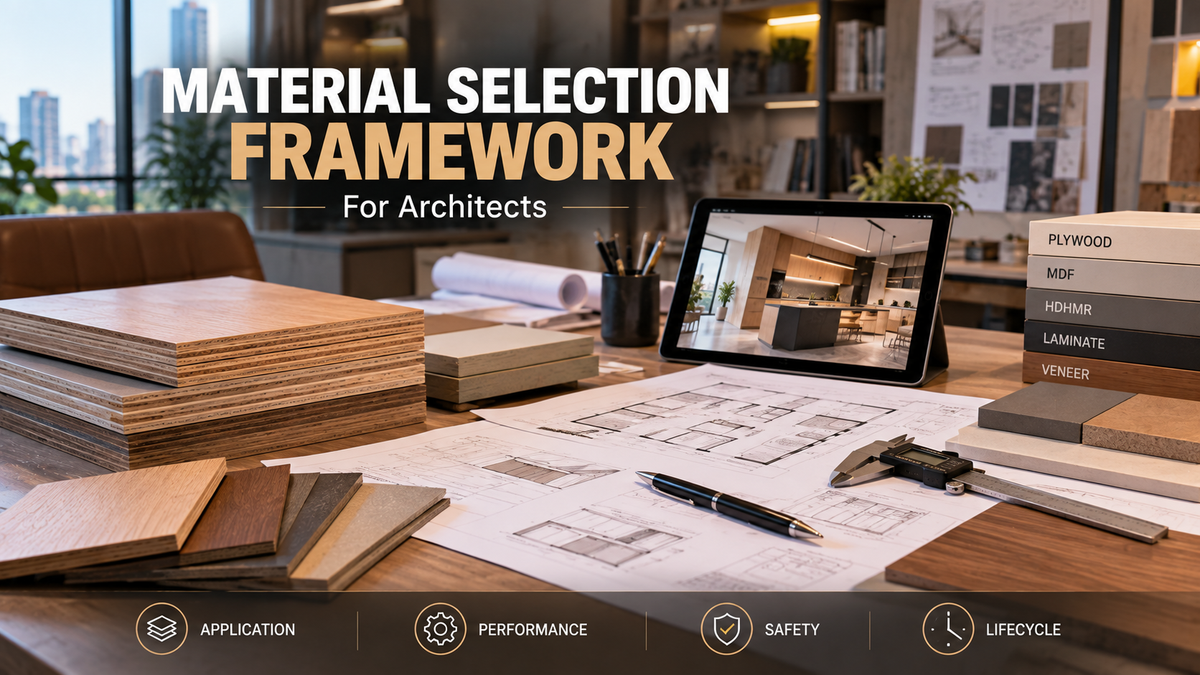
Material Selection Framework for Architects
Architects make hundreds of material decisions within a single project. While finishes determine how an interior looks, the materials underneath influence performance, durability and maintenance.
The challenge is that there is rarely one material that is best for every application.
A better approach is to use a structured framework.
Here are 10 factors architects can evaluate before specifying plywood and other interior materials.
1. Start With the Application
Material selection should begin with one question:
Where will this material be used?
A bedroom wardrobe, kitchen cabinet, bathroom vanity and decorative wall panel operate under very different conditions.
Instead of creating one universal specification, divide the project into applications and specify accordingly.
2. Evaluate Moisture Exposure
Classify each application according to its expected moisture exposure.
For example:
| Application | Typical Material Direction |
|---|---|
| Bedroom Wardrobe | MR Plywood |
| TV / Study Unit | MR Plywood |
| Modular Kitchen | BWP Plywood |
| Under-Sink Cabinet | BWP / suitable wet-area material |
| Utility Cabinet | BWP where water exposure is expected |
| Bathroom Vanity | Suitable moisture-resistant solution |
| Decorative CNC Panel | MDF / HDHMR depending application |
| Curved Furniture | Flexible Plywood |
This helps prevent both under-specification and unnecessary over-specification.
3. Define Structural Requirements
Ask what the material actually needs to do.
Consider:
- Expected load
- Unsupported span
- Thickness
- Fixing method
- Hardware
- Frequency of use
A bookshelf carrying heavy books requires a different specification from a decorative panel.
Material quality cannot compensate for poor structural design.
4. Examine Core Construction
For plywood, the internal construction deserves as much attention as the face.
Evaluate characteristics such as:
✓ Core consistency
✓ Bonding quality
✓ Visible gaps
✓ Thickness consistency
✓ Surface quality
Once laminate or veneer is applied, the core disappears—but it remains the structural foundation of the furniture.
5. Consider Hardware and Screw Holding
Modern interiors increasingly depend on sophisticated hardware.
Soft-close hinges, drawer systems, sliding mechanisms and wardrobe accessories transfer repeated loads into the substrate.
For high-use furniture, architects should therefore consider the relationship between:
Substrate + Fastener + Hardware + Load
Good hardware deserves a dependable material underneath it.
6. Evaluate Safety and Compliance
Material specifications should consider applicable project requirements and standards.
Where relevant, architects should verify:
- Product grade
- Applicable IS/BIS standard
- Certification claims
- Fire-performance requirements
- Manufacturer documentation
- Warranty conditions
For projects requiring enhanced fire performance, appropriately specified fire-retardant plywood may form one part of the overall fire-safety strategy.
Fire-retardant should not be confused with fireproof.
7. Consider Manufacturing Compatibility
Furniture production is becoming increasingly precise.
CNC cutting, drilling and edge banding benefit from materials with dependable dimensional and thickness consistency.
When furniture will be manufactured using automated processes, consider:
- Thickness consistency
- Surface flatness
- Machining behaviour
- Edge quality
- Repeatability
Material consistency can help reduce adjustments and rework during production.
8. Evaluate the Finish and Substrate Together
Don't specify veneer, laminate or acrylic independently from the substrate.
A premium finish requires an appropriate foundation.
For example, expensive natural veneer applied over an unsuitable or unstable substrate can undermine the overall investment.
A useful specification sequence is:
Application → Substrate → Performance → Finish
rather than selecting the visible finish first.
9. Consider Maintenance and Replacement
Initial material price is only one part of project economics.
Architects should also consider:
- Repair frequency
- Hardware maintenance
- Moisture-related risk
- Ease of replacement
- Furniture accessibility
- Expected service life
This is particularly important for built-in kitchens, wardrobes and commercial furniture that can be expensive and disruptive to replace.
10. Evaluate Lifecycle Value
The lowest-cost material isn't automatically the most economical solution.
For long-term projects, evaluate:
Initial Cost + Maintenance + Repair + Replacement + Service Life
Premium material may cost more initially but can offer better lifecycle value when correctly specified for demanding applications.
Likewise, there is little value in unnecessarily specifying premium wet-area material for every dry decorative component.
Smart specification means investing where performance justifies it.
Architect's Material Selection Checklist
Before approving an interior material, confirm:
✓ What is the application?
✓ Is the environment dry or moisture-prone?
✓ What loads will the component carry?
✓ What thickness and support are required?
✓ Which hardware will be installed?
✓ How frequently will the furniture be used?
✓ What finish will be applied?
✓ Are there relevant fire or safety requirements?
✓ What standards or certifications apply?
✓ Is the material suitable for CNC/manufacturing requirements?
✓ How difficult will future maintenance be?
✓ What is the expected service life?
Conclusion
Good material specification isn't about selecting the most expensive product.
It is about selecting the right material for the right application.
Architects can make stronger decisions by evaluating:
Environment + Performance + Structure + Safety + Manufacturing + Maintenance + Lifecycle Value
This creates interiors that don't simply photograph beautifully at handover—they are designed to continue performing years later.
Specify for Performance. Design for the Long Term.
At Plyneer Industries, we work with architects, interior designers and furniture manufacturers across plywood and interior material requirements, from MR and BWP plywood to fire-retardant plywood, MDF, HDHMR, blockboards, WPC, laminates and veneers.
🌐 www.plyneer.com
📞 +91 8861717273


