

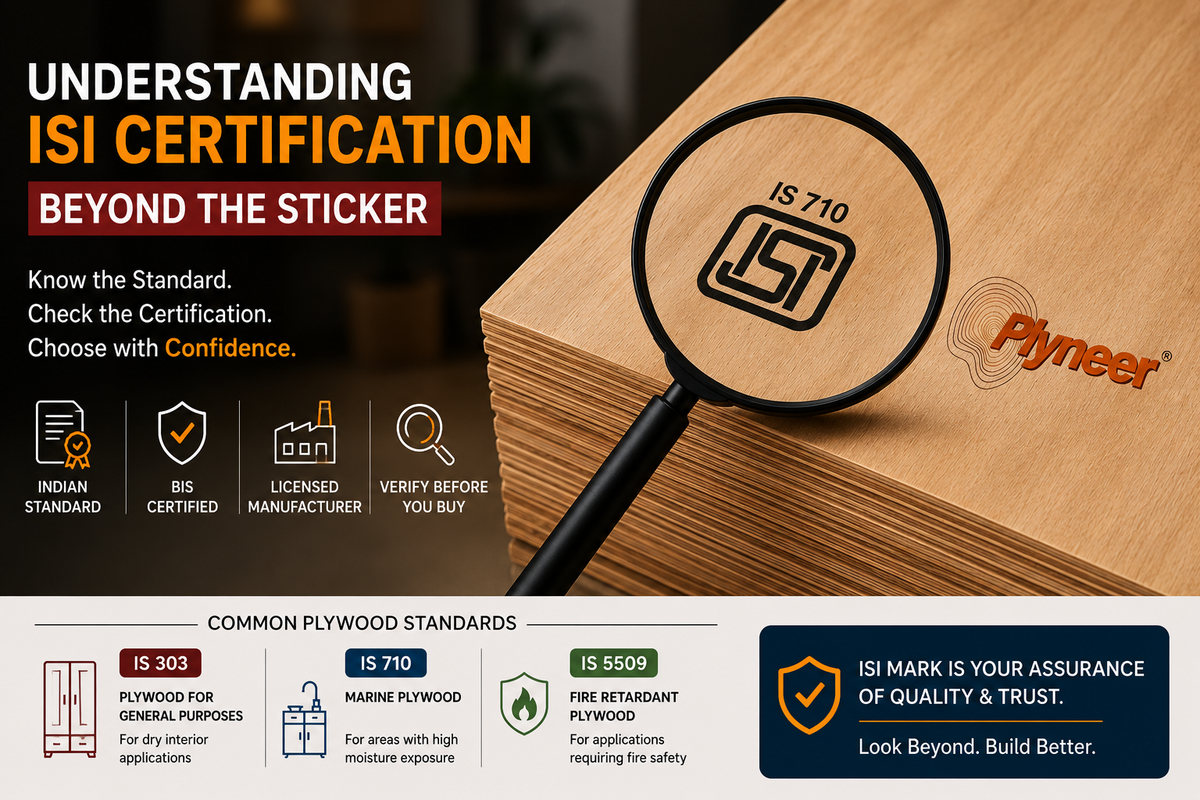
Understanding ISI Certification Beyond the Sticker
Walk into a plywood shop and you will see plenty of impressive claims.
Waterproof. Marine. Premium. Heavy Duty. Termite Resistant. Lifetime.
And somewhere on many sheets, you may also find the familiar ISI mark.
For many buyers, that mark becomes a quick shortcut:
ISI mark = good plywood.
But there is much more behind it.
The mark is meaningful because it connects a product to a particular Indian Standard and to a manufacturer operating under a BIS licence for that product. Understanding those details can help homeowners, architects, interior designers, contractors and furniture manufacturers make more informed material decisions.
The important question isn't simply:
“Does this plywood have ISI?”
It is:
“Which standard does it conform to, is the licence genuine, and is that standard appropriate for my application?”
That is where informed plywood buying begins.
1. ISI and BIS: What Do They Actually Mean?
The Bureau of Indian Standards (BIS) is India's national standards body.
The familiar ISI Standard Mark is used under BIS conformity-assessment schemes for products covered by relevant Indian Standards.
A genuine certification mark therefore shouldn't be viewed as decoration.
It indicates conformity to a specific standard under the applicable BIS certification framework.
For a buyer, the critical information is not only the logo but also the Indian Standard number and licence details associated with it.
2. The Standard Number Matters
Imagine two plywood sheets both carrying certification markings.
That doesn't automatically mean they are designed for exactly the same application.
Different Indian Standards cover different product categories and performance requirements.
For plywood buyers, three numbers are particularly useful to recognise:
IS 303
IS 303 covers plywood for general purposes.
It is commonly relevant to plywood intended for general interior applications, with the applicable classification and requirements defined by the standard.
For homeowners, this category is often encountered when selecting plywood for applications such as:
- Wardrobes
- TV units
- Study furniture
- Bedroom storage
- Office furniture
- General interior cabinetry
The exact grade should still be checked against the product specification and intended environment.
IS 710
IS 710 covers marine plywood.
This is an important standard when plywood is intended for demanding moisture-related applications.
In residential interiors, IS 710 plywood is frequently considered for areas such as:
- Modular kitchens
- Sink cabinets
- Utility cabinets
- Bathroom vanities
- Other moisture-prone furniture
But certification does not mean furniture should be allowed to remain continuously wet. Good plumbing, edge protection, fabrication and maintenance remain essential.
IS 5509
IS 5509 relates to fire-retardant plywood.
Fire-retardant plywood is a specialised product where the relevant fire-performance requirements matter in addition to normal plywood performance.
It may be considered for projects where fire-safety specifications form part of the material requirement, subject to the project's applicable codes, approvals and design requirements.
So instead of asking only:
“Is this ISI plywood?”
ask:
“Which IS number is this plywood certified to?”
That one question makes the conversation considerably more meaningful.
3. Certification Is Not the Same as a Marketing Claim
This distinction is extremely important.
Words such as:
- Premium
- Superior
- Heavy Duty
- Ultra Strong
- Luxury
- Professional Grade
may describe how a manufacturer positions a product.
They are not, by themselves, Indian Standards.
Similarly, if a plywood product is described as waterproof, marine or fire-retardant, a professional buyer should look beyond the large words printed on the face.
Check the applicable technical specification and certification information.
Marketing tells you what a product claims.
Standards help define what requirements it is being assessed against.
4. Look Beyond the ISI Logo
When inspecting certified plywood, don't stop after spotting the ISI symbol.
Look for information such as:
- The Standard Mark
- Relevant IS number
- BIS licence/CM/L number
- Manufacturer identification
- Product grade or classification where applicable
- Batch or traceability information where provided
These details help connect the physical product with the certification claim.
If the marking is unclear, ask the dealer or manufacturer for clarification before purchasing.
5. What Is a CM/L Number?
The CM/L number is an important part of BIS product certification identification.
CM/L refers to the licence number associated with the manufacturer's BIS certification.
This gives buyers something much more useful than simply recognising a logo—it provides a way to check whether the certification claim corresponds to a BIS licence.
For architects, contractors, procurement teams and large projects, recording relevant certification details can also form part of better material documentation.
6. Can You Verify BIS Certification?
Yes—and this is one of the most useful habits a plywood buyer can develop.
BIS provides official digital resources, including its online services and BIS Care ecosystem, through which consumers can access information relating to standards, licences and certification.
Before making a large purchase, particularly for a premium residential or commercial project, consider verifying the certification information shown on the product.
This can help answer questions such as:
- Does the licence exist?
- Which manufacturer is associated with it?
- Which product/standard is covered?
- Does the information correspond with the plywood being offered?
Verification turns the ISI mark from something you merely recognise into something you actually understand.
7. Does ISI Certification Mean Every Certified Plywood Is Identical?
No.
This is another common misunderstanding.
A standard establishes defined requirements, but manufacturers can still differ in many aspects of their products and manufacturing approach.
Two products conforming to the same applicable standard may still differ in areas such as:
- Timber selection
- Core construction
- Manufacturing consistency
- Calibration
- Surface quality
- Thickness consistency
- Product positioning
- Warranty
- Quality-control processes
Certification is therefore an important buying criterion—but it should not necessarily be your only buying criterion.
Think of it as part of a larger quality evaluation.
8. Core Construction Still Matters
Most plywood disappears once furniture is completed.
The laminate or veneer becomes visible, while the core remains hidden.
But that hidden core influences how furniture performs.
When evaluating plywood, consider:
- Core uniformity
- Internal gaps
- Thickness consistency
- Bond quality
- Screw holding
- Dimensional stability
- Surface calibration
These characteristics become particularly important in modular kitchens, large wardrobes, heavy shelving and furniture fitted with demanding hardware systems.
A beautiful laminate cannot compensate for poor construction underneath it.
9. Match Certification to the Application
The most expensive or highest-specification plywood isn't automatically necessary for every part of a home.
Good specification is about matching the material to the environment.
| Application | Practical Material Direction |
|---|---|
| Bedroom Wardrobe | Suitable general-purpose/MR plywood |
| TV Unit | Suitable MR plywood for dry interiors |
| Study Table | Suitable MR plywood |
| Bookshelves | Suitable MR plywood with appropriate thickness |
| Modular Kitchen | Quality BWP / appropriate IS 710 plywood |
| Under-Sink Cabinet | BWP / appropriate moisture-resistant specification |
| Utility Cabinet | BWP where moisture exposure is expected |
| Bathroom Vanity | Moisture-appropriate material |
| Fire-Safety-Sensitive Application | Appropriate fire-retardant plywood/specification |
This approach avoids two mistakes:
Under-specifying critical areas and over-specifying areas that don't require it.
10. Certification Doesn't Replace Good Furniture Design
Even properly certified plywood can perform poorly if furniture is badly designed or installed.
Consider a long bookshelf.
If the plywood is too thin for the span and load, the shelf can sag.
Consider a kitchen sink cabinet.
If plumbing leaks continuously and exposed edges aren't protected properly, even moisture-resistant materials are being subjected to unnecessary stress.
Furniture performance depends on the complete system:
Correct Material + Correct Grade + Correct Thickness + Good Hardware + Good Design + Proper Installation + Maintenance
Certification provides confidence in an important part of that system.
It doesn't replace the rest.
11. Don't Confuse Warranty with Certification
Warranty and certification answer different questions.
Certification relates to conformity with specified requirements under the applicable standard and certification scheme.
Warranty is a manufacturer's commercial commitment, subject to its stated terms and conditions.
A plywood sheet can therefore carry a long warranty, but that doesn't automatically tell you which Indian Standard applies.
Likewise, certification doesn't automatically mean every type of damage or furniture failure will be covered by a warranty.
When comparing products, examine both separately.
12. Why Architects and Interior Designers Should Specify the IS Number
Professional specifications should ideally be more precise than:
“Use good quality ISI plywood.”
A better material specification identifies what is actually required for the application.
For example, depending on project requirements, a specification may include:
- Plywood type
- Applicable Indian Standard
- Thickness
- Intended application
- Surface/calibration requirement
- Relevant performance requirements
- Manufacturer/brand approval process
This reduces ambiguity between the architect, client, contractor, carpenter and material supplier.
It also makes quotations easier to compare.
13. Why Homeowners Should Care
Homeowners may never see the plywood again after the furniture is finished.
That's exactly why material verification should happen before fabrication.
Once the laminate is applied and the wardrobe or kitchen is installed, identifying the original plywood becomes much more difficult.
Before cutting begins, consider checking:
- Brand and manufacturer
- Plywood grade/type
- Thickness
- Relevant IS number
- Certification/licence details where applicable
- Warranty documentation
- Quantity delivered
Taking photographs of sheet markings before fabrication can also provide useful project documentation.
14. A Simple Plywood Buying Checklist
Before approving a plywood purchase, ask:
✓ What grade/type is this plywood?
✓ Which Indian Standard applies?
✓ Is the certification claim verifiable?
✓ Does the manufacturer/licence information match?
✓ Is this grade suitable for where I am using it?
✓ What thickness do I need?
✓ What does the warranty actually cover?
✓ Is the plywood being stored correctly before installation?
These questions take only a few minutes.
But they can make your material-selection process far more informed.
15. The Bigger Lesson: Don't Buy the Sticker. Understand the Specification.
The ISI mark matters.
But informed buyers go one step further.
They understand what is behind the mark.
A professional plywood decision should consider:
Certification + Correct Standard + Application + Core Quality + Thickness + Workmanship
That's much more useful than choosing a product simply because a familiar logo appears on the sheet.
Conclusion
ISI certification shouldn't be treated as a decorative stamp on plywood.
It represents a connection between a product, an applicable Indian Standard and a BIS certification framework.
For plywood buyers, the most important habit is therefore to look beyond the logo.
Understand the standard.
Check the licence details.
Verify when necessary.
Match the plywood to the application.
And then evaluate the construction quality, thickness, hardware and workmanship that will ultimately determine how the finished furniture performs.
Because smart material selection isn't about buying the plywood with the most impressive sticker.
It's about understanding what you're actually putting inside your furniture.
Why Choose Plyneer?
At Plyneer Industries Pvt. Ltd., we believe customers should understand the materials going into their interiors.
Whether you're selecting plywood for wardrobes, modular kitchens, TV units, commercial furniture or specialised applications, choosing the correct specification is fundamental to long-term performance.
Plyneer offers plywood and interior material solutions for homeowners, architects, interior designers, contractors, carpenters and furniture manufacturers.
Don't just look at the mark. Understand the material. Choose Plyneer.
🌐 www.plyneer.com
📞 +91 8861717273


