

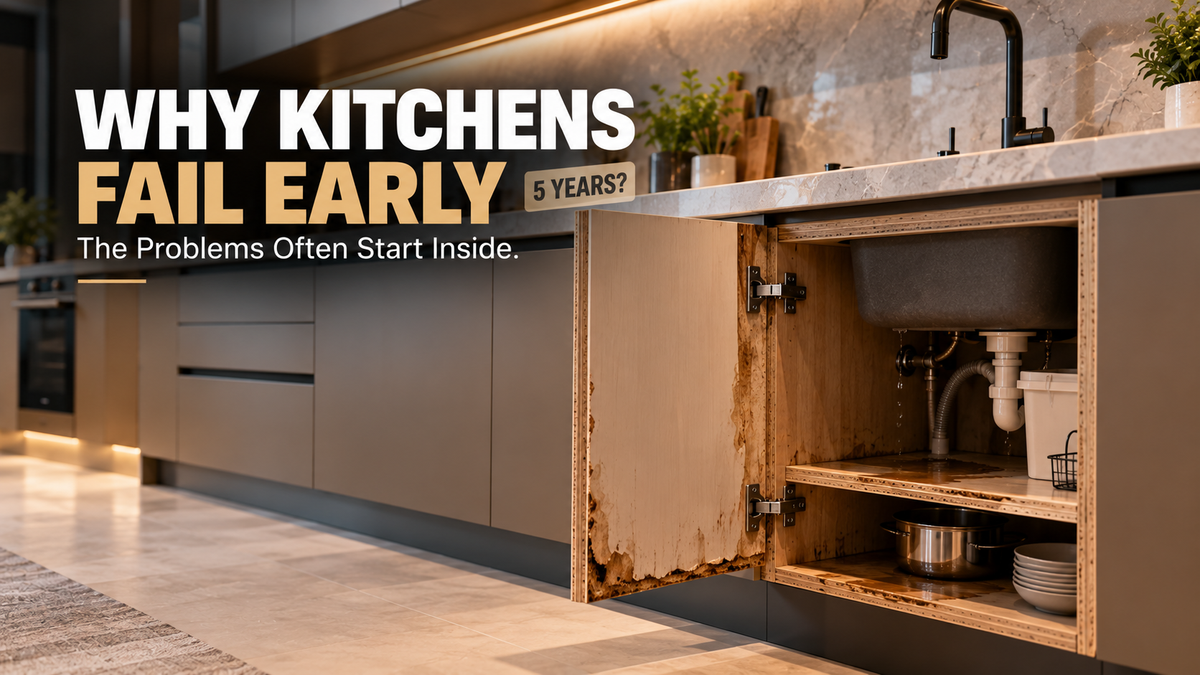
Why Kitchen Cabinets Fail in 5 Years
A new modular kitchen can be one of the biggest investments in a home's interiors. Yet some homeowners begin experiencing problems within only a few years.
Shutters become misaligned. Hinges loosen. Sink cabinets deteriorate. Shelves sag. Edges swell. Drawers stop operating smoothly.
Why?
Kitchen cabinet failure is rarely caused by just one problem. It is usually a combination of incorrect material selection, moisture, poor workmanship, hardware issues and inadequate design.
Here are 10 common reasons kitchen cabinets can fail prematurely.
1. Using the Wrong Plywood Grade
One of the biggest mistakes is treating kitchen furniture like bedroom furniture.
A kitchen experiences water, steam, spills, wet cleaning and plumbing risks.
While quality MR plywood can be suitable for dry-area furniture such as wardrobes and TV units, BWP plywood is generally a more appropriate choice for moisture-prone kitchen cabinetry.
The right grade should be selected before fabrication begins.
2. Ignoring the Sink Cabinet
The under-sink cabinet is often the most vulnerable part of a modular kitchen.
Even a small plumbing leak can remain unnoticed for days.
Check:
- Sink connections
- Drain pipes
- Water purifier connections
- Flexible hoses
- Tap connections
Use appropriate moisture-resistant materials and design the cabinet so plumbing remains accessible for inspection.
A small leak shouldn't become a complete cabinet replacement.
3. Poor Edge Protection
A plywood surface may be covered with laminate, but cutting creates exposed edges and openings.
Particular attention is needed around:
Sink cut-outs, plumbing holes, cabinet edges and hardware drilling.
Good fabrication and appropriate edge protection help reduce unnecessary moisture exposure.
4. Poor Core Construction
The decorative laminate is not the structural foundation of your kitchen.
The plywood underneath is.
Core construction can influence the overall stability, fastening performance and durability of furniture.
When selecting plywood, look beyond the face and evaluate:
✓ Core consistency
✓ Bonding
✓ Thickness consistency
✓ Surface quality
✓ Appropriate grade
A beautiful finish cannot compensate for a poor foundation.
5. Weak Screw Holding
Kitchen shutters may be opened thousands of times.
Each movement transfers force through the hinges into the cabinet material.
If the substrate doesn't hold fasteners reliably, homeowners may experience:
Loose Hinge → Misaligned Shutter → Repeated Tightening → Damaged Fixing Point
Good plywood, appropriate hardware and correct installation must work together.
6. Using the Wrong Thickness
Using thicker plywood everywhere isn't automatically the answer.
Cabinet thickness should be selected according to:
Application + Load + Span + Support + Hardware
Long shelves carrying heavy utensils may require different structural planning from small cabinet components.
Even good plywood can sag when furniture is poorly designed.
7. Poor Appliance Ventilation
Modern kitchens integrate refrigerators, ovens, microwaves and other appliances into cabinetry.
These appliances may have specific ventilation and clearance requirements.
Ignoring manufacturer installation requirements can expose surrounding cabinetry to unnecessary heat and create maintenance problems.
Design cabinetry around the appliance—not simply around its dimensions.
8. Poor-Quality Hardware
A kitchen is a complete system.
Premium plywood cannot compensate for unsuitable hinges, channels or connectors.
Likewise, premium hardware needs a dependable substrate and correct installation.
For long-lasting kitchens, think:
Plywood + Hardware + Design + Installation
not plywood alone.
9. Ignoring Moisture After Installation
BWP plywood doesn't mean homeowners can ignore water indefinitely.
Leaks should still be repaired quickly.
Standing water should be wiped.
Sink plumbing should be inspected periodically.
Ventilation should be maintained.
Water-resistant performance is protection—not permission to ignore leaks.
10. Choosing the Lowest Quotation
Two modular kitchens may look almost identical on installation day.
Both may have beautiful shutters, handles and countertops.
But what's underneath can be very different.
A lower quotation may involve compromises in:
- Plywood grade
- Core quality
- Hardware
- Thickness
- Edge finishing
- Installation
- Internal accessories
Instead of asking only:
“What is the kitchen price?”
Ask:
“What exactly is being used inside my kitchen?”
Quick Kitchen Cabinet Checklist
Before approving your modular kitchen, confirm:
✓ Exact plywood brand and product
✓ BWP grade where appropriate
✓ Thickness of carcass, shelves and shutters
✓ Core construction
✓ Hardware brand/specification
✓ Under-sink material
✓ Edge finishing
✓ Plumbing accessibility
✓ Appliance ventilation
✓ Warranty and invoice
Photograph the plywood markings before fabrication begins. Once laminate is applied, identifying the material becomes much harder.
Conclusion
Kitchen cabinets don't necessarily fail because they are five years old.
They fail prematurely when material, moisture protection, hardware, design and workmanship don't work together.
A long-lasting modular kitchen begins beneath the visible finish.
Choose the appropriate plywood grade. Protect moisture-prone areas. Use dependable hardware. Plan structural support correctly. Fix leaks early.
Don't Design Your Kitchen Only for Handover Day. Design It for the Years Ahead.
At Plyneer Industries, we offer premium plywood solutions for kitchens and other demanding interior applications, including BWP plywood designed for water-exposed areas.
🌐 www.plyneer.com
📞 +91 8861717273


