

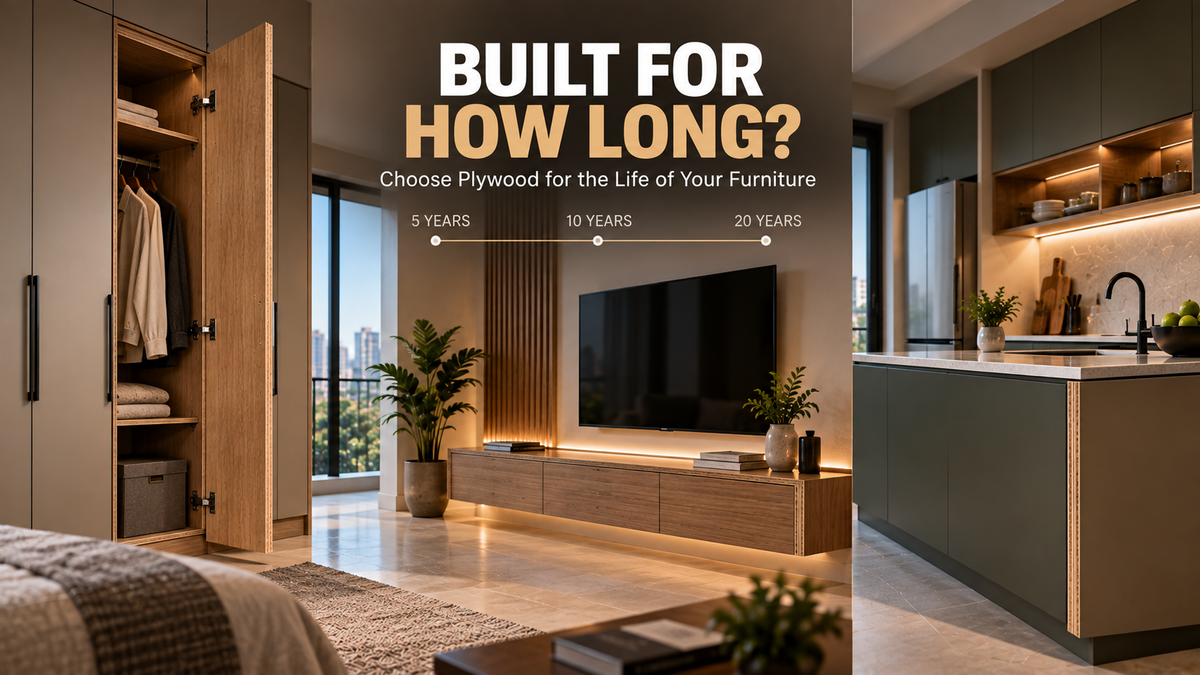
Choosing Plywood Based on Furniture Lifespan
When buying plywood, most homeowners compare price, thickness and brand.
But there is another useful question:
“How many years do I expect this furniture to last?”
A temporary storage cabinet and a premium modular kitchen should not necessarily have the same material specification.
Furniture lifespan depends on several factors—including plywood quality, hardware, workmanship, moisture exposure, load and everyday usage.
Here are 10 factors to consider when choosing plywood for long-lasting furniture.
1. Start With the Expected Furniture Life
Before selecting plywood, decide whether the furniture is intended for short-term use or as a long-term part of the home.
Built-in wardrobes, kitchens and permanent storage are expensive to dismantle and replace. For these applications, investing in dependable materials can make greater financial sense.
2. Consider How Frequently the Furniture Is Used
A decorative cabinet opened once a month experiences very different stress from a kitchen shutter opened several times every day.
Frequently used furniture includes:
- Modular kitchens
- Wardrobes
- Drawers
- Shoe cabinets
- Workstations
For high-use furniture, pay closer attention to plywood construction, screw holding, hardware and workmanship.
3. Match the Grade to the Environment
Don't automatically use the same plywood throughout the house.
For normal dry interiors such as wardrobes, TV units and study furniture, quality MR plywood can be appropriate.
For kitchens and other water-exposed or moisture-prone applications, BWP plywood is generally a more suitable direction.
The longer you expect furniture to last, the more important correct material selection becomes.
4. Pay Attention to Core Construction
The surface of plywood eventually disappears beneath laminate or veneer.
The core doesn't.
Consistent core construction and proper bonding contribute to furniture performance over time.
Before buying, inspect plywood edges and look for obvious core gaps, irregular construction or delamination.
Long-lasting furniture needs a dependable foundation.
5. Consider Screw-Holding Performance
Furniture hardware depends on the material underneath it.
Hinges, drawer channels, sliding systems and other fittings can operate thousands of times during the life of furniture.
Reliable screw holding helps hardware remain securely fitted and can reduce repeated adjustments and repairs.
This becomes particularly important when furniture is expected to perform for 15–20 years.
6. Choose the Right Thickness
Long furniture life doesn't come simply from choosing thicker plywood.
Thickness should be based on:
Application + Load + Span + Support
A long bookshelf carrying heavy books needs different structural planning from a TV back panel.
Correct furniture engineering is just as important as plywood quality.
7. Think About Moisture Over the Entire Lifespan
A kitchen cabinet may not experience a leak today.
But what about over the next 15 years?
Plumbing connections can fail. Sinks can overflow. Utility areas can experience repeated wet cleaning.
When furniture is expected to remain for many years, consider the likely lifetime exposure, not only today's conditions.
This is why BWP plywood makes sense for many water-exposed applications.
8. Match Plywood Quality to the Finish
If you're investing in premium veneer, laminate, acrylic finishes or expensive hardware, the substrate deserves equal attention.
A premium surface over unsuitable plywood can become a false economy if the underlying furniture requires premature repair.
Premium finishes deserve a dependable foundation.
9. Consider Replacement Difficulty
Some furniture is easy to replace.
Built-in furniture isn't.
Replacing a modular kitchen or large wardrobe may involve dismantling, carpentry, plumbing, electrical work, new finishes and several days of disruption.
The harder the furniture is to replace, the stronger the case for investing in appropriate long-term materials from the beginning.
10. Calculate Cost Per Year, Not Just Purchase Price
Suppose one furniture solution costs ₹1,50,000 and requires replacement after a shorter period, while another costs more initially but performs considerably longer.
The second option may ultimately deliver a lower cost per year of use.
This doesn't mean expensive plywood automatically lasts longer. Material quality, grade, installation and environment all matter.
But it demonstrates an important principle:
Purchase price and lifetime value are not the same thing.
Quick Plywood Selection Guide
| Furniture Application | Material Direction | Key Consideration |
|---|---|---|
| Bedroom Wardrobe | Quality MR Plywood | Dry interior use |
| TV Unit | Quality MR Plywood | Stability & finish |
| Study Table | Quality MR Plywood | Daily usage |
| Bookshelf | MR + correct thickness | Load & span |
| Modular Kitchen | BWP Plywood | Water exposure |
| Under-Sink Cabinet | BWP / wet-area solution | Higher moisture risk |
| Utility Storage | BWP where exposed | Moisture cycles |
| Premium Veneered Furniture | Premium plywood | Protect expensive finish |
Conclusion
The right plywood isn't necessarily the most expensive plywood.
It is the plywood that matches the expected furniture lifespan, application and environment.
For long-term interiors, consider:
✓ Expected years of use
✓ Frequency of use
✓ Moisture exposure
✓ Plywood grade
✓ Core construction
✓ Screw holding
✓ Thickness and support
✓ Hardware quality
✓ Replacement difficulty
✓ Lifetime cost
If you're building furniture that you expect to use for the next 15–20 years, don't evaluate plywood only by today's price.
Choose for the Years Ahead, Not Just the Day of Installation.
At Plyneer Industries, we offer plywood and interior material solutions for different applications—from dry-area furniture to demanding water-exposed interiors.
🌐 www.plyneer.com
📞 +91 8861717273


