

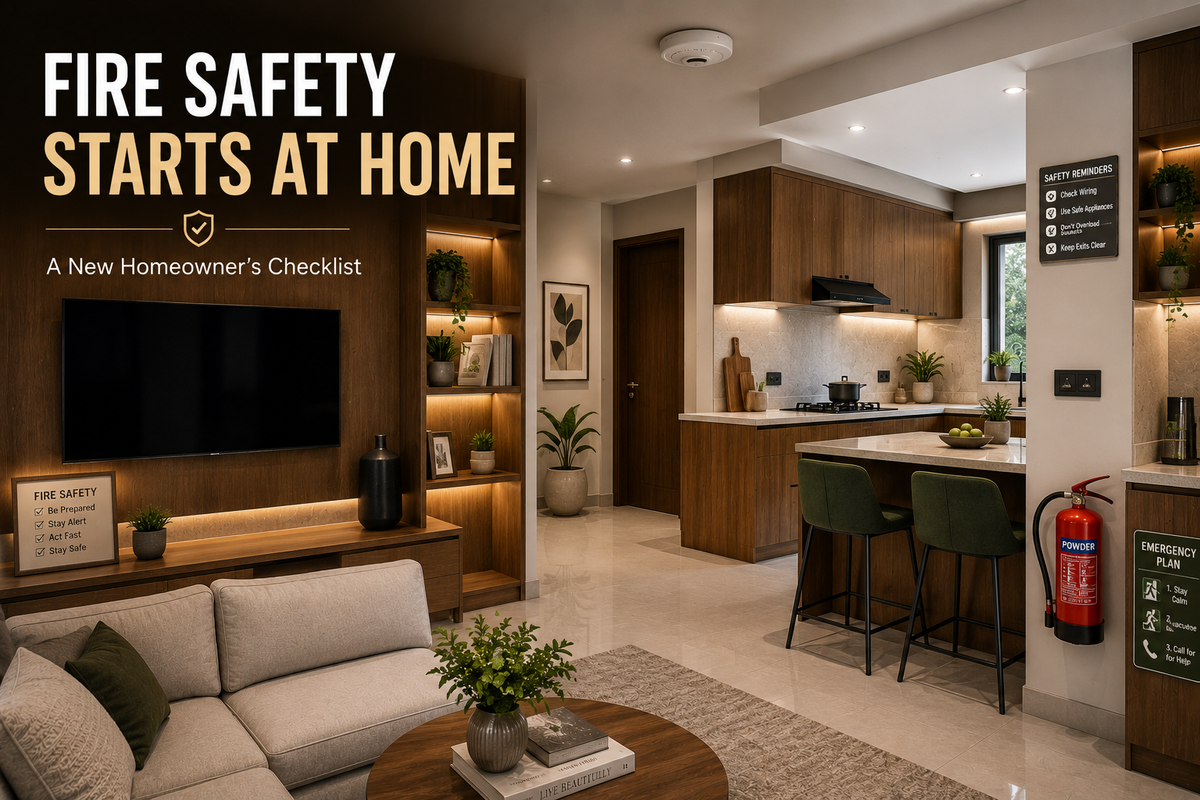
Build Safety Into Your Home From Day One
Buying or moving into a new home is exciting.
You choose the furniture, lighting, kitchen finishes, wardrobes, appliances, curtains and décor. But there is another part of home planning that deserves equal attention:
Fire safety.
Fire safety isn't something to think about only after an emergency. Many precautions are easier to implement while the home is being designed, renovated or furnished.
Electrical systems, kitchens, LPG connections, appliances, smoke alarms, escape routes and even the materials used in interiors can influence overall fire safety.
For new homeowners, the objective isn't to become a fire-safety expert.
It's to ask the right questions and build sensible precautions into everyday living.
Here is a practical checklist to get started.
1. Install Smoke Alarms
Smoke alarms can provide early warning of a developing fire.
Consider suitable alarms in key areas of the home, particularly near sleeping areas, while following the manufacturer's placement instructions and applicable building/fire-safety guidance.
Once installed:
- Test alarms regularly.
- Replace batteries where required.
- Keep alarms unobstructed.
- Replace units according to manufacturer recommendations.
- Make sure everyone at home recognises the alarm sound.
A smoke alarm is only useful if it works when needed.
2. Get the Electrical System Checked
Electrical faults can become serious fire hazards.
This is particularly important when buying an older property or renovating an existing home.
Have electrical work handled by a qualified professional and pay attention to:
- Distribution boards
- Circuit protection
- Earthing
- Loose connections
- Damaged wiring
- Overheating sockets
- Appropriate wire sizing
- High-load appliance circuits
Air conditioners, ovens, water heaters, induction cooktops and other high-load equipment should have electrical provisions appropriate to their requirements.
Don't build expensive interiors around questionable wiring.
3. Avoid Overloaded Sockets
Modern homes have an extraordinary number of electrical devices.
TVs, chargers, computers, speakers, routers, kitchen appliances and entertainment systems can quickly turn one socket into several extensions.
Avoid:
- Overloading power strips
- Daisy-chaining extension boards
- Using damaged plugs
- Running cables underneath carpets
- Continuing to use sockets showing heat or burn marks
If a room consistently needs more outlets, adding properly installed sockets may be safer than permanently depending on extensions.
4. Pay Special Attention to the Kitchen
The kitchen combines heat, electricity, gas and combustible materials in a relatively small area.
Good kitchen planning should consider fire safety from the beginning.
Keep:
- Towels away from open flames.
- Packaging away from cooking areas.
- Electrical appliances away from unnecessary water exposure.
- Cooking surfaces clean of excessive grease.
- Gas connections properly maintained.
And never leave active cooking unattended when doing so could create a fire risk.
5. Check Your LPG Setup
If your home uses LPG, installation and maintenance deserve particular attention.
Use approved equipment and authorised/qualified service personnel, and follow the LPG supplier's safety instructions.
Regularly inspect the setup for signs of damage or deterioration.
If you suspect a gas leak, avoid operating electrical switches or creating a flame, ventilate the area where safe to do so, shut off the supply if this can be done safely, leave the area if necessary, and contact the gas supplier/emergency services.
Treat the smell of gas seriously.
6. Keep an Appropriate Fire Extinguisher
Having a fire extinguisher can be useful—but simply buying one isn't enough.
Different extinguishing agents are intended for different types of fires. Selection and placement should therefore be based on the actual risks in the home and applicable guidance.
Keep extinguishers:
- Accessible
- Clearly visible
- Properly maintained
- Within their service/inspection requirements
Most importantly, household members should understand when an extinguisher can be used safely.
If a fire is spreading, producing heavy smoke or blocking your escape, evacuation takes priority over fighting the fire.
7. Consider a Fire Blanket for the Kitchen
A suitable fire blanket can provide another layer of preparedness for certain small kitchen fires when used correctly.
Store it somewhere accessible rather than hidden behind the cooking appliance or buried inside a cabinet.
As with an extinguisher, homeowners should read the product instructions before an emergency occurs.
8. Create a Family Escape Plan
One of the simplest precautions costs almost nothing.
Ask:
If there were a fire tonight, how would everyone get outside?
Identify:
- Primary exit
- Alternative exit where available
- Accessible stairways
- A safe outdoor meeting point
- Assistance required by children or elderly family members
Everyone should understand one fundamental principle:
Get out, stay out and call emergency services.
Possessions can be replaced.
People cannot.
9. Keep Exits Clear
Beautiful interiors shouldn't obstruct evacuation.
Avoid placing furniture, storage boxes, bicycles or other objects where they significantly restrict important exits or circulation paths.
This deserves extra attention in:
- Apartment entrance areas
- Staircases
- Corridors
- Balconies used as possible secondary escape routes
- Common building areas
During an emergency, visibility may be poor and every second can matter.
10. Don't Ignore Apartment-Level Fire Safety
If you're moving into an apartment in Bangalore, fire safety doesn't stop at your front door.
Understand the building's:
- Emergency exits
- Staircases
- Fire alarm arrangements
- Fire extinguishers/hose systems
- Assembly areas
- Emergency procedures
Do not rely on lifts during a fire evacuation unless specifically directed by the building's approved emergency system or emergency personnel.
Residents should also know whom to contact within the apartment management during an emergency.
11. Think About Interior Materials
Homeowners spend significant time selecting the visible finishes in their homes.
But fire-conscious interior design should also consider the materials beneath those finishes.
Furniture can contain:
- Plywood
- MDF and engineered boards
- Laminates
- Adhesives
- Fabrics
- Foams
- Plastics
- Coatings
These materials do not all behave identically when exposed to heat or flame.
Where a project calls for enhanced fire performance, architects and designers can consider appropriately specified fire-retardant materials as part of a broader fire-safety strategy.
12. Understand Fire-Retardant Plywood
Fire-retardant plywood should not be interpreted as fireproof plywood.
That's an important distinction.
Fire-retardant products are designed to meet specified fire-performance requirements under defined test conditions. They don't make furniture incapable of burning or eliminate the need for alarms, extinguishers, safe electrical systems or evacuation planning.
In India, IS 5509 is the relevant Indian Standard associated with fire-retardant plywood.
When specifying such a product, look beyond a marketing statement such as "fire resistant."
Check the applicable standard, certification information and technical documentation.
13. Where Can Fire-Retardant Materials Be Considered?
Depending on the project's design, applicable requirements and professional fire-safety advice, enhanced fire-performance materials may be considered for selected applications such as:
- Premium residential interiors
- Home offices
- Entertainment areas
- Electrical-panel-adjacent interiors where appropriately designed
- Commercial spaces
- Hospitality interiors
- Public-facing interiors
Material selection should always form part of the overall fire-safety design—not be treated as a substitute for it.
14. Be Careful With Decorative Lighting
Luxury interiors increasingly use:
- LED strips
- Profile lights
- Cabinet lighting
- Cove lighting
- Display lighting
- Decorative fixtures
These can look excellent, but installation quality matters.
Use appropriate components and ensure electrical work is professionally executed. Drivers, wiring and connections should not be casually concealed inside furniture without consideration for heat, access and servicing.
Good detailing isn't only about appearance.
It's also about safety.
15. Watch Charging Devices and Batteries
Homes now contain many rechargeable devices.
Phones, laptops, power banks, cordless appliances, toys, e-bikes and other battery-powered products require appropriate charging practices.
Use compatible, reputable charging equipment and stop using batteries or devices showing signs such as unusual swelling, damage, overheating, odour or other abnormal behaviour.
Avoid creating unnecessary fire risk through poor-quality chargers or damaged batteries.
16. Curtains and Soft Furnishings Need Thoughtful Placement
Curtains, upholstery and decorative fabrics contribute enormously to an interior's appearance.
But avoid placing easily combustible materials unnecessarily close to:
- Open flames
- Candles
- Cooking areas
- High-temperature appliances
- Other significant heat sources
The same principle applies to decorative timber, paper, plastics and artificial plants.
17. Don't Forget the Puja Area
This deserves special attention in many Indian homes.
Puja units may involve:
- Diyas
- Incense
- Camphor
- Matches
- Decorative fabrics
- Wooden cabinetry
Open flames should never be left unattended.
The surrounding design should account for heat and flame exposure, and combustible decorative materials should be kept at a safe distance.
A beautiful mandir should be planned with safety as carefully as the kitchen.
18. Teach Children Basic Fire Safety
Children don't need frightening explanations.
They need simple rules.
Teach them:
- Never play with matches or lighters.
- Don't touch electrical sockets.
- Tell an adult if they smell smoke or see fire.
- Know how to leave the house.
- Never hide during a fire.
- Never return inside to collect toys or belongings.
Families can practise the escape plan occasionally so that everyone understands what to do.
19. Review Fire Safety Every Year
Fire safety isn't a one-time installation.
Homes change.
New appliances arrive. Furniture gets added. Batteries age. Electrical loads increase. Extinguishers require servicing.
Create a simple annual review.
New Home Fire Safety Checklist
✓ Smoke alarms installed and tested
✓ Electrical system professionally checked
✓ High-load appliances correctly connected
✓ No overloaded sockets
✓ LPG/gas system checked
✓ Appropriate extinguisher accessible
✓ Kitchen fire precautions understood
✓ Escape plan discussed with family
✓ Exits and stairs kept clear
✓ Apartment emergency routes understood
✓ Interior materials reviewed where enhanced fire performance is required
✓ Decorative lighting professionally installed
✓ Charging devices and batteries inspected
✓ Puja/open-flame area planned safely
✓ Emergency numbers accessible
Fire Safety Should Begin Before the Interiors
One of the biggest opportunities for a new homeowner is timing.
If you're still designing your interiors, you can consider fire safety before everything gets concealed.
Discuss electrical loads with your electrician.
Discuss emergency circulation with your architect.
Discuss material specifications with your interior designer.
Discuss plywood and board requirements with your material supplier.
And where enhanced fire performance is part of the design requirement, investigate appropriately certified fire-retardant materials rather than relying only on marketing claims.
It's much easier to design safety into a home than to retrofit every precaution later.
Conclusion
A safe home isn't created by one product.
It's created through layers of sensible decisions.
Safe electrical systems.
Responsible cooking.
Gas safety.
Early warning.
Fire-fighting equipment.
Clear exits.
An escape plan.
Appropriate interior materials.
For new homeowners, the most important step is simply to make fire safety part of the planning conversation.
Because a truly premium home isn't only beautiful, comfortable and well built.
It should also be thoughtfully designed for the people living inside it.
Why Choose Plyneer?
At Plyneer Industries Pvt. Ltd., we believe material performance should be considered alongside design.
For projects requiring enhanced fire performance, Plyneer Club FR combines fire-retardant positioning with premium plywood construction for demanding interior applications, subject to the product's applicable specifications and certification.
Alongside specialised plywood, Plyneer offers plywood, blockboards, MDF, HDHMR, WPC, veneers, laminates and other materials for residential and commercial interiors.
For architects, designers and homeowners, the principle is simple:
Build beautifully. Specify intelligently. Think safety.
🌐 www.plyneer.com
📞 +91 8861717273


