

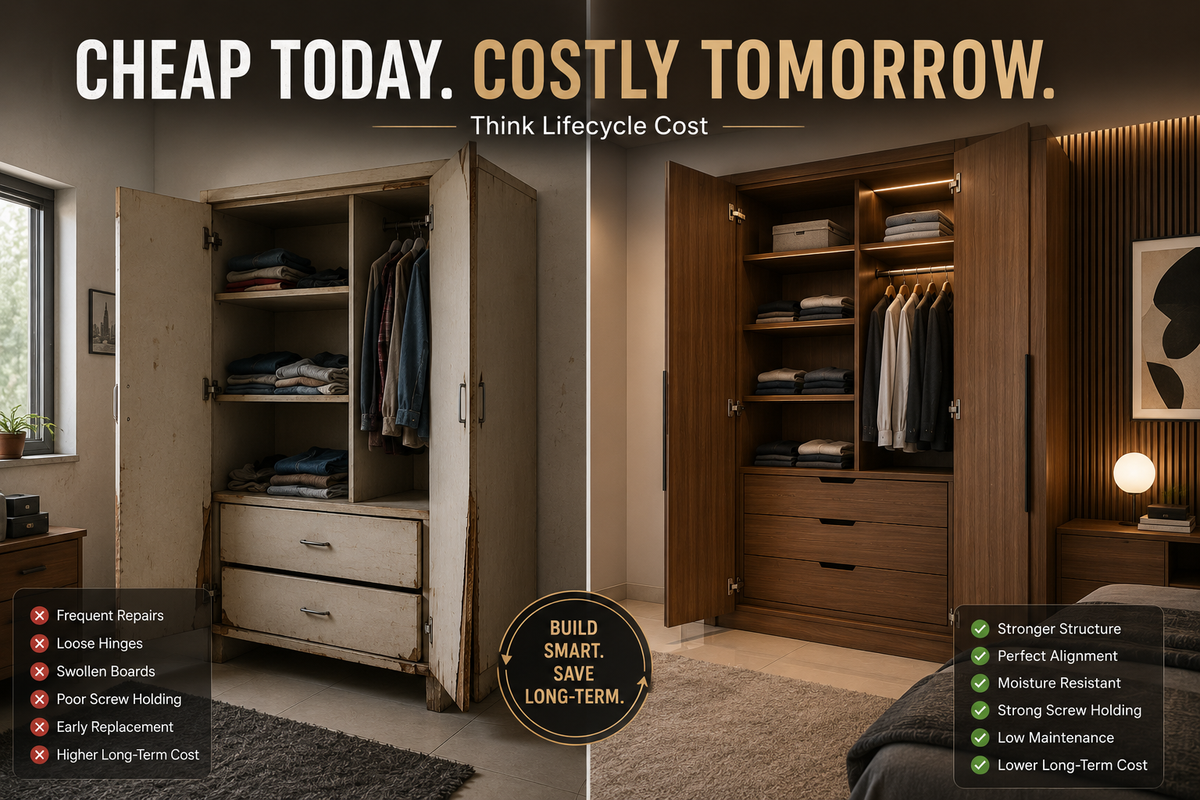
Calculating Furniture Lifecycle Cost: Why the Cheapest Furniture Can Cost More
When buying furniture or planning interiors, most people compare one number first: the initial price.
A wardrobe costing ₹60,000 appears better value than one costing ₹90,000. A lower-priced modular kitchen can seem like an easy way to control a renovation budget.
But purchase price tells only part of the story.
What happens if the less expensive wardrobe needs major repairs after six years? What if kitchen cabinets swell because of moisture? What if hinges repeatedly become loose because the underlying board no longer holds screws properly?
The more useful question is
How much will this furniture actually cost throughout the period you use it?
That's where furniture lifecycle cost becomes valuable.
What Is Furniture Lifecycle Cost?
Furniture lifecycle cost is the total cost associated with owning and using a piece of furniture over a defined period.
Instead of considering only the purchase price, it can include:
- Initial furniture cost
- Installation
- Maintenance
- Repairs
- Hardware replacement
- Refurbishment
- Replacement
- Disposal or removal
For a homeowner planning to use an interior for 15–20 years, lifecycle cost can provide a much more meaningful comparison than showroom price alone.
A Simple Lifecycle Cost Formula
A practical simplified calculation is
Lifecycle Cost = Initial Cost + Maintenance + Repairs + Replacement Costs + Other Ownership Costs
For more advanced commercial calculations, future costs can also be discounted to present value. But for homeowners, even a basic estimate can reveal an important difference between cheap to buy and economical to own.
An Example: Two Wardrobes Over 20 Years
Imagine you're comparing two wardrobe options.
| Cost Factor | Budget Wardrobe | Premium Wardrobe |
|---|---|---|
| Initial Investment | ₹60,000 | ₹90,000 |
| Minor Repairs | ₹12,000 | ₹5,000 |
| Major Repair/Refurbishment | ₹25,000 | ₹10,000 |
| Replacement During 20 Years | ₹70,000 | ₹0 |
| Illustrative 20-Year Cost | ₹167,000 | ₹105,000 |
*Illustrative example only. Actual furniture life depends on material quality, design, workmanship, environment, maintenance, loading, and usage.
The ₹90,000 wardrobe initially appears 50% more expensive.
But under these hypothetical assumptions, the budget option costs ₹62,000 more over 20 years.
That's why lifecycle thinking matters.
Why Plywood Has a Major Impact on Lifecycle Cost
The plywood inside furniture affects several characteristics that can influence future repair and replacement costs.
Screw Holding
Hinges, drawer channels, handles, brackets, and other hardware depend on secure fastening.
Poor screw retention can contribute to:
- Loose hinges
- Misaligned doors
- Unstable drawers
- Repeated hardware repairs
Quality core construction and appropriate plywood help provide a more dependable substrate for hardware.
Structural Stability
Furniture must handle continuous loads for years.
Wardrobe shelves carry clothes. Kitchen cabinets hold cookware. Bookshelves may remain heavily loaded continuously.
Appropriate plywood thickness, core quality, shelf span, support design, and installation all influence whether furniture remains stable or starts sagging.
Moisture Performance
Water damage can dramatically increase lifecycle costs.
A leak below a kitchen sink can damage unsuitable materials and may eventually require part—or all—of a cabinet to be replaced.
Using an appropriate BWP-grade plywood in moisture-prone applications can help reduce this risk when combined with correct detailing and maintenance.
The Wrong Material Can Create Hidden Costs
A cheaper material can generate expenses that aren't visible in the original quotation.
These may include:
- Carpenter visits
- Replacement hinges
- Drawer channel repairs
- Shelf reinforcement
- Shutter replacement
- Laminate replacement
- Cabinet reconstruction
- Transport and labor
- Disruption during repairs
There is also an inconvenience cost.
Repairing a wardrobe is annoying. Reconstructing part of an operational kitchen can disrupt the household significantly.
Lifecycle analysis encourages you to consider these consequences before construction begins.
Material Selection Should Be Application-Based
Using the most expensive plywood everywhere isn't necessarily smart either.
Good lifecycle planning means matching the material to the application.
| Application | Practical Approach |
| Modular Kitchen | Quality BWP plywood |
| Sink Cabinet | BWP plywood + careful edge protection |
| Bathroom Vanity | Moisture-appropriate plywood/material |
| Bedroom Wardrobe | Quality MR or BWP plywood |
| TV Unit | MR plywood for normal dry interiors |
| Study Table | Quality MR plywood |
| Utility Storage | BWP plywood where moisture is expected |
| Heavy Shelving | Appropriate thickness + support design |
This approach helps direct the budget toward areas where additional performance provides meaningful value.
Don't Forget Hardware
Plywood is only one part of the furniture lifecycle cost.
Hardware also has a significant impact.
Quality:
- Hinges
- Drawer channels
- Sliding systems
- Handles
- Shelf supports
- Fasteners
can reduce maintenance and improve daily usability.
There's little value in specifying excellent plywood and then installing hardware that requires frequent replacement.
Installation Quality Matters Too
Premium materials cannot correct poor workmanship.
Furniture lifespan depends on the complete system:
Material + Design + Hardware + Installation + Maintenance
Incorrect screw placement, inadequate shelf support, poor edge protection, badly installed hardware, and insufficient moisture detailing can reduce the service life of even good materials.
Lifecycle planning therefore needs to begin during design—not after problems appear.
Calculate Cost Per Year
Another simple way to compare furniture is to divide its total cost by its useful life.
Imagine:
Option A: ₹60,000 ÷ 8 years = ₹7,500 per year
Option B: ₹90,000 ÷ 20 years = ₹4,500 per year
Even though Option B costs considerably more initially, its annualized purchase cost is lower if those service-life assumptions prove accurate.
This method isn't perfect, because actual lifespan varies, but it is useful for comparing value beyond the initial quotation.
Five Questions to Ask Before Choosing Furniture Materials
Before approving a quotation, ask:
- Which plywood or board is being used?
- Is the grade appropriate for the application?
- What thickness is being specified?
- Which hardware brands/specifications are included?
- What maintenance and replacement should I reasonably expect?
These questions can reveal much more about long-term value than simply asking for another discount.
Lifecycle Cost Matters Even More for Commercial Projects
For offices, hotels, hospitals, schools, retail stores, and restaurants, furniture may experience far more intensive use than residential furniture.
A failure can mean:
- Operational disruption
- Maintenance labor
- Customer inconvenience
- Replacement procurement
- Downtime
Architects, contractors, facility managers, and business owners should therefore consider lifecycle performance when preparing material specifications.
A slightly higher initial material investment may be justified when it reduces maintenance frequency and extends replacement cycles.
Sustainability and Lifecycle Cost Are Connected
Long-lasting furniture isn't only financially attractive—it can also reduce material consumption.
Replacing furniture frequently requires additional:
- Raw materials
- Manufacturing
- Packaging
- Transportation
- Installation
- Waste disposal
Extending useful furniture life can reduce the frequency of those activities.
This is why durability should be considered alongside other sustainability factors when selecting interior materials.
Conclusion: Don't Ask What Furniture Costs Today
Ask what it will cost you over its useful life.
The lowest quotation isn't automatically the best value, and the highest-priced option isn't automatically the best either.
The smarter approach is to evaluate:
Initial Cost + Material Quality + Expected Life + Maintenance + Repairs + Replacement
When furniture is properly designed using application-appropriate plywood, dependable hardware, professional installation, and sensible maintenance, it has a better chance of delivering value for many years.
So before choosing the cheapest sheet, cabinet, or quotation, calculate the bigger number:
The cost of owning it.
Why Choose Plyneer?
At Plyneer Industries Pvt. Ltd., we believe interior materials should be evaluated by the performance and value they deliver over time—not simply their purchase price.
Plyneer's plywood solutions are designed for applications ranging from modular kitchens and wardrobes to TV units, office furniture, commercial interiors, and custom furniture.
Along with plywood, Plyneer offers laminates, MDF, HDHMR, veneers, blockboards, and other interior material solutions, helping homeowners, architects, interior designers, builders, carpenters, and furniture manufacturers select the right material for each application.
Don't build only for today. Build for the years ahead. Choose Plyneer.
🌐 www.plyneer.com
📞 +91 8861717273


