

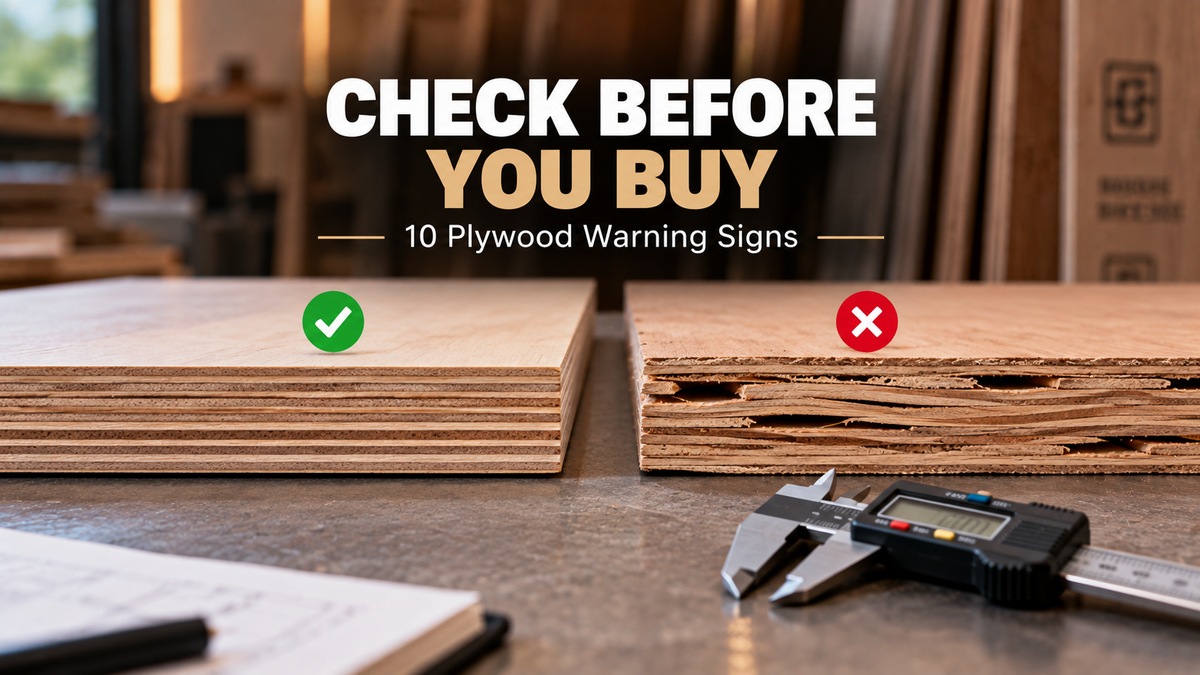
Signs of Low-Quality Plywood: What to Check Before Buying
Plywood is usually hidden beneath laminate, veneer or another decorative finish.
That makes choosing the right sheet especially important because once furniture is completed, checking what is underneath becomes difficult.
A plywood sheet may look perfectly acceptable from the surface while differences exist inside its construction.
Here are 10 warning signs worth checking before your plywood goes into furniture.
1. Visible Core Gaps
Look carefully at the plywood edge.
Large or repeated gaps between core veneers can be a warning sign of inconsistent construction.
Core quality matters because screws, hardware and furniture loads depend on the material beneath the surface.
Don't inspect only the face—inspect the edge.
2. Uneven Thickness
Check thickness at several points across the sheet.
Significant variations can create problems during furniture fabrication, particularly where precision is important.
Inconsistent thickness may contribute to difficulties with:
- CNC machining
- Cabinet alignment
- Laminate finishing
- Hardware installation
- Modular furniture assembly
Consistency becomes particularly important in precision furniture manufacturing.
3. Poor Surface Quality
Before lamination, examine the plywood surface.
Watch for unusual:
✓ Depressions
✓ Raised areas
✓ Excessive roughness
✓ Surface cracks
✓ Uneven patches
A good substrate helps achieve a better final finish.
4. Signs of Delamination
The layers of plywood should remain properly bonded.
If layers are already separating at the edges before fabrication, investigate further.
Delamination can indicate a bonding or storage issue and should not simply be hidden beneath laminate.
5. Irregular or Damaged Edges
Edges can reveal a lot about plywood construction.
Look for excessively irregular veneers, large voids, damaged layers or visible separation.
Some natural variation can occur in wood products, so the objective isn't cosmetic perfection. Look for repeated or significant defects that could affect performance.
6. Unclear Plywood Grade
A seller saying:
“This is waterproof plywood.”
isn't enough information.
Ask exactly what product and grade you are buying.
Depending on the application, you may encounter terms such as MR, BWR and BWP.
For normal dry furniture such as wardrobes and TV units, quality MR plywood may be appropriate.
For kitchens and other demanding moisture-prone applications, BWP plywood is generally a more suitable direction.
7. Missing or Unclear Product Identification
Before purchasing, check whether the plywood can be clearly identified.
Depending on the product, look for information such as:
- Manufacturer/brand
- Product name
- Grade
- Thickness
- Applicable standard
- Certification details where relevant
- Batch/product markings
Be cautious when important product information cannot be clearly explained or documented.
8. Certification Claims That Cannot Be Verified
An ISI mark should not be treated merely as printed artwork.
Where BIS certification applies, check the relevant product marking and licence information.
Common plywood standards encountered in India include IS 303 for applicable general-purpose plywood categories, IS 710 for marine plywood and IS 5509 for fire-retardant plywood.
Certification is important—but it should be considered alongside the actual product specification and application.
9. Suspiciously Low Price Without Explanation
A lower price doesn't automatically mean lower quality.
Manufacturers can have different sourcing, distribution and operating costs.
However, if one plywood quotation is dramatically cheaper than comparable products, ask why.
The difference could involve:
Core Construction | Grade | Veneer Quality | Manufacturing | Certification | Warranty | Distribution
Compare specifications, not just ₹/sheet.
10. No Proper Invoice or Warranty Clarity
Furniture is often expected to remain in a home for many years.
Your documentation should therefore survive beyond installation day.
Keep:
✓ Purchase invoice
✓ Product details
✓ Warranty information
✓ Batch/marking photographs
✓ Certification information where relevant
Photograph plywood markings before fabrication. Once the carpenter applies laminate, identifying the original sheet can become much harder.
Quick Plywood Quality Checklist
Before approving plywood, check:
| Check | What to Look For |
|---|---|
| Core | Consistent construction, no major visible gaps |
| Thickness | Reasonable consistency |
| Edges | No obvious separation or major voids |
| Surface | Flat and suitable for finishing |
| Bonding | No visible delamination |
| Grade | Clearly identified MR/BWR/BWP as applicable |
| Standard | Relevant product standard where applicable |
| Brand | Clearly identifiable manufacturer |
| Invoice | Proper purchase documentation |
| Warranty | Clear terms, not only verbal promises |
Don't Judge Plywood by Weight Alone
A common buying method is to lift two sheets and assume:
“The heavier plywood must be better.”
Weight can provide some information about a panel, but it is not a complete quality test.
Plywood performance depends on several factors, including core construction, veneer quality, bonding, density, moisture content, grade and manufacturing consistency.
Likewise, appearance alone cannot determine quality.
Quality should be evaluated as a combination of characteristics—not one shortcut test.
What Should You Check Before the Carpenter Starts?
Before fabrication begins:
- Verify the product ordered is the product delivered.
- Check plywood grade and thickness.
- Inspect several sheet edges.
- Check product markings.
- Keep the invoice.
- Photograph identifying markings.
- Confirm where each plywood grade will be used.
This last step is especially important.
MR plywood should go into appropriate dry interiors. BWP plywood should be prioritised where significant moisture or water exposure is expected.
Conclusion
Low-quality plywood isn't always obvious from the surface.
The real warning signs may appear in the core, edges, bonding, thickness consistency, documentation and product specification.
Don't wait until your plywood is covered with laminate to start asking questions.
Inspect Before You Buy. Verify Before You Cut. Build With Confidence.
At Plyneer Industries, we provide plywood solutions for different furniture and interior applications, with options across MR, BWP and premium performance plywood.
🌐 www.plyneer.com
📞 +91 8861717273


