

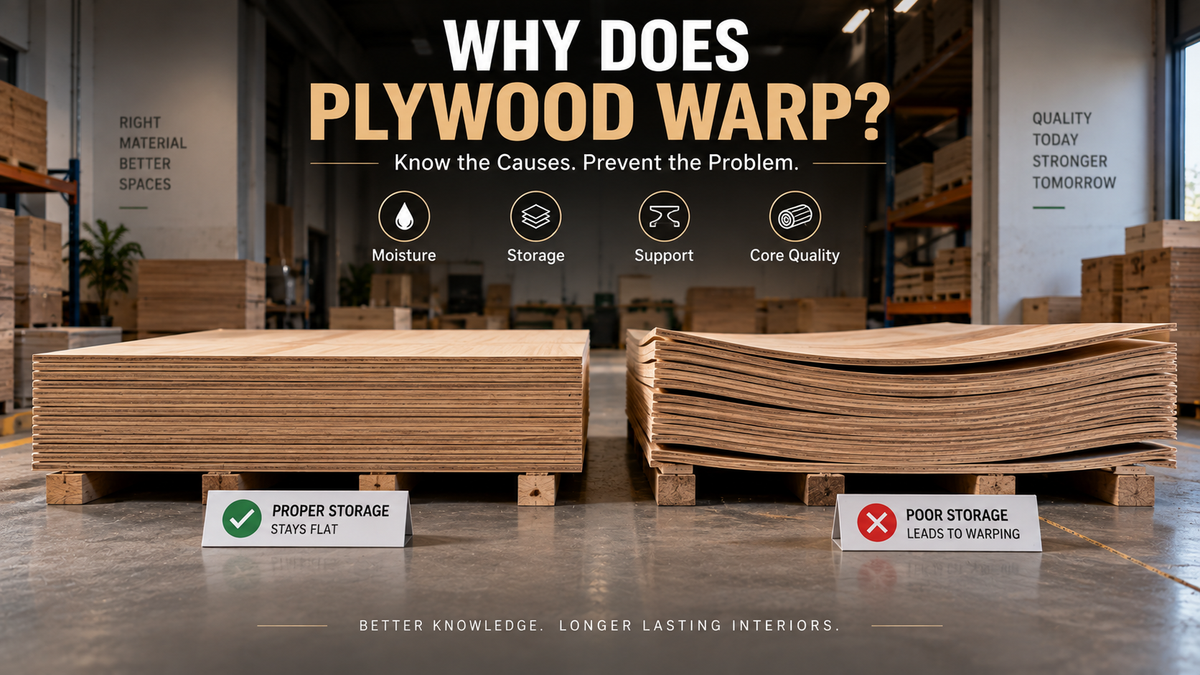
Plywood is engineered by bonding multiple wood veneers with their grain directions arranged across layers. This cross-layered construction helps provide dimensional stability compared with ordinary solid timber.
However, plywood is still a wood-based material, and under certain conditions it can bend, bow, twist or warp.
Understanding why this happens is important for homeowners, carpenters, interior designers and furniture manufacturers.
Here are the most common causes.
1. Uneven Moisture Exposure
Wood naturally reacts to changes in moisture.
If one face or edge of a plywood sheet absorbs more moisture than another, the two sides may respond differently. This imbalance can contribute to bending or warping.
This can happen when plywood is:
- Stored against a damp wall
- Placed on a wet floor
- Exposed to rain
- Left in a humid construction area
- Exposed unevenly from only one side
Moisture doesn't always need to be visible to affect wood-based materials.
2. Improper Storage
Storage conditions can significantly affect sheet flatness.
Plywood should generally be stored flat, level and properly supported.
Problems can arise when sheets are:
- Stored vertically for extended periods
- Leaning against walls
- Supported only at a few points
- Kept on an uneven floor
- Left partially unsupported
Large sheets can gradually take the shape of the surface or position in which they are stored.
3. Direct Contact With the Floor
Plywood should not be placed directly on damp floors.
Construction sites frequently contain residual moisture from plastering, flooring, painting and cleaning.
Use suitable supports or pallets to keep sheets flat, elevated and protected from moisture.
4. Poor Core Construction
The internal construction of plywood also matters.
Inconsistent veneers, core gaps, uneven construction or manufacturing inconsistencies can affect the overall stability of a panel.
Quality plywood should have a well-constructed, consistently bonded core.
Read more about this in our Premium Core Construction Guide.
5. Uneven Finishing on Both Sides
Furniture panels are sometimes laminated or finished on one side while the reverse remains untreated for extended periods.
Different surface conditions can influence how each side responds to environmental moisture.
For applications where dimensional stability is important, fabricators should follow appropriate balancing and finishing practices for the material and application.
6. Incorrect Plywood for the Application
Material selection matters.
MR plywood is designed primarily for dry interior applications such as wardrobes, TV units, study tables and normal bedroom furniture.
For kitchens, utility areas and other moisture-prone applications, BWP plywood may be more appropriate.
Using a material in conditions beyond its intended application can increase the risk of performance problems.
7. Insufficient Support
Sometimes the plywood isn't actually warped—it is deflecting under load.
A long shelf carrying books or heavy storage can bend because of:
Long Span + Heavy Load + Insufficient Thickness + Inadequate Support
Adding intermediate supports or selecting an appropriate thickness can make a major difference.
This is particularly important for bookshelves, wardrobes and heavy storage furniture.
8. Extreme Temperature and Humidity Changes
Interior materials can experience changing environmental conditions during construction.
For example, plywood may move between:
Warehouse → Transport Vehicle → Construction Site → Air-Conditioned Home
Changes in temperature and humidity can affect wood-based materials.
Proper storage and allowing materials to adjust appropriately to site conditions before fabrication can help.
9. Poor Installation
Even good plywood can perform poorly when furniture is incorrectly designed or installed.
Problems can result from:
- Incorrect framing
- Excessive unsupported spans
- Uneven fixing
- Forcing bent sheets into position
- Inadequate structural support
Material quality and workmanship must work together.
Premium plywood cannot compensate for poor furniture engineering.
10. Choosing Plywood Only by Price
Two plywood sheets may look almost identical from the outside.
But their internal construction, bonding, veneer quality and manufacturing consistency can differ.
Instead of comparing only the price per square foot, consider:
✓ Plywood grade
✓ Core construction
✓ Thickness consistency
✓ Surface quality
✓ Intended application
✓ Applicable certification
✓ Manufacturer credibility
The lowest purchase price may not deliver the lowest lifecycle cost.
How to Help Prevent Plywood Warping
Follow a few basic practices:
✓ Store plywood flat and level
✓ Keep sheets elevated from the floor
✓ Protect plywood from rain and standing water
✓ Avoid prolonged leaning storage
✓ Support sheets evenly
✓ Select the correct grade for the application
✓ Use appropriate thickness for the span and load
✓ Follow proper finishing and fabrication practices
✓ Check site moisture conditions before installation
✓ Use good-quality plywood with consistent construction
Is Slight Plywood Bending Always a Defect?
Not necessarily.
A sheet may temporarily develop some curvature because of storage or environmental conditions, and the significance depends on the severity, material specification and intended application.
However, severe bowing, twisting, delamination or persistent deformation should be investigated before fabrication.
Don't simply force a severely distorted sheet into furniture.
Conclusion
Plywood warping rarely comes down to just one factor.
It can result from a combination of:
Moisture + Storage + Material Construction + Environment + Furniture Design + Installation
Choosing quality plywood is important—but correct handling is equally important.
From the warehouse to the construction site and finally into the furniture, plywood should be stored correctly, protected from moisture and used according to its intended application.
Better Material. Better Handling. Better Furniture Life.
At Plyneer Industries, we focus on dependable plywood construction and application-based material selection for modern interiors.
🌐 www.plyneer.com
📞 +91 8861717273


